


Attorneys' Economic Impact and Ethical Reform
The legal profession occupies a profoundly paradoxical space within the architecture of modern economic theory. In one respect, legal practitioners are the indispensable custodians of the institutional frameworks that secure property rights, enforce contracts, and mitigate systemic uncertainties. These activities are universally recognized by institutional economists as absolute prerequisites for capital formation, technological innovation, and macroeconomic growth. Conversely, the profession is frequently scrutinized as an engine of rent-seeking behavior, characterized by exorbitant transaction costs, zero-sum litigation, and systemic deadweight losses that severely constrain aggregate economic output. The tension between these two realities has produced an economic environment where the foundational benefits of the rule of law are increasingly counterbalanced by the frictional costs of its execution. Furthermore, recent empirical data reveals a historic crisis of confidence, with public trust in the United States judicial system plummeting to a record low of 35 percent in 2024, representing a precipitous 24-point decline since 2020.[1] This decline in institutional trust is not merely a political phenomenon; it is a macroeconomic vulnerability.
To rigorously reconcile these opposing realities and chart a normative, economically viable path forward, this report applies the novel analytical framework of Capacity-Based Monetary Theory (CBMT). By redefining money as a priced claim on the future productive capacity of an economy, CBMT provides a precise mathematical and theoretical lens through which the macroeconomic impact of attorneys can be accurately quantified and evaluated. This analysis will meticulously evaluate the current economic footprint of the United States legal system, unpack the structural mechanisms by which legal friction and rent-seeking degrade national economic capacity, and propose a systemic pivot toward the doctrines of "Preventive" and "Proactive" lawyering. Finally, this report will outline exactly how these macroeconomic imperatives can be codified into a new operational standard within the American Bar Association (ABA) Model Rules of Professional Conduct, thereby permanently aligning the ethical obligations of attorneys with the economic preservation and expansion of society.
The Theoretical Framework: Capacity-Based Monetary Theory (CBMT)
To accurately assess the macroeconomic impact of the legal profession, one must first establish the fundamental ontology of value within a modern economy. Traditional monetary economics relies heavily on tripartite functional definitions of money, categorizing it merely as a medium of exchange, a unit of account, and a store of value. However, as advanced theoretical frameworks suggest, these functional definitions merely describe the operational symptoms of currency rather than articulating its underlying asset structure in an ontological sense.
Capacity-Based Monetary Theory (CBMT) resolves this ambiguity by positing that in the double-entry bookkeeping of a civilization, money manifests as a liability on the balance sheet of the sovereign state. Because a liability cannot exist in a vacuum without a corresponding asset, CBMT identifies the backing asset of fiat currency not as gold or mere state decree, but as the Expected Future Impact of the society that issues it. Consequently, money is conceptualized as a floating-price claim, effectively a call option, on the future productive capacity and aggregate labor of an economy. When an individual or entity accepts currency today, they are betting that the issuing society will possess the physical, intellectual, and institutional capacity to redeem that claim for tangible value at a later date.
The Augmented Solow-Swan Production Function and Human Capital
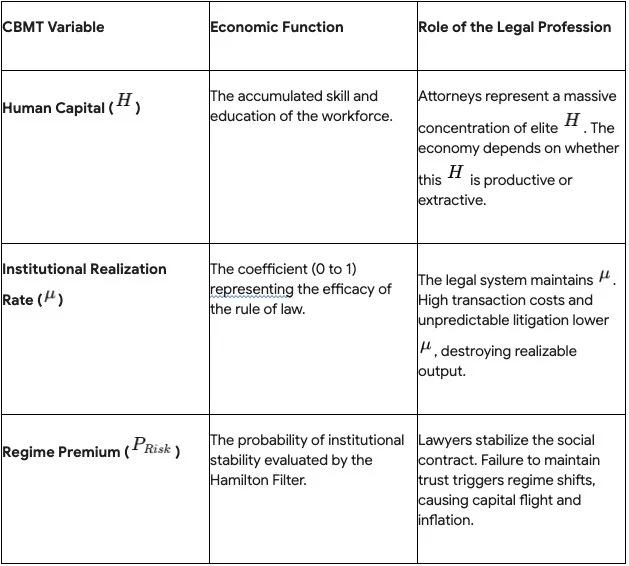
Under the CBMT framework, the productive capacity of an economy is not a static reserve of wealth but a highly dynamic vector function dependent on three primary variables: the aggregate labor of the population, the efficiency of that labor as amplified by technology and human capital, and the stability of the institutional social contract. To formalize this mathematically, CBMT utilizes the Augmented Solow-Swan framework, specifically the Mankiw-Romer-Weil specification, which crucially isolates Human Capital ($H$) as an independent and depreciable factor of production. The theoretical output, or "Impact" ($Y$), which serves as the collateral for the currency, is expressed as:
$$Y = K^\alpha H^\beta (A L)^{1-\alpha-\beta}$$
Where $Y$ represents total theoretical production, $K$ denotes the stock of physical capital, $H$ represents the stock of human capital (encompassing advanced skills, education, and professional expertise), $L$ is the aggregate labor force, and $A$ signifies labor-augmenting technology or "Efficiency Capacity". The variables $\alpha$ and $\beta$ represent the elasticities of output with respect to physical and human capital.
Within this precise macroeconomic equation, attorneys represent a highly concentrated, elite pool of Human Capital ($H$). Gary Becker’s micro-foundations of human capital assert that labor is not a fungible commodity but an asset accumulated through intense investment of time and resources. The American legal profession absorbs a massive share of the nation's top intellectual talent. The central macroeconomic question is whether this specific subset of $H$ is deployed to increase the overall efficiency and output of the economy ($A$ and $Y$), or whether the profession's operational model acts as a frictional force that diminishes output while extracting rents from other productive sectors.
The Institutional Realization Rate and the Hobbesian Trap
The theoretical capacity of an economy ($Y$) remains a purely mathematical abstraction if the fruits of labor cannot be legally secured. CBMT incorporates the institutional frameworks pioneered by Douglass North to account for the frictional costs of trust, order, and contract enforcement. In a theoretical Hobbesian "state of nature," characterized by systemic violence, expropriation, and an absence of property rights, the economy faces infinite transaction costs. In such a regime, money cannot exist because the discount rate applied to future impact is effectively infinite; rational agents will not trade present goods for future promises if the future guarantees expropriation.
To avert this Hobbesian trap, the state (the "Leviathan") imposes a legal order and a social contract, which is administered and maintained by the legal profession. CBMT formalizes this critical legal constraint through the Institutional Realization Rate ($\mu$), a coefficient ranging between 0 and 1 that quantifies the quality of a society's legal infrastructure, the predictability of contract enforcement, and the rule of law.
$$Y_{realizable} = \mu \times Y_{MRW}$$
In this formulation, $Y_{realizable}$ is the actual, tangible economic impact generated by the society, while $Y_{MRW}$ is the maximum theoretical output predicted by the Augmented Solow-Swan model. In a highly functional, high-trust society with an efficient legal system, $\mu$ approaches 1, meaning theoretical capacity is fully realized and the currency remains strong. Conversely, in a system paralyzed by systemic corruption, exorbitant litigation costs, or unpredictable judicial outcomes, $\mu$ degrades toward 0. Even a nation with vast physical resources ($K$) and labor ($L$) will suffer currency collapse and economic stagnation if its Institutional Realization Rate fails. Attorneys, acting as the primary architects and operators of the justice system, are the direct custodians of the $\mu$ variable. Their professional methodologies dictate whether $\mu$ operates near its optimum or serves as a severe discount on national productivity.
Signaling Theory and Regime-Switching Risk Models
CBMT further integrates Amotz Zahavi’s Handicap Principle and Michael Spence's signaling theory to explain how market participants identify and price high-capacity agents within complex systems. The massive expenditures associated with elite legal services often act as costly signals, proving surplus capacity and separating high-impact corporate actors from low-capacity ones. Furthermore, the pricing of money and the valuation of the economy are heavily dependent on regime-switching models, such as the Hamilton Filter, which constantly estimate the probability of institutional stability versus collapse. If the legal system becomes so inefficient that the Hamilton Filter detects a shift toward a regime of institutional failure, the discount rate spikes, investment capital flees, and the fundamental value of the economy degrades.
The Macroeconomic Baseline of the United States Legal System
The United States legal profession influences the broader economy through two divergent and conflicting channels. The first channel is the foundational enhancement of the Institutional Realization Rate ($\mu$) via the maintenance of the rule of law. The second channel is the degradation of economic capacity through widespread rent-seeking, massive deadweight losses, and the artificial inflation of transaction costs. To understand the profession's total macroeconomic footprint, both channels must be exhaustively analyzed using recent empirical data.
The Value of the Rule of Law and Direct GDP Contributions
The legal services sector is a colossal component of both global and domestic economic output. According to the 2024 Impact Report published by the International Bar Association (IBA), the legal profession directly contributes an astonishing \$1.6 trillion to the global economy annually.[4] This figure accounts for approximately 1.7 percent of the global Gross Domestic Product (GDP).[4] The global impact is driven by a workforce of more than 20 million lawyers, paralegals, and support staff, supported by an additional 14 million workers in the supplier ecosystem.[4] The \$1.6 trillion total is comprised of \$787 billion in direct legal service revenues, \$191 billion in tax contributions, and \$637 billion in ecosystem effects generated by supply-side services.[4] North America and Europe absolutely dominate this landscape, accounting for 80 percent of the global legal services market.[4]
Focusing specifically on the domestic front, data from the U.S. Bureau of Economic Analysis reveals that the legal services sector directly contributed \$387.7 billion to the United States GDP in 2024, reflecting a consistent upward trajectory from \$359 billion in 2023 and \$348 billion in 2022.[5] When the legal profession functions optimally, it unlocks immense, quantifiable socio-economic value that extends far beyond direct revenue generation. The IBA Impact Report utilizes big data analysis identifying over 24,000 potential correlations to demonstrate that countries firmly upholding the rule of law experience significantly greater socio-economic benefits than those that restrict legal rights.[4]
Specific macroeconomic benefits derived from a robust, independent legal system include:
- Governmental Accountability and Institutional Trust: Countries with the best access to justice experience 25 percent fewer cases of governmental overreach.[4] Strong independent legal professions hold governments to account, which stabilizes the Hamilton Filter regime probabilities and attracts foreign direct investment.[6, 4]
- Innovation and Capital Allocation: Innovation levels are demonstrably higher in countries ranking in the top quartile for the rule of law. The IBA estimates that this robust legal infrastructure could generate an additional \$83 billion in research and development investment globally by securing intellectual property and enforcing complex contractual joint ventures.[4]
- Socio-Economic Equality and Human Capital: Increasing legal aid to match the standards of the top quartile of countries could reduce global inequality by 5 percent.[4] Furthermore, a robust rule of law is associated with profound human capital ($H$) accumulation metrics, including 30 percent more girls completing secondary education, higher overall life expectancies, and 34 million fewer youths disengaged from education or employment.[4]
- Environmental and Labor Market Stability: Strong legal systems correlate with 53 percent less pollution and greater protection for minority communities.[4] Additionally, improving the effectiveness of civil justice systems could reduce informal, untaxed employment by \$34 million globally.[4]
By establishing a predictable environment where property rights are secure and contracts are impartially enforced, the legal profession allows market participants to confidently project value into the future. This predictability lowers the discount rate, drives the accumulation of physical capital ($K$), and fosters technological efficiency ($A$). As cross-national empirical studies consistently demonstrate, robust property rights protection and checks on government power are the most vital institutional prerequisites for long-run economic performance.[7, 8, 9]
The Frictional Drag: Rent-Seeking and the Misallocation of Talent
Despite the undeniable foundational benefits of the rule of law, the operational reality of the United States legal system introduces severe inefficiencies that act as a massive drag on economic capacity. The core theoretical explanation for this phenomenon lies in occupational choice and the economics of rent-seeking.
In a seminal 1991 paper published in the Quarterly Journal of Economics, economists Kevin Murphy, Andrei Shleifer, and Robert Vishny explored the macroeconomic implications of talent allocation.[10] The authors posited that individuals choose occupations that offer the highest returns on their abilities. When the most talented individuals in a society (the highest-tier $H$) direct their efforts toward entrepreneurship and technological innovation, they expand the production frontier, innovate, and foster aggregate economic growth.[10] However, when institutions allow for highly lucrative, zero-sum wealth redistribution, this same elite talent flows into rent-seeking professions—specifically, certain forms of law and speculative finance.[10]
Rent-seeking activities do not create new wealth; they merely redistribute existing wealth while consuming vast amounts of human and physical capital in the process.[10] Murphy, Shleifer, and Vishny's empirical cross-national evidence demonstrated a stark macroeconomic reality: countries with a higher proportion of college students majoring in engineering experience significantly faster economic growth, whereas countries with a higher proportion of students concentrating in law experience measurably slower growth.[10, 11]
This dynamic is further elucidated by Stephen Magee's theory of the "Invisible Foot," which argues that an overabundance of lawyers acts as a negative externality, imposing direct and indirect transaction costs, delays, and bottlenecks on property rights exchanges and economic undertakings.[12] While a certain baseline number of lawyers is essential to establish the rule of law, the relationship between lawyer density and economic welfare is subject to severe diminishing returns.[12] Beyond a specific equilibrium point, the legal profession transitions from an enabler of capacity to a bureaucratic tax on productive activities.[12, 13] In the context of CBMT, this rent-seeking behavior constitutes a systemic attack on the Institutional Realization Rate ($\mu$).
The Quantitative Burden of the United States Tort System
The theoretical critiques of legal rent-seeking are overwhelmingly substantiated by contemporary empirical data regarding the U.S. litigation landscape. The direct economic costs associated with the American tort system represent one of the most significant deadweight losses in the modern global economy.
According to a comprehensive 2024 empirical analysis produced by The Brattle Group and published by the U.S. Chamber of Commerce Institute for Legal Reform (ILR), the total costs and compensation paid into the U.S. tort system reached an unprecedented \$529 billion in 2022.[14, 15] This staggering figure equates to 2.1 percent of the entire national GDP. To contextualize this burden, the economic weight of the tort system amounts to a hidden "tort tax" of \$4,207 for every single American household.[14, 16] In the most severely impacted jurisdictions, often termed "Judicial Hellholes" due to unpredictable jackpot verdicts and the prevalence of junk science, the per-household cost is even higher, reaching \$5,429 in California and over \$8,000 in Delaware.[14, 17, 18]
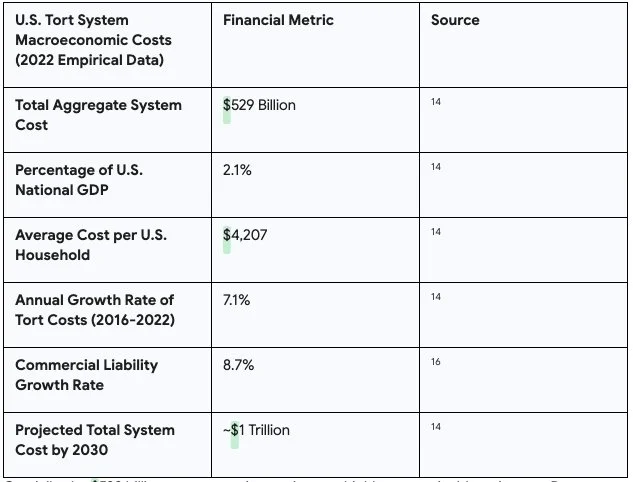
Crucially, the \$529 billion tort system is growing at a highly unsustainable trajectory. Between 2016 and 2022, national tort costs increased at an average annual rate of 7.1 percent, vastly outpacing both average annual economic inflation (3.4 percent) and average annual GDP growth (5.4 percent) over the same period.[15] Costs associated specifically with commercial liability are expanding even faster, at an alarming 8.7 percent annually.[16] If this trajectory remains unaltered, the direct costs of the U.S. lawsuit system will approach \$1 trillion by 2030.[14, 19]
The inefficiency of this system is profound. Research indicates that the tort system is highly ineffective at delivering actual relief to injured parties; traditionally, only 53 cents of every dollar paid into the tort system actually reaches the claimants, with the remaining 47 percent absorbed by the frictional costs of litigation, administrative overhead, and attorneys' fees.[20] The American Tort Reform Foundation estimates that this \$367.8 billion to \$529 billion annual lawsuit epidemic actively eliminates 4.8 million jobs across the U.S. economy by diverting capital away from productive expansion.[18]
Several specific procedural mechanisms severely exacerbate this macroeconomic drain:
- Substandard Patents and Patent Trolls: Non-practicing entities, commonly known as patent trolls, exploit the legal system to extract settlements from productive technology firms and startups.[21, 22] Economic research indicates that granting substandard patents imposes a deadweight loss of \$21 billion per year by deterring valid scientific research.[23] When combined with an additional \$4.5 billion in direct litigation and administrative costs, the total deadweight loss created by this specific sector of the patent system exceeds \$25.5 billion annually.[23]
- Class Action Distribution Inefficiencies: Between 2022 and 2024, class action settlements in the United States reached historic highs, totaling \$159.4 billion.[24] The top ten mega-settlements alone accounted for over 80 percent of this total value, representing an enormous wealth transfer.[24] However, the actual economic relief provided to the public is minimal; the median consumer recovery in these actions remains under $35 per person.[24] This highlights massive distribution inefficiencies and suggests a winner-take-all dynamic that primarily enriches the elite law firms possessing the capital to finance complex, multi-district litigation.[24]
- Social Inflation and Third-Party Litigation Funding: The proliferation of Third-Party Litigation Funding (TPLF)—where outside investors finance lawsuits in exchange for a percentage of the proceeds—has transformed litigation into a commoditized asset class.[16, 25] This financialization of justice, coupled with aggressive lawyer advertising, has driven a phenomenon known as "social inflation," where insured liability claims increase at a rate completely detached from underlying economic factors.[25] A recent report by the Swiss Re Institute revealed that social inflation increased liability claims in the U.S. by 57 percent over the past decade, reaching an annual growth peak of 7 percent in 2023.[25] This environment of heightened uncertainty reduces insurance capacity, raises premiums for consumers, and forces corporations into defensive postures that stifle capital investment.[25, 26]
In the strict terminology of Capacity-Based Monetary Theory, these massive frictional elements represent a catastrophic degradation of the Institutional Realization Rate ($\mu$). When an economy is burdened by a tort tax that consumes 2.1 percent of its GDP and grows exponentially faster than its baseline production function, the society is effectively incinerating its physical capital ($K$) and misallocating its most valuable human capital ($H$) to sustain a parasitic legal apparatus. This systemic friction directly diminishes the Expected Future Impact that underwrites the value of the U.S. dollar, driving structural economic inflation and compromising the long-term competitiveness of the nation's markets.
Law Firm Economics, Realization Rates, and the Billable Hour Trap
The macroeconomic inefficiencies of the legal system are deeply rooted in the microeconomic incentive structures of traditional law firms. Despite the broader economic uncertainty facing their corporate clients, elite law firms have experienced a period of unprecedented financial prosperity. The 2025 Report on the State of the US Legal Market, published jointly by the Thomson Reuters Institute and Georgetown Law, describes a "tectonic shift" in the industry.[27] Since 2019, profits per lawyer at Am Law 100 firms have increased by nearly 54 percent.[27]
This profitability is largely driven by aggressive, compounding increases in hourly billing rates. According to a Wells Fargo Legal Specialty Group survey, average standard billing rates grew by a staggering 9.6 percent in 2025, following a 9.1 percent increase in 2024.[28] Among the elite Am Law 50 firms, rate growth exceeded 10.4 percent in a single year.[28] Concurrently, law firms are heavily increasing their overhead spending on technology, business development, and generative artificial intelligence, treating these as strategic investments to capture larger market shares of counter-cyclical litigation demand.[29]
However, beneath this veneer of record-breaking profitability lies a fundamental structural flaw: the growing disconnect between the time billed by attorneys and the actual economic value perceived and paid for by the client. This disconnect is measured by the "realization rate"—the percentage of billed time that is successfully collected as actual cash revenue.[30] While billing rates have soared, realization rates have steadily declined. Industry data indicates that the average law firm now achieves an overall realization rate of merely 84 to 88 percent.[31, 32] In certain highly adversarial practice areas, such as complex litigation, realization rates routinely plummet to 82 percent or lower, meaning firms are effectively writing off nearly 20 percent of their labor as uncollectible friction.[31, 32]
This dynamic reveals the inherent macroeconomic fallacy of the traditional billable hour model. The billable hour financially rewards attorneys for the expenditure of time rather than the efficiency of the outcome.[33] It incentivizes prolonged discovery, procedural gamesmanship, and the generation of maximal complexity, directly conflicting with the client's desire for swift, predictable, and inexpensive resolution.[33, 34] As corporate clients become more sophisticated and heavily scrutinize invoices, they are actively pushing back against this model, leading to severe year-end collections disputes and the erosion of long-term attorney-client trust.[30, 35] The traditional law firm operational model has prioritized immediate revenue metrics over the sustainable preservation of the client's economic resources, further degrading the broader macroeconomic capacity of the nation.
Pivoting the Profession: From Reactive Friction to Proactive Value Creation
The empirical data paints an unequivocal picture: while the existence of a baseline legal system is necessary for market function, the current reactive execution of legal services in the United States acts as a severe macroeconomic constraint. To fundamentally alter the trajectory of the profession and generate a positive impact on the economy, attorneys must execute a systemic pivot away from the reactive model of post-hoc dispute resolution and embrace forward-looking paradigms of dispute prevention and structural value creation. This necessary transformation is deeply grounded in the established jurisprudential movements of Preventive Law and Proactive Law.
The Paradox of Reactive Legal Service
The traditional paradigm of the American legal profession is overwhelmingly reactive. Attorneys are typically engaged ex-post—summoned only after a contract has been breached, a regulatory violation has occurred, or a catastrophic injury has manifested. Operating from this adversarial posture, the primary objective is dispute resolution. However, as established by the principles of transaction cost economics, post-hoc litigation is inherently inefficient. It demands massive expenditures on retrospective discovery, navigating complex procedural hurdles, and engaging in zero-sum brinkmanship that frequently destroys the underlying commercial relationships.[34, 36]
Professor Richard Susskind famously identified this dynamic as the "paradox of reactive legal service".[37] The legal system waits for economic damage to occur before deploying its most sophisticated human capital ($H$) to mitigate the fallout. In a modern, complex, fast-paced economy, treating legal expertise solely as an emergency response mechanism is a profound misallocation of resources that virtually guarantees high deadweight losses and suboptimal macroeconomic outcomes.[36, 37]
Preventive Law: Securing the Institutional Realization Rate
The concept of Preventive Law was pioneered in the 1950s by Professor Louis M. Brown, who recognized that the traditional adversarial approach was fundamentally inadequate for optimizing client outcomes.[38, 39, 40] Brown posited a powerful medical analogy: just as preventive medicine utilizes vaccinations and routine checkups to avoid disease, Preventive Law utilizes strategic planning to "vaccinate" clients against the disease of legal disputes and costly litigation.[38, 41, 42]
Preventive Law defines that branch of legal practice concerned with minimizing the risk of legal trouble and maximizing legal rights at the precise moment when transactional facts are first being considered and established.[39] Brown advocated that lawyers should operate as strategic planners rather than mere combatants, conducting routine "legal checkups" to diagnose corporate vulnerabilities, ensure regulatory compliance, and implement protective procedures long before an acute crisis emerges.[39]
The core principles of Preventive Law revolve around risk anticipation and structural clarity. Attorneys employing this approach meticulously draft and negotiate contracts to eliminate ambiguities that frequently serve as the genesis of future disputes.[39] By addressing potential vulnerabilities early, standardizing critical contractual terms, and establishing shared understandings between parties, Preventive Law drastically reduces the probability of litigation.[37, 39]
From the perspective of Capacity-Based Monetary Theory, Preventive Law serves as the ultimate insurance mechanism for the Institutional Realization Rate ($\mu$). By resolving friction ex-ante, preventive lawyering ensures that the theoretical economic capacity of a firm ($Y_{MRW}$) is not subsequently cannibalized by the deadweight losses of the courtroom. It preserves the client's physical and financial capital ($K$), allowing those resources to be reinvested into productive operations rather than squandered on legal defense.
Proactive Law: Expanding the Macroeconomic Production Frontier
While Preventive Law focuses primarily on risk mitigation and dispute avoidance, the subsequent movement of Proactive Law, spearheaded in the late 1990s by Finnish scholar Helena Haapio, introduces a critical promotive dimension to the practice.[36, 38] Proactive Law expands the paradigm by perceiving the law not merely as a boundary of compliance or a shield against liability, but as an active, strategic instrument used to create value, strengthen collaborative relationships, and generate sustainable competitive advantage.[36, 38, 41]
Proactive Law requires a fundamental shift in the attorney's mindset, demanding that legal professionals step outside the isolated silos of black-letter doctrine and actively integrate their expertise with business strategy, project management, and human-centric design.[41, 43] Key components of the proactive approach include:
- The Creation of "Future Facts": Rather than litigating the immutable facts of past events, proactive lawyers use their legal knowledge to consciously design "future facts," structuring transactions, joint ventures, and organizational protocols that actively facilitate successful business performance.[41, 42]
- Relationship Preservation and Systems Intelligence: Proactive Law recognizes that aggressive, adversarial contracting often poisons the well of future cooperation. Proactive attorneys prioritize collaborative negotiations, treating contracts not as static weapons to be deployed in court, but as dynamic, living management tools that guide supply chain success and preserve vital commercial relationships.[42, 44, 45]
- Legal Design and Technological Integration: Recognizing that legal opacity creates systemic risk, proactive practitioners embrace legal design—utilizing visual elements, plain-language summaries, and clear architectures to ensure that non-lawyers fully understand their contractual obligations.[39] Furthermore, proactive law advocates for the implementation of "preventive legal technology," leveraging artificial intelligence to continuously audit contracts, flag compliance risks, and streamline operations, thereby making elite legal guidance highly accessible and frictionless.[39]
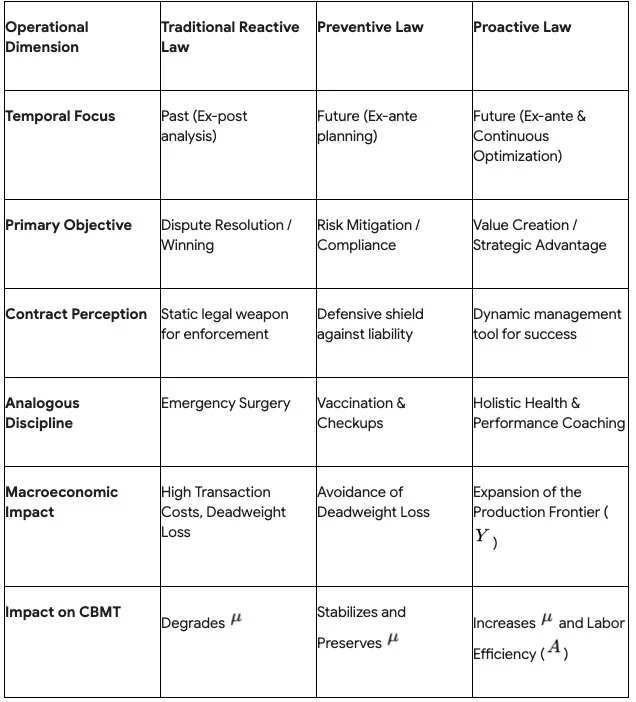
If the United States legal profession systematically pivots from the reactive paradigm to the preventive and proactive paradigms, the resulting macroeconomic dividend would be transformational. Eliminating even a fraction of the \$529 billion annual tort burden and redirecting the profession's elite human capital ($H$) toward value-generative corporate structuring would materially increase the Expected Future Impact of the national economy. This pivot would lower transaction costs, accelerate the velocity of commerce, and dramatically strengthen the underlying productive capacity that stabilizes the monetary system.
Codifying the Macroeconomic Mandate: Reforming the ABA Model Rules of Professional Conduct
To achieve a profession-wide pivot from reactive friction to proactive value creation, the theoretical concepts of Preventive and Proactive Law must be translated into enforceable, ethical mandates. The underlying incentive structures and professional obligations of American attorneys require a systemic overhaul. In the United States, the blueprint for legal ethics is the American Bar Association (ABA) Model Rules of Professional Conduct, which, when adopted by state supreme courts, serve as the binding regulatory framework for the profession.[46, 47]
Currently, the ABA Model Rules fail to address the macroeconomic impact of the legal profession. They are structurally focused on the micro-dynamics of the attorney-client relationship, the boundaries of zealous adversarial advocacy, and the mechanics of post-hoc dispute management.[47] They lack an explicit mandate requiring attorneys to prioritize economic efficiency or engage in proactive value creation.
The Limitations of the Current Regulatory Framework
An analysis of the existing Model Rules reveals a framework that permits, but does not ethically require, proactive and preventive lawyering:
- The Preamble: The current Preamble characterizes the lawyer as a "representative of clients, an officer of the legal system and a public citizen having special responsibility for the quality of justice".[48, 49] It notes that lawyers "play a vital role in the preservation of society".[48] However, this vital role is traditionally interpreted through the lens of civil rights, equal access to justice (as encouraged in Rule 6.1 regarding Pro Bono service [50]), and procedural fairness. It entirely ignores the lawyer's immense responsibility for the preservation of society's economic capacity.
- Rule 1.5 (Fees): This rule mandates that a lawyer shall not make an agreement for, charge, or collect an "unreasonable fee," listing several factors to determine reasonableness, such as the time and labor required and the novelty of the question.[51] Crucially, it does not explicitly penalize the intentional prolongation of disputes inherent in the billable hour model, nor does it mandate that fees must align with the actual economic value preserved or created for the client.[33]
- Rule 2.1 (Advisor): This rule explicitly permits a lawyer to exercise independent professional judgment and render candid advice. It states that a lawyer "may refer not only to law but to other considerations such as moral, economic, social and political factors, that may be relevant to the client's situation".[52, 53] While this permissive rule allows an attorney to act as a holistic counselor, it does not create an affirmative, disciplinary duty to proactively structure affairs to prevent foreseeable economic disputes.
- Rule 3.2 (Expediting Litigation): This rule states that a lawyer "shall make reasonable efforts to expedite litigation consistent with the interests of the client".[54] While aimed at reducing judicial delays, this rule is inherently reactive; it only applies after the catastrophic failure of litigation has already commenced. It does nothing to obligate the attorney to utilize legal design to prevent the litigation from occurring in the first place.
To fundamentally alter the economic output of the legal profession, the Model Rules must be modernized to incorporate the macroeconomic realities illuminated by Capacity-Based Monetary Theory. The ethical framework must explicitly recognize that unnecessary transaction costs, unchecked rent-seeking, and the deliberate escalation of adversarial friction constitute a severe breach of the lawyer's duty to the preservation of society.
Proposed Codification: Modifying the Preamble
The Preamble establishes the philosophical orientation and fundamental responsibilities of the profession. To integrate the macroeconomic mandate, the Preamble must be updated to reflect that economic efficiency is a core component of the "quality of justice." A proposed addition to Preamble Paragraph (or the creation of a new Paragraph ) should read:
Proposed Addition to the ABA Model Rules Preamble: "As public citizens and officers of the legal system, lawyers serve as the vital stewards of the institutional and contractual frameworks that enable economic stability, innovation, and societal prosperity. Lawyers must recognize that unnecessary legal friction, rent-seeking behaviors, and the deliberate escalation of adversarial disputes impose severe deadweight losses on the economy, thereby restricting the productive capacity of society as a whole. Therefore, in addition to their representational duties, lawyers possess a systemic, ethical responsibility to foster macroeconomic efficiency. This is achieved by prioritizing the prevention of disputes, utilizing clear and transparent legal design to ensure mutual understanding, and employing the law proactively to create sustainable value and reduce societal transaction costs."
Proposed Codification: A New Section—Rule 2.5 (Duty of Preventive and Proactive Counsel)
To successfully operationalize the doctrines of Preventive and Proactive Law, a new, mandatory rule must be introduced into the "Counselor" section of the Model Rules (falling sequentially after Rule 2.4, Lawyer Serving as Third-Party Neutral).[51] This new rule will transition the concepts of risk mitigation and value creation from best practices into enforceable standards of professional conduct.
Proposed Rule 2.5: Duty of Preventive and Proactive Counsel
(a) In representing a client in transactional, organizational, or advisory matters, a lawyer shall act competently and diligently to anticipate reasonably foreseeable legal and economic risks, and shall take proactive measures in the structuring of the client's affairs to prevent future disputes.
(b) A lawyer shall endeavor to draft legal instruments, agreements, and communications utilizing clear, unambiguous, and accessible language. The lawyer must take reasonable steps to ensure mutual comprehension among all executing parties to minimize the risk of subsequent litigation stemming from opacity or misunderstanding.
(c) When advising a client on a contemplated course of action or the initiation of adversarial proceedings, a lawyer shall explicitly consider the transaction costs, deadweight economic losses, and potential deterioration of commercial or personal relationships that may result from litigation. The lawyer shall affirmatively counsel the client regarding preventive alternatives, including collaborative structuring, alternative dispute resolution, and proactive risk avoidance mechanisms.
(d) A lawyer shall not deliberately exploit ambiguities, introduce unnecessary complexity, or engage in procedural gamesmanship during the formulation of legal agreements with the intent of generating future billable litigation or extracting economically inefficient rents.
Official Commentary on Proposed Rule 2.5
To guide disciplinary agencies and practitioners in the interpretation of this new mandate, the following official comments should be appended to Rule 2.5:
- ** The Promotive Dimension:** This Rule explicitly recognizes that the practice of law is not merely the reactive resolution of disputes, but the proactive structuring of relationships to create and preserve value. A lawyer serves the client and society best by acting as a strategic planner who immunizes the client against legal liabilities and friction before they materialize.
- ** Economic Efficiency and Transaction Costs:** Litigation and adversarial dispute resolution impose heavy, often unrecoverable transaction costs that deplete the economic resources of the client and the broader macroeconomic system. By prioritizing Preventive Law, lawyers fulfill their duty to preserve the economic capacity of society. Paragraph (c) requires the lawyer to communicate the true, holistic economic costs of adversarial postures, empowering the client to make rational, cost-effective decisions.
- ** Accessible Legal Design:** Paragraph (b) addresses a root cause of contractual failure: systemic opacity and unnecessary complexity. Lawyers should utilize modern legal design, standardized clauses, plain-language principles, and appropriate technological tools to ensure that legal documents are easily understood by the individuals and businesses governed by them. Obfuscation designed to secure a future adversarial advantage, or to ensure future reliance on legal counsel for basic interpretation, violates the spirit of this Rule.
- ** Relationship to Zealous Advocacy:** The duty to proactively prevent disputes does not conflict with a lawyer's duty of zealous advocacy under the adversary system. Rather, it acknowledges that the most effective and economically efficient advocacy routinely occurs ex-ante. Securing a client's interests through robust, unassailable, and transparent structuring renders subsequent, costly litigation entirely unnecessary.
Ancillary Reform: Realigning Rule 1.5 (Fees) to Support Proactive Value
Finally, to guarantee the success of the transition to Proactive Law, the fundamental economic incentives of the profession must be realigned. Rule 1.5, which governs fees, must be amended to explicitly encourage Alternative Fee Arrangements (AFAs) that reward value creation and efficiency rather than mere time expenditure.
When lawyers are compensated purely by the hour, the financial incentive structure rewards inefficiency. The system naturally maximizes the time spent on a matter, which inherently drives up transaction costs, lowers realization rates, and depresses the Institutional Realization Rate ($\mu$) of the broader economy.[32, 33] As the legal market rapidly integrates Generative AI, which can drastically reduce the time required to complete complex legal tasks, continuing to rely on an inputs-driven, time-based billing model is economically irrational.[33]
To rectify this, a specific comment should be added to Rule 1.5 officially endorsing value-based pricing:
"A fee structure that relies exclusively on the expenditure of time may fail to align the lawyer's financial incentives with the client's core objective of swift, efficient, and permanent resolution. Lawyers are strongly encouraged to utilize flat fees, phase-based billing, subscription models, and value-based pricing structures. These alternative arrangements appropriately reward the prompt prevention of disputes and the efficient, proactive structuring of legal affairs, particularly when the lawyer leverages technological advancements to eliminate transactional friction."
Conclusion
Viewed comprehensively through the rigorous macroeconomic lens of Capacity-Based Monetary Theory, the ultimate role of the United States legal profession is brought into sharp, empirical focus. Money is a derivative of future economic impact, and that future impact is entirely dependent upon the stability, efficiency, and clarity of the institutional frameworks that govern society. Attorneys are the primary architects and operators of this vital framework.
Currently, the United States economy suffers from an artificially suppressed Institutional Realization Rate ($\mu$). The expenditure of \$529 billion annually on an inefficient tort system, compounded by the prevalence of patent trolls, class action distribution failures, and rent-seeking behavior, diverts elite human capital away from technological innovation. This dynamic imposes a severe deadweight loss on national output, operating as a massive, hidden tax on American productivity.
However, the legal profession possesses the capacity to engineer its own reform. By systematically adopting the proven frameworks of Preventive and Proactive Law, attorneys can pivot from serving as agents of economic friction to acting as powerful engines of value creation. By anticipating risks, drafting highly accessible and transparent agreements, and prioritizing the preservation of long-term commercial relationships, the legal profession can drastically reduce transaction costs and expand the nation's production frontier. Codifying these proactive duties into the ABA Model Rules of Professional Conduct—specifically through the introduction of Rule 2.5, modifications to the Preamble, and the endorsement of value-based billing—will permanently align the ethical obligations of attorneys with the macroeconomic survival of the state. Ultimately, a legal profession strictly dedicated to the proactive prevention of disputes is the strongest possible underwriter of a nation's economic capacity.
-
US confidence in judicial system dropped to record low this year, data shows - The Guardian, accessed April 1, 2026, https://www.theguardian.com/us-news/2024/dec/17/judicial-system-courts-confidence-data
Americans' confidence in judicial system drops to record low | PBS News, accessed April 1, 2026, https://www.pbs.org/newshour/politics/americans-confidence-in-judicial-system-drops-to-record-low
Americans Pass Judgment on Their Courts - Gallup News, accessed April 1, 2026, https://news.gallup.com/poll/653897/americans-pass-judgment-courts.aspx
Capacity-Based Monetary Theory
Economic impact of the legal profession valued at $1.6tn states new IBA study, accessed April 1, 2026, https://www.ibanet.org/Economic-impact-of-the-legal-profession-valued-at-$1.6tn-states-new-IBA-study
Gross Domestic Product: Legal Services (5411) in the United States (USLEGALNGSP) | FRED | St. Louis Fed, accessed April 1, 2026, https://fred.stlouisfed.org/series/USLEGALNGSP
The Rule of Law and Economic Growth: Where Are We? By: Stephan Haggard Graduate School of International Relations and Pacifi, accessed April 1, 2026, https://law.utexas.edu/conferences/measuring/The%20Papers/ruleoflawconference.Haggard&Tiede.Rule%20of%20Law.March13.2010.pdf
Economic Consequences of Legal Framework | Statute Law Review - Oxford Academic, accessed April 1, 2026, https://academic.oup.com/slr/article/45/2/hmae024/7686329
Why the rule of law is the key to prosperity: Lessons from thirty years of data, accessed April 1, 2026, https://www.atlanticcouncil.org/in-depth-research-reports/issue-brief/why-the-rule-of-law-is-the-key-to-prosperity-lessons-from-thirty-years-of-data/
Working Paper No. 3530 - NBER, accessed April 1, 2026, https://www.nber.org/system/files/working_papers/w3530/w3530.pdf
Lawyers and Economic Growth - economics, psychology, policy, accessed April 1, 2026, https://economicspsychologypolicy.blogspot.com/2011/12/lawyers-and-economic-growth.html
Do Lawyers Inhibit Economic Growth? New Evidence from the 50 U.S. States, accessed April 1, 2026, https://digitalcommons.odu.edu/cgi/viewcontent.cgi?article=1071&context=economics_facpubs
Do Lawyers Impair Economic Growth? | Law & Social Inquiry | Cambridge Core, accessed April 1, 2026, https://www.cambridge.org/core/journals/law-and-social-inquiry/article/do-lawyers-impair-economic-growth/AED8D3146D2577613D8B1AEFB964DE72
Tort Costs in America: An Empirical Analysis of Costs and Compensation of the U.S. Tort System - Third Edition - ILR - U.S. Chamber Institute for Legal Reform, accessed April 1, 2026, https://instituteforlegalreform.com/research/tort-costs-in-america-an-empirical-analysis-of-costs-and-compensation-in-the-u-s-tort-system-third-edition/
Tort Costs in America - Institute for Legal Reform, accessed April 1, 2026, https://instituteforlegalreform.com/wp-content/uploads/2024/11/2024_ILR_USTorts-CostStudy-FINAL.pdf
U.S. Households Pay the Price of Rising Tort Lawsuit Costs | U.S. Chamber of Commerce, accessed April 1, 2026, https://www.uschamber.com/lawsuits/lawsuit-costs-are-escalating-and-u-s-households-are-paying-the-price
Study says West Virginia's tort costs are down thanks to legal reform, accessed April 1, 2026, https://wvchamber.com/study-says-west-virginias-tort-costs-are-down-thanks-to-legal-reform/
America's $367 Billion Lawsuit Epidemic - American Tort Reform Association, accessed April 1, 2026, https://atra.org/americas-367b-lawsuit-epidemic/
Hidden Costs of Lawsuits on U.S. Households Continue to Grow | U.S. Chamber of Commerce, accessed April 1, 2026, https://www.uschamber.com/lawsuits/hidden-costs-lawsuits-grow
Tort Costs in America: An Empirical Analysis of Costs and Compensation of the U.S. Tort System - ILR - Institute for Legal Reform, accessed April 1, 2026, https://instituteforlegalreform.com/research/tort-costs-in-america-an-empirical-analysis-of-costs-and-compensation-of-the-u-s-tort-system/
Committee on the Judiciary Subcommittee on Courts, Intellectual Property, and the Internet Hearing The Impact of Bad Patents on - Document Repository, accessed April 1, 2026, https://docs.house.gov/meetings/JU/JU03/20170713/106230/HHRG-115-JU03-Wstate-SamuelsJ-20170713.pdf
Patent Trolls: Evidence from Targeted Firms - NBER, accessed April 1, 2026, https://www.nber.org/papers/w20322
Quantifying the Cost of Substandard Patents: Some Preliminary Evidence, accessed April 1, 2026, https://yjolt.org/quantifying-cost-substandard-patents-some-preliminary-evidence
US Legal Settlement Campaigns – 35 Statistics Every Legal Professional Should Know in 2025 - Talli Insights, accessed April 1, 2026, https://blog.talli.ai/settlement-campaigns-statistics/
Litigation costs drive US liability claims by 57% over past decade, reveals Swiss Re Institute, accessed April 1, 2026, https://www.swissre.com/press-release/Litigation-costs-drive-US-liability-claims-by-57-over-past-decade-reveals-Swiss-Re-Institute/0b538159-9648-47da-a152-4550a7640d35
The Economic Effects of the Liability System - Hoover Institution, accessed April 1, 2026, https://www.hoover.org/research/economic-effects-liability-system
Law firms saw surge in demand and profits in 2025, new report says - ABA Journal, accessed April 1, 2026, https://www.abajournal.com/news/article/law-firms-saw-surge-in-demand-and-profits-in-2025-new-report-says
US firms see revenue grow in 2025 driven by rising billing rates and demand – study, accessed April 1, 2026, https://www.globallegalpost.com/news/us-firms-see-revenue-grow-in-2025-driven-by-rising-billing-rates-and-demand-study-1006740245
“2025 State of the US Legal Market” analysis: The cost of chasing opportunity, accessed April 1, 2026, https://www.thomsonreuters.com/en-us/posts/legal/legal-market-report-analysis-opportunity-cost/
Law Firms' Zeal for Realization Undermines Client Relationships - Bloomberg Law News, accessed April 1, 2026, https://news.bloomberglaw.com/legal-exchange-insights-and-commentary/law-firms-zeal-for-realization-undermines-client-relationships
Law Firm Realization Rate Analysis by Practice - LeanLaw - Legal Billing Made Easy, accessed April 1, 2026, https://www.leanlaw.co/blog/a-guide-to-analyzing-your-realization-rate-by-practice-area-to-identify-opportunities-for-improvement/
The Impact of Falling Law Firm Realization Rates - American Bar Association, accessed April 1, 2026, https://www.americanbar.org/groups/litigation/resources/litigation-news/2024/summer/impact-falling-law-firm-realization-rates/
2025 Report on the State of the US Legal Market | Thomson Reuters, accessed April 1, 2026, https://www.thomsonreuters.com/en-us/posts/wp-content/uploads/sites/20/2025/01/State-of-the-US-Legal-Market-Report-2025.pdf
Litigation Cost Survey of Major Companies - United States Courts, accessed April 1, 2026, https://www.uscourts.gov/sites/default/files/litigation_cost_survey_of_major_companies_0.pdf
Real Estate Law Billing Rates Guide 2025 - LeanLaw - Legal Billing Made Easy, accessed April 1, 2026, https://www.leanlaw.co/blog/real-estate-law-billing-rates-the-mid-sized-firms-guide-to-competitive-pricing-in-2025/
Proactive International Law, accessed April 1, 2026, https://repository.uclawsf.edu/cgi/viewcontent.cgi?article=4069&context=hastings_law_journal
From Risk Mitigation to Value Creation: Preventive and Proactive Law - Legal Creatives, accessed April 1, 2026, https://www.legalcreatives.com/blog/from-risk-mitigation-to-value-creation-preventive-law-and-proactive-law-differences-and-similarities
Building an Ethical Culture of Legal Knowledge (Chapter 10) - Legal ..., accessed April 1, 2026, https://www.cambridge.org/core/books/legal-knowledge-in-organizations/building-an-ethical-culture-of-legal-knowledge/E9E4144D9A89178EE7E0F06D58CA0E31
Full article: Preventive legal technology for micro-entities: improving access to justice in commercial contract analysis - Taylor & Francis, accessed April 1, 2026, https://www.tandfonline.com/doi/full/10.1080/13600869.2025.2602106
Working Paper - Semantic Scholar, accessed April 1, 2026, https://pdfs.semanticscholar.org/cdff/122db56fad9081dc9249d91b2882e003c272.pdf
Introduction to Proactive Law: A Business Lawyer's View, accessed April 1, 2026, https://scandinavianlaw.se/pdf/49-2.pdf
Resilience in Contract Law a Proactive/Preventive Law approach - Resilienz, accessed April 1, 2026, https://resilienz.hypotheses.org/287
Building Long-Term Strategic Value by Addressing Barriers to Future-Oriented Legal Thinking - DigitalCommons@Fairfield, accessed April 1, 2026, https://digitalcommons.fairfield.edu/cgi/viewcontent.cgi?article=1225&context=nealsb
Business Success and Problem Prevention through Proactive Contracting - Scandinavian Studies in Law, accessed April 1, 2026, https://scandinavianlaw.se/pdf/49-9.pdf
Introduction to Proactive Law: A Business Lawyer's View | Request PDF - ResearchGate, accessed April 1, 2026, https://www.researchgate.net/publication/284027387_Introduction_to_Proactive_Law_A_Business_Lawyer's_View
Model Rules of Professional Conduct - American Bar Association, accessed April 1, 2026, https://www.americanbar.org/groups/professional_responsibility/publications/model_rules_of_professional_conduct/
The Access and Justice Imperatives of the Rules of Professional Conduct - Georgetown Law, accessed April 1, 2026, https://www.law.georgetown.edu/legal-ethics-journal/wp-content/uploads/sites/24/2023/03/GT-GJLE220026.pdf
Model Rules of Professional Conduct: Preamble & Scope - American Bar Association, accessed April 1, 2026, https://www.americanbar.org/groups/professional_responsibility/publications/model_rules_of_professional_conduct/model_rules_of_professional_conduct_preamble_scope/
The Rules of Professional Conduct - PA Disciplinary Board, accessed April 1, 2026, https://www.padisciplinaryboard.org/for-attorneys/rules/rule/3/the-rules-of-professional-conduct
Rule 6.1: Voluntary Pro Bono Publico Service - American Bar Association, accessed April 1, 2026, https://www.americanbar.org/groups/professional_responsibility/publications/model_rules_of_professional_conduct/rule_6_1_voluntary_pro_bono_publico_service/
Model Rules of Professional Conduct - Table of Contents - American Bar Association, accessed April 1, 2026, https://www.americanbar.org/groups/professional_responsibility/publications/model_rules_of_professional_conduct/model_rules_of_professional_conduct_table_of_contents/
Rule 2.1: - American Bar Association, accessed April 1, 2026, https://www.americanbar.org/groups/professional_responsibility/policy/ethics_2000_commission/e2k_rule21/
Rule 2.1: Advisor - American Bar Association, accessed April 1, 2026, https://www.americanbar.org/groups/professional_responsibility/publications/model_rules_of_professional_conduct/rule_2_1_advisor/
Rule 3.2: Expediting Litigation - American Bar Association, accessed April 1, 2026, https://www.americanbar.org/groups/professional_responsibility/publications/model_rules_of_professional_conduct/rule_3_2_expediting_litigation/

Monopolies: Necessity or Hindrance?
Introduction: The Production of Impact and the Architecture of Monopolies
The structural dominance of modern mega-corporations and geographic technology hubs presents a profound challenge to classical economic frameworks and contemporary antitrust jurisprudence. Traditional neoclassical models often struggle to differentiate between market dominance achieved through the indispensable, organic accumulation of massive infrastructure and dominance sustained through artificial market distortions and rent-seeking behavior. To accurately dissect the monopolies of Google in search, San Francisco in artificial intelligence (AI) funding, Amazon in e-commerce, and Visa and MasterCard in global payments, this analysis deploys Capacity-Based Monetary Theory (CBMT).[1]
Capacity-Based Monetary Theory postulates that money and market value are not static stores of wealth, nor are they mere fiat illusions, but rather floating-price claims on the future productive capacity of an economy.[1] This capacity is mathematically defined by an augmented Mankiw-Romer-Weil production function, where Total Impact ($I$)—the underlying collateral of a civilization—is a vector function of physical capital ($K$), human capital ($H$), the labor force ($L$), and labor-augmenting technology or efficiency ($A$).[1] The governing equation for the underlying collateral of these monopolies is expressed as:
$$I = K^\alpha H^\beta (A L)^{1-\alpha-\beta}$$
Where $\alpha$ and $\beta$ represent the elasticities of output with respect to physical and human capital, respectively.[1] In this framework, human capital ($H$) is treated not as a fungible multiplier of labor, but as a distinct, depreciating asset class that requires continuous, massive investment.[1] However, theoretical capacity is strictly constrained by the "Institutional Realization Rate" ($R_i$), a coefficient between 0 and 1 that represents the frictional costs of trust, order, the rule of law, and anti-competitive deadweight loss.[1] The realized impact of an economy is $I_{realized} = I_{theoretical} \times R_i$.[1] In a state of perfect institutional trust and competition, $R_i$ approaches 1; in a Hobbesian trap characterized by infinite transaction costs, systemic failures, or absolute monopolistic rent extraction, $R_i$ approaches 0.[1]
The central inquiry of this comprehensive report is whether the dominant market positions of Google, San Francisco, Amazon, and the Visa/MasterCard duopoly are organic derivatives of the immense physical capital ($K$) and human capital ($H$) required to operate vastly complex services—making the monopoly a structural, technological necessity—or whether these entities actively degrade the Institutional Realization Rate ($R_i$) of the broader economy through anti-competitive practices designed to lock out rivals and extract unearned rents. Through an exhaustive examination of capital expenditures, antitrust litigation, agglomeration economics, and network externalities, this report demonstrates a distinct duality. While these monopolies originated from the absolute, unavoidable necessity of scaling physical and human capital to push the technological frontier ($A$) forward, they have increasingly utilized their entrenched market positions to manipulate the institutional architecture of the market, prompting severe regulatory interventions across global jurisdictions.
San Francisco and Artificial Intelligence: The O-Ring Filter and Human Capital Agglomeration
The concentration of artificial intelligence development and venture funding in the San Francisco Bay Area defies post-pandemic expectations of decentralized, remote work. Rather than operating as a traditional corporate monopoly controlled by a single board of directors, San Francisco functions as a geographic and institutional monopoly over advanced Human Capital ($H$). The empirical data defining this agglomeration is unprecedented in modern economic history. In 2025, California-based companies captured a staggering 80% of all United States AI startup funding, representing the highest share on record.[2] Furthermore, 42% of the nation’s AI firms are clustered specifically in the Bay Area, and California accounts for over 15% of all AI-related job postings across the United States.[2, 3]
To understand why this geographic monopoly exists, one must look beyond basic networking effects and apply Michael Kremer’s O-Ring Theory of Economic Development, as integrated into the Capacity-Based Monetary Theory framework.[1, 4]
The O-Ring Theory and the Fragility of AI Production
The development of frontier generative artificial intelligence and Large Action Models (LAMs) is arguably the most complex production process currently undertaken by human civilization.[5] The O-Ring theory posits that in highly complex production processes consisting of numerous sequential tasks, a single failure or mistake by a low-skill worker in the chain destroys the value of the entire output.[4] The theory dictates that it is impossible to substitute multiple low-skill workers ($L$) for one high-skill worker ($H$) in these environments.[4]
The extreme fragility of this production chain is evidenced by the staggering failure rates of enterprise AI deployments. In 2025, American enterprises expended approximately $644 billion on AI deployments.[6] Despite this astronomical capital outlay, between 70% and 95% of those pilots failed to reach production, and a McKinsey report noted a 42% abandonment rate for enterprise AI initiatives.[6] Because the cost of failure is measured in hundreds of billions of dollars, firms must ensure that every node in their production chain is staffed by absolute top-tier talent. This imperative drives extreme assortative mating in the labor market, forcing high-skill workers to cluster together to maximize the probability of successful execution.
San Francisco acts as the ultimate O-Ring filter.[1] The city’s notoriously high cost of living, taxation, and commercial real estate operates similarly to Amotz Zahavi’s Handicap Principle within signaling theory.[1] It serves as a costly signal that reliably filters out low-capacity participants. By setting an entry cost that only agents with elite human capital ($H$) can afford, the geographic destination acts as a sorting mechanism, guaranteeing the highest talent density on the planet.[1, 2]
Physical Proximity, the Solow Residual, and Fitness Interdependence
Venture capital effectively underwrites the expected future impact of a firm that lacks current physical capital ($K$), betting almost entirely on the team’s human capital ($H$) and their ability to generate a high Solow Residual ($A$), which represents total factor productivity.[1] Despite widespread commercial office vacancies in the broader city—reaching highs of 37%—AI firms have aggressively clustered in San Francisco's SoMa, Mission Bay, and Financial District, occupying nearly 7 million square feet of premium real estate.[2, 7] Major commitments include OpenAI securing a 486,600-square-foot lease and Anthropic expanding to 650,000 square feet.[2]
This physical clustering is driven by the absolute necessity of spontaneous, high-value synergy. The ecosystem relies on physical proximity to facilitate rapid iteration, often described by insiders as "Friday debates about model architecture" that occur spontaneously in walkable neighborhoods.[2] The pipeline from elite institutions like UC Berkeley's AI Research Lab and Stanford University ensures that breakthrough academic research transitions into commercial, deployable products within months.[2] This mirrors the concept of Fitness Interdependence, where the geographic and economic survival of these engineers and founders is linked through shared equity and proximity, drastically reducing internal transaction costs and maximizing the efficiency term ($A$) in their production function.[1]
| San Francisco / California AI Ecosystem Metrics (2025) | Data Point | Source |
|---|---|---|
| US AI Startup Funding Share Captured | 80% | [2] |
| National AI Firms Hosted in the Bay Area | 42% | [2] |
| Global AI Venture Dollars Captured by OpenAI & Anthropic | 14% | [8] |
| California Venture Dollars in 1H 2025 | $94.5 Billion (68% of US total) | [3] |
| AI-Related Office Space Occupied in San Francisco | ~7 Million Sq. Ft. | [2] |
| Enterprise AI Spend (US) | $644 Billion | [6] |
| Enterprise AI Pilot Abandonment Rate | 42% | [6] |
In this context, San Francisco's monopoly on AI funding and talent is not an anti-competitive market failure artificially orchestrated by a cartel. It is a structural necessity derived directly from the inherent complexity of the technology. The sheer difficulty of training and aligning multi-modal AI models requires a density of human capital ($H$) and an efficiency of interaction ($A$) that cannot be replicated in a distributed, remote-work paradigm or dispersed across secondary cities. The monopoly is a required condition to operate at the bleeding edge of complicated computational sciences.
However, this geographic monopoly is not without systemic risks. The extreme concentration of capital creates a highly speculative environment, drawing comparisons to historical asset bubbles. If the massive capital expenditures do not yield proportional gains in economic productivity, the resulting collapse in venture valuations could trigger a severe regional economic contraction.[9] Yet, regarding the specific question of whether this monopoly hinders progress through anti-competitive practices, the evidence suggests the opposite: the agglomeration is the very engine enabling the rapid advancement of the technological frontier.
Google Search: The Physical Capital Behemoth and the Behavioral Manipulation of Defaults
While San Francisco exemplifies an organic monopoly of human capital ($H$), Google’s overwhelming dominance in general internet search represents a monopoly born from unprecedented physical capital ($K$) requirements, which has subsequently been fortified and maintained through the deliberate, anti-competitive manipulation of the Institutional Realization Rate ($R_i$).
Google maintains an estimated 90% share of the global search engine market in 2026, processing an astounding 9.5 million searches every minute, drawing from a search index that exceeds 100,000,000 gigabytes.[10, 11] The foundational argument for Google as a "natural monopoly" rests securely on the sheer scale of the infrastructure required to continuously crawl, index, and rank the exponentially expanding internet.
The Immense Physical Capital ($K$) Requirement of Web Indexing
The financial cost of indexing the web and maintaining the requisite hyperscale data centers constitutes a near-insurmountable technical and economic barrier to entry.[12] To support its core search functions, alongside its aggressive expansion into generative AI infrastructure, Google's parent company Alphabet reported capital expenditures of \$52.5 billion in 2024 and \$91.4 billion in 2025.[13] In 2026, executives announced plans to elevate CapEx to upwards of \$185 billion globally, primarily directed toward advanced servers, networking equipment, and the acceleration of data center construction to meet compounding computational demands.[13, 14, 15]
For a nascent competitor to replicate this index from scratch, the capital requirements are entirely prohibitive. Even Apple, a corporation with vast financial resources, estimated it would cost an additional \$6 billion annually in ongoing operational costs just to match Google's search and indexing capabilities, completely independent of the initial capital outlay required to build the infrastructure.[16] Thus, under the strict Capacity-Based Monetary Theory framework, the initial monopolization of the search market is a direct, unavoidable result of the immense physical capital ($K^\alpha$) necessary to produce the required efficiency ($A$) and utility for the end user. The search engine is a vast mechanical Turk—a reinforcement learning engine where extreme scale creates a virtuous cycle of data refinement that no sub-scale competitor can match.[16]
The DOJ Case: Transitioning from Natural Monopoly to Anti-Competitive Exclusion
If Google's market dominance rested purely on its superior physical infrastructure ($K$) and algorithmic efficiency ($A$), it would not necessitate the expenditure of tens of billions of dollars annually to manipulate user behavior. However, the United States Department of Justice (DOJ) successfully argued, and a federal court affirmed, that Google illegally maintained its monopoly through a vast network of exclusionary default contracts.[17, 18]
The most prominent of these is Google's Information Services Agreement (ISA) with Apple, under which Google pays an estimated \$18 billion to \$20 billion annually to remain the undisputed default search engine on all iOS devices.[19, 20] This single partnership drives nearly 50% of Google's search traffic.[19]
By paying \$20 billion annually to secure default placement, Google is effectively creating a Hobbesian transaction cost for its competitors.[1] This exorbitant payment does not improve the production function; it adds no physical capital, no human capital, and no algorithmic efficiency to the search index. Rather, it artificially suppresses the Institutional Realization Rate ($R_i$) of rivals like Microsoft's Bing, DuckDuckGo, or emerging AI-native search engines. It buys the behavioral architecture of the internet.
The mechanics of this behavioral barrier were rigorously explored in a 2025 National Bureau of Economic Research (NBER) randomized controlled trial involving 2,354 desktop users.[21] The study sought to measure the precise factors explaining Google's dominance. The findings were revelatory: high switching costs (the actual effort required to change search engines) are not the primary barrier. Instead, user inattention and the overwhelming power of defaults dictate market share.[21] When users in the study were forced to make an "active choice" regarding their search engine, a significant portion deviated from Google, proving that the default status, rather than pure product superiority, sustains the monopoly.[21] Therefore, Google's modern monopoly is no longer purely a function of its superior index ($K$), but of its financial ability to buy the behavioral pathways of consumers, actively hindering the progress of competitors.
| Google Search Monopoly Metrics (2024-2026) | Data Point | Source |
|---|---|---|
| Global Search Market Share | ~90% | [11] |
| Search Volume | 9.5 Million per minute | [10] |
| Estimated Size of Search Index | > 100,000,000 GB | [10] |
| Alphabet Capital Expenditures (2025) | \$91.4 Billion | [13] |
| Alphabet Capital Expenditures (2026 Est.) | \$185 Billion | [14] |
| Annual Default Payment to Apple | \$18 Billion - \$20 Billion | [20] |
| Search Revenue (2025) | \$63.1 Billion | [11] |
Judicial Remedies and the Future of the Search Algorithm
In August 2024, U.S. District Court Judge Amit Mehta ruled decisively that Google violated Section 2 of the Sherman Act by maintaining monopolies in general search services and general text advertising.[17] The subsequent remedies ordered in late 2025 stopped short of aggressively breaking up the company—such as forcing the divestiture of the Chrome browser or the Android mobile operating system—recognizing that such draconian structural remedies could severely disrupt the integrated ecosystem and harm consumers.[22, 23]
Instead, the court pursued a remedy perfectly aligned with the CBMT framework. The court ordered Google to share targeted portions of its underlying search index and user-interaction data with competitors for a period of five years, while simultaneously prohibiting future exclusive default contracts across devices and browsers.[17, 18] By forcing Google to share its index data, the judiciary is artificially transferring a portion of Google's accumulated physical capital ($K$) and historical human capital ($H$) to rivals. This intervention attempts to lower the insurmountable barrier to entry and restore a competitive Institutional Realization Rate ($R_i$) to the broader digital ecosystem.[24, 25]
However, the rapid integration of artificial intelligence is fundamentally altering this landscape before the remedies can fully take effect. Google's aggressive rollout of "AI Overviews" at the top of search results has already caused a massive paradigm shift. Industry data indicates that AI Overviews caused a 68% decline in click-through rates (CTR) to third-party websites for certain query categories between mid-2024 and late 2025.[26] This phenomenon, dubbed "The Great Decoupling," results in 60% of Google searches ending without a single click to an external website.[27] Google is leveraging its illegally maintained monopoly position in search to rapidly gain a foothold in the nascent market for AI-powered answer engines.[28]
Ultimately, Google's search monopoly began as an absolute necessity of scale—no entity could map the internet without hundreds of billions in capital. Yet, it steadily evolved into a legally recognized anti-competitive structure reliant on exclusionary contracts, proving that while the infrastructure is necessary, the monopolistic business practices actively hinder digital progress.
Amazon: The Logistics Flywheel, Algorithmic Pricing, and the Extraction of Seller Rents
Amazon represents the most complex and multifaceted intersection of inherent capital necessity and anti-competitive rent-seeking in the modern global economy. Capturing a verified 37.6% of the United States e-commerce market in 2024, generating an estimated $447.4 billion in U.S. online retail revenue [29], Amazon operates a highly integrated business model often described as a "flywheel".[30] This flywheel connects the extraordinarily high-margin profits of its cloud computing division (Amazon Web Services, or AWS) and its burgeoning advertising services network with the notoriously low-margin, high-volume operations of retail and physical logistics.[30]
The Absolute Necessity of $K$: The Fulfillment Network
Amazon’s dominance in e-commerce is fundamentally underpinned by a physical logistics and data center infrastructure that is virtually impossible for any new entrant, or even established legacy retailers, to replicate. In 2025, Amazon's total domestic investment in the United States exceeded \$340 billion, an amount encompassing physical infrastructure expansion and employee compensation.[31] Looking forward, the company has committed to an unprecedented, staggering \$200 billion in global capital expenditures for the fiscal year 2026, heavily driven by the deployment of AI infrastructure, custom silicon (such as Trainium2 chips), and the continued expansion of AWS.[30, 32, 33]
The physical reality of Amazon's Fulfillment by Amazon (FBA) network—comprising thousands of massive fulfillment centers, regional sortation facilities, advanced autonomous robotics, and an immense last-mile delivery fleet—requires an astronomical input of physical capital ($K^\alpha$).[33, 34] In the second quarter of 2025 alone, Amazon's fulfillment costs reached \$25.9 billion, an operating expense that covers the labor, leasing, and depreciation required to maintain this vast network.[35]
This massive physical capital accumulation allows Amazon to achieve an unparalleled efficiency term ($A$) in the Mankiw-Romer-Weil equation. The result is an infrastructure that generates immense consumer surplus. A 2024 independent study demonstrated that prices in Amazon's store were, on average, 14% lower than all other major U.S. retailers across all product categories.[36] Furthermore, the network delivers unprecedented shipping speeds, fundamentally altering consumer expectations globally. Under the strict CBMT specification, Amazon is optimizing the production function for maximum retail impact. The sheer complexity of moving millions of physical goods globally within 48 hours absolutely necessitates this monopolistic scale; fragmented, sub-scale competitors simply cannot match the unit economics of Amazon's logistics network.
Project Nessie, FBA Tying, and Algorithmic Collusion: The FTC’s Allegations
However, the immense benefits provided to the consumer do not negate the anti-competitive mechanisms utilized to sustain the ecosystem. In the fall of 2023, the Federal Trade Commission (FTC), alongside 19 state attorneys general, filed a sweeping, landmark antitrust lawsuit against Amazon, alleging that the company operates as an illegal monopoly that utilizes interlocking anticompetitive strategies to stifle innovation, overcharge sellers, and ultimately harm consumers.[37, 38] The core of the FTC's argument is that Amazon deliberately degrades the Institutional Realization Rate ($R_i$) for independent sellers and rival platforms, raising transaction costs across the entire internet economy.
The FTC allegations center on three primary mechanisms of market manipulation:
- The First Anti-Discounting Algorithm: Amazon deploys an expansive surveillance network to monitor the prices of similar goods across the entire internet. If Amazon detects that a third-party seller is offering a product at a lower price on a competing website (e.g., Walmart.com or their own direct-to-consumer site), Amazon algorithmically punishes the seller by removing them from the "Buy Box".[37, 39] Because approximately 98% of all Amazon sales occur through the Buy Box, losing access is economically devastating.[37] This forces sellers to use their Amazon price as the absolute price floor across the internet, artificially inflating prices across all competing retail platforms.[39]
- Tying Prime Eligibility to Fulfillment by Amazon (FBA): The FTC alleges that Amazon unfairly restricts competition among logistics providers by premising a seller's access to the coveted "Prime" badge on their mandatory use of Amazon's exclusive fulfillment service, FBA.[40, 41] Because independent merchants generally lack the capital to utilize multiple disparate logistics services simultaneously, tying Prime sales to FBA exploits Amazon's market dominance to lock out competing shipping networks and forces sellers into Amazon's fee structure.[40]
- Project Nessie: Perhaps the most sophisticated allegation involves a secret algorithmic pricing tool known internally as "Project Nessie," which Amazon utilized between 2014 and 2019.[37, 42] Nessie was an algorithm designed to predict whether competing retailers would match Amazon's price increases. If the algorithm determined a match was highly probable, it would intentionally raise Amazon's prices, effectively inducing competitors to follow suit.[37, 42] This resulted in coordinated overcharges for shoppers both on and off the Amazon platform.
Project Nessie highlights a profound and alarming evolution in modern monopolies: the use of artificial intelligence and adaptive learning algorithms to achieve implicit, tacit collusion without any traditional, illegal communication between executives. Academic research from Carnegie Mellon University indicates that when advanced AI algorithms (utilizing reinforcement learning) compete against simple rule-based algorithms (like automated "tit-for-tat" price matching), the AI quickly learns to strategically raise prices. The AI understands that its competitors will blindly match the increase, thereby boosting profits for all sellers at the direct and severe expense of consumer surplus, creating substantial deadweight loss.[43] The FTC successfully argued that this constitutes an unfair method of competition under Section 5 of the FTC Act, marking the first time in over 40 years that a standalone Section 5 claim survived a motion to dismiss in federal court.[37]
The Escalation of Seller Fees: A Deadweight Loss Analysis
The most direct, empirical evidence of Amazon's unchecked monopoly power—defined economically as the ability to raise prices above competitive levels without suffering a commensurate loss in market share—is found in its increasingly aggressive treatment of third-party sellers. Over the last decade, Amazon's extraction of revenue from independent merchants has escalated dramatically.
Reports from research groups indicate that Amazon's total "take-rate"—the percentage of a seller's revenue that Amazon retains through mandatory referral fees, FBA fulfillment charges, and virtually required advertising spend—has exploded from an average of 19% in 2014 to roughly 45% in 2023 and 2024.[39, 44] In 2024 alone, seller fees generated over \$150 billion in revenue for Amazon, a figure so substantial it would qualify as a Fortune 25 company independently.[44] Crucially, these seller fees now account for 29% of Amazon's non-AWS revenue, a 53% proportional increase in just five years.[44]
These fees act as an inescapable, monopolistic tax on the entire e-commerce ecosystem. Sellers are increasingly forced into what industry analysts term the "Hidden Cost Trap," navigating constant, opaque increases in dimensional weight pricing, inbound placement fees, low-inventory surcharges, and aggressive aged-inventory penalties.[45, 46, 47] Because sellers cannot afford to leave the platform that controls nearly 40% of the market, they are forced to absorb these costs until they inevitably pass them on to consumers through higher retail prices.
| Amazon Financial & Market Metrics (2024-2026) | Data Point | Source |
|---|---|---|
| U.S. E-commerce Market Share (2024) | 37.6% | [29] |
| Total U.S. E-commerce Market Size (2024) | $1.19 Trillion | [29] |
| Amazon Global CapEx (2026 Estimate) | $200 Billion | [30] |
| Third-Party Seller Estimated Take-Rate | ~45% of seller revenue | [39, 44] |
| Seller Fee Revenue (2024) | > $150 Billion | [44] |
| Q2 2025 Fulfillment Costs | $25.9 Billion | [35] |
Interestingly, empirical economic research following the announcement of the FTC's antitrust allegations suggests that the mere threat of severe regulatory intervention altered Amazon's behavior. A study analyzing product pricing and fee structures found that Amazon reduced its FBA fees by approximately \$0.27 to \$0.29 per product within six months of the FTC's allegations.[48] This slight reduction, driven purely by regulatory pressure to uphold public trust and appease regulators, is estimated to save FBA sellers between \$0.85 billion and \$0.92 billion annually, actively reducing the deadweight loss in the market.[48]
In conclusion, Amazon’s fulfillment and cloud networks absolutely necessitate monopolistic scale ($K$) to function at their current, miraculous efficiency. A fragmented logistics market could never provide two-day nationwide shipping at current cost structures. However, the aggressive algorithmic policing of off-platform prices, the tying of essential services, and the relentless, unchecked extraction of seller fees demonstrate unequivocally that Amazon utilizes this necessary infrastructure to impose severe transaction costs on the broader retail market. The monopoly is required to operate the service, but its current business practices actively hinder the economic progress of independent merchants and artificially inflate prices across the digital economy.
Visa and MasterCard: Network Externalities and the Two-Sided Market Architecture
The global payments duopoly of Visa and MasterCard presents a fundamentally different structural and architectural model from the primary producers of goods (Amazon) or information indexes (Google). Visa and MasterCard do not manufacture physical products, nor do they hold consumer deposits or issue credit directly. Rather, they are the vital "software" of the global economy. In the context of Capacity-Based Monetary Theory, they directly provide the institutional trust and verification ($R_i$) required to escape the Hobbesian trap of counterparty risk in instantaneous, cross-border commerce.[1]
Visa and MasterCard operate classic "two-sided markets," a complex economic structure where the platform must simultaneously balance and incentivize the participation of two distinct user groups: merchants (who must be willing to accept the cards) and consumers/issuing banks (who must be incentivized to carry and use the cards).[49] The scale of these networks is staggering and deeply entrenched. In fiscal year 2025, Visa processed an astonishing 257.5 billion transactions, facilitating \$16.7 trillion in total payments volume across 4.9 billion active payment credentials globally.[50] MasterCard processes similarly massive volumes, driving net revenues of \$28.2 billion in 2024.[51]
The Enormous Capital Requirements of Global Trust
Maintaining a ubiquitous payment network that operates seamlessly, instantly, and securely across hundreds of different sovereign borders and fiat currencies requires continuous, massive investment in both labor-augmenting technology ($A$) and highly secure physical infrastructure ($K$). Visa operates four primary, global hyperscale data centers that feature extreme redundancy, network connectivity, power backup, and advanced cooling systems designed to provide absolute, continuous availability of financial systems.[52]
Furthermore, the cybersecurity requirements to protect this volume of capital transfer are monumental. Visa has invested over $3 billion specifically in artificial intelligence and data infrastructure over the past decade to enhance predictive fraud detection and network security.[52] This infrastructure is not an optional luxury; it is an absolute necessity. The cost of credit card fraud to the financial system is immense. A comprehensive 2025 study determined that for every single dollar of face-value fraud loss incurred, the actual, total cost to U.S. lenders is 5.4 times higher due to downstream operational impacts, risk management, and labor-intensive recovery processes.[53]
By socializing the exorbitant costs of cybersecurity, network tokenization, and real-time ledger processing across tens of trillions of dollars in transaction volume, Visa and MasterCard achieve economies of scale that no individual regional bank, credit union, or independent merchant could ever hope to replicate.[52, 54] The monopoly (or strict duopoly) is therefore a natural, inevitable byproduct of extreme network externalities—the payment system becomes exponentially more valuable and secure to both merchants and consumers as more global participants join.[54]
The Interchange Fee Dispute: System Maintenance vs. Monopolistic Rent Extraction
Despite the undeniable, foundational value of the network infrastructure, the pricing structure dictated by the duopoly—specifically the "interchange fee" (colloquially referred to as a "swipe fee")—has been the subject of decades of bitter, intense antitrust litigation and legislative battles.
Interchange fees are not paid directly to Visa or MasterCard. Rather, they are paid by the merchant's acquiring bank to the consumer's card-issuing bank, though the network operators (Visa/MasterCard) centrally set the rates and rules governing these transfers.[55] In 2025, Visa's credit interchange rates range generally from 1.30% to 2.60% per transaction, while MasterCard's rates range from 1.45% to 2.90%, depending heavily on the type of card used (e.g., standard vs. premium rewards cards) and the merchant category.[56, 57] In 2023, these fees cost U.S. merchants and, by extension, consumers upwards of \$133.75 billion, a figure that rose to an estimated, record-breaking \$148.5 billion in 2024.[58, 59]
Merchants and retail advocacy groups argue vehemently that these fees operate as monopolistic, inescapable taxes enforced through anti-competitive contractual restraints.[59] Historically, networks enforced "honor-all-cards" rules and network exclusivity agreements, obligating merchants who accepted basic Visa cards to also accept ultra-premium rewards cards that carry significantly higher interchange fees, while simultaneously preventing merchants from steering consumers to cheaper payment methods or applying surcharges to offset the specific costs of premium cards.[59, 60]
Conversely, the payment networks and issuing banks argue that interchange fees are simply the cost of doing business, funding the vital fraud prevention architecture, guaranteeing immediate payment to the merchant, and subsidizing highly popular consumer rewards programs (cashback, airline miles) that ultimately drive increased retail spending and macroeconomic velocity.[59, 60]
The 2024/2025 Settlement and the Danger of Legislative Price Controls
The tension between necessary system funding and monopolistic rent extraction culminated in a landmark legal resolution. In March 2024, after nearly twenty years of grueling antitrust litigation, Visa and MasterCard agreed to a historic settlement with U.S. merchants, over 90% of which are small businesses.[61, 62]
The proposed settlement provides estimated relief of over $30 billion to merchants.[62] Crucially, it caps standard U.S. consumer credit card interchange rates at 1.25% for a period of eight years, and mandates a reduction of the published effective rate by 10 basis points for a period of five years, providing unprecedented cost certainty.[63, 64] More importantly from an antitrust perspective, the settlement fundamentally alters network rules, providing merchants with much greater point-of-sale flexibility. Merchants will now have the optionality to surcharge specific card brands or categories, and the ability to actively steer customers to lower-cost preferred payment methods.[61, 63, 65]
When evaluating whether the Visa/MasterCard duopoly fundamentally hinders progress, one must examine the historical impact of direct government price controls on complex payment networks. The most prominent example is the 2010 Durbin Amendment to the Dodd-Frank Act, which sought to alleviate merchant burdens by capping debit card interchange fees for banks with over \$10 billion in assets at a maximum of 21 cents plus 0.05% of the transaction value.[66]
While this legislation saved merchants an estimated \$8.5 billion in its first year, it yielded severe, highly regressive unintended consequences. Because the regulation forced a strict issuer-cost-based model and completely ignored the delicate, cross-subsidizing nature of a two-sided market, the card networks responded rationally to preserve revenue: they raised the fees on small-value purchases to the maximum allowable cap level.[66] Consequently, small merchants processing low-ticket items (e.g., coffee shops) suddenly faced higher relative costs, while large big-box retailers benefited massively.[67] Furthermore, research indicated that the Durbin amendment created a regressive wealth transfer, where low-income, cash-using households effectively subsidized the system for affluent card-using households, with each cash-using household transferring approximately \$149 annually to card-accepting merchants.[68]
| Payment Network Metrics (2024-2025) | Data Point | Source |
|---|---|---|
| Visa Total Payment Volume (FY 2025) | \$16.7 Trillion | [50] |
| Visa Processed Transactions (FY 2025) | 257.5 Billion | [50] |
| Total Swipe Fees Paid by U.S. Merchants (2024) | \$148.5 Billion | [58] |
| Visa Estimated Interchange Range (2025) | 1.30% - 2.60% | [56] |
| MasterCard Estimated Interchange Range (2025) | 1.45% - 2.90% | [56] |
| Merchant Settlement Relief | > \$30 Billion | [62] |
| Settlement Rate Cap (Standard Consumer) | 1.25% for 8 years | [63] |
Thus, under the CBMT framework, while Visa and MasterCard extract a significant economic premium for operating the trust layer of the economy, forcibly altering their intricate pricing structure via heavy-handed legislative price controls (such as the heavily debated Credit Card Competition Act) often violently distorts the Institutional Realization Rate ($R_i$) rather than organically optimizing it.[66, 69] The 2024/2025 class-action settlement, which focuses intensely on enhancing merchant choice, transparency, and competitive steering capabilities rather than enforcing strict legislative price ceilings, represents a far more market-aligned, sophisticated approach to checking the duopoly's formidable market power.[61, 64]
Synthesis: Capacity-Based Monetary Theory and the Duality of Modern Monopolies
Applying Capacity-Based Monetary Theory to these four distinct, massive entities reveals a unifying, profound ontological truth about modern market dominance: absolute scale is no longer an optional business strategy; it is an unavoidable technological prerequisite.
The Absolute Necessity of Scale ($K$ and $H$): None of these monopolies could operate their core, foundational services without their current, unprecedented scale. Google cannot index over 100 million gigabytes of the rapidly expanding web and serve 9.5 million queries a minute without committing to \$185 billion in ongoing Capital Expenditures. San Francisco cannot incubate fragile, frontier Large Action Models without the extreme concentration of elite human capital facilitated by its high-cost O-Ring filter. Amazon cannot reliably fulfill millions of retail orders globally within 48 hours without its massive, heavily integrated warehousing and robotics infrastructure. Visa cannot secure \$16.7 trillion in global commerce without socializing the immense cost of AI-driven fraud detection across hundreds of billions of transactions. In the strict terms of the Mankiw-Romer-Weil equation, these entities have logically maximized physical capital ($K^\alpha$) and human capital ($H^\beta$) to push the technological efficiency frontier ($A$) forward for human civilization.[1] The monopolies are structurally necessary to provide the services at the current level of expected utility.
The Willful Degradation of Institutions ($R_i$): However, the transition from a benign "necessary monopoly" to a parasitic "anti-competitive monopoly" occurs reliably when the entity realizes that maintaining its absolute dominance through continuous physical and human capital investment is ultimately more expensive, or less certain, than artificially manipulating the behavioral, legal, and contractual architecture of the market.
This is the precise crux of the intense global antitrust scrutiny facing these firms. Google's \$20 billion annual payment to Apple is a synthetic, behavioral barrier to entry, not an improvement in search technology or consumer utility. Amazon's deployment of Project Nessie and its relentless extraction of up to 45% of independent seller revenue represent the weaponization of its indispensable platform to extract unearned rents, driving up consumer prices implicitly across the entire e-commerce ecosystem. Visa and MasterCard's historical reliance on "honor-all-cards" rules forced merchants to accept exorbitant fees on premium rewards cards, explicitly restricting free-market steering and price discovery.
These deliberate corporate actions artificially and maliciously lower the Institutional Realization Rate ($R_i$) for competitors, merchants, and emerging innovators. They introduce Hobbesian transaction costs back into an economic system that the digital platforms originally promised to streamline and democratize.
Conclusion
The structural monopolies of Google in search, San Francisco in AI funding, Amazon in e-commerce, and Visa and MasterCard in global payments are derived fundamentally from inherent technological complexity and the massive, unprecedented capital required to build and operate modern digital and physical infrastructure. The barriers to entry—whether the cost of building a global hyperscale server network, the geographic clustering of elite AI PhDs to prevent production chain failure, the deployment of a continent-spanning logistics fleet, or the maintenance of a highly secure, instantaneous financial routing network—are organic, logical, and structurally necessary. Sub-scale competitors simply cannot execute these tasks efficiently.
However, recognizing the structural necessity of their massive scale does not absolve these corporations of anti-competitive behavior. The empirical evidence, validated by federal courts and antitrust regulators globally, overwhelmingly indicates that once these entities achieved their natural, capital-driven dominance, they actively deployed exclusionary contracts, algorithmic price-fixing, and unavoidable ecosystem taxes to insulate themselves from future competition and extract outsized rents from dependent participants.
Economic progress is not hindered by the mere existence of their massive infrastructure; rather, it is choked by the frictional, anti-competitive constraints these monopolies place on the merchants, consumers, and innovators who have no choice but to interface with it. The most economically sound and effective regulatory responses—such as the DOJ's mandate for Google to share its underlying search data, or the Visa/MasterCard class-action settlement granting merchants the right to steer payments—are those that carefully preserve the immense efficiency and utility of the centralized infrastructure (maximizing $K$ and $A$), while surgically dismantling the artificial, contractual barriers that degrade the broader economic ecosystem's Institutional Realization Rate ($R_i$). By managing capacity and ensuring open access rather than simply punishing scale, policymakers can ensure that these necessary monopolies continue to drive the future impact of civilization without cannibalizing the very free markets that birthed them.
-
CBMT
How the Top 10 AI Companies in San Francisco Are Shaping the ..., accessed March 19, 2026, https://www.mexc.co/news/803141
OAI California Impact [Aug 2025] - OpenAI, accessed March 19, 2026, https://cdn.openai.com/pdf/12082a3a-1a59-4bb9-b3e2-08a8c65849b0/OAI_California-Impact_Aug-2025.pdf
The O-Ring Theory of Economic Development Michael Kremer The Quarterly Journal of Economics, Vol. 108, No. 3. (Aug., 1993), pp. - FADEP, accessed March 19, 2026, https://fadep.org/wp-content/uploads/2024/03/D-63_THE_O-RING_THEORY.pdf
18th edition – 2025 tech trends report - Future Today Strategy Group, accessed March 19, 2026, https://ftsg.com/wp-content/uploads/2025/03/FTSG_2025_TR_FINAL_LINKED.pdf
How the AI Industry Created $644 Billion of Economic Vandalism in 2025 | by Srinivas Rao, accessed March 19, 2026, https://skooloflife.medium.com/how-the-ai-industry-created-644-billion-of-economic-vandalism-in-2025-1ca0d71ab6f2
Silicon Valley's 2025 Outlook: Challenges Persist Amidst AI-Driven Resurgence, accessed March 19, 2026, https://www.bayareaeconomy.org/files/pdf/SiliconValley2025Outlook-TimesOfIndia-SR.pdf
6 Charts That Show The Big AI Funding Trends Of 2025 - Crunchbase News, accessed March 19, 2026, https://news.crunchbase.com/ai/big-funding-trends-charts-eoy-2025/
Fears of an AI bubble permeate the industry amid San Francisco's Dreamforce conference, accessed March 19, 2026, https://www.cbsnews.com/sanfrancisco/news/ai-bubble-artificial-intelligence-dreamforce-san-francisco/
29 Eye-Opening Google Search Statistics for 2025 - Semrush, accessed March 19, 2026, https://www.semrush.com/blog/google-search-statistics/
Google Search Maintains Dominance Amid AI Competition | Intellectia.AI, accessed March 19, 2026, https://intellectia.ai/news/etf/google-search-maintains-dominance-amid-ai-competition
Digital Platforms: A New Natural Monopoly? (Chapter 4) - Regulating Competition in the Digital Network Industry, accessed March 19, 2026, https://www.cambridge.org/core/books/regulating-competition-in-the-digital-network-industry/digital-platforms-a-new-natural-monopoly/C7BAD258DCFEBCA681D49CC056B5AB0A
Annual Report - Alphabet Inc., accessed March 19, 2026, https://s206.q4cdn.com/479360582/files/doc_financials/2025/q4/GOOG-10-K-2025.pdf
Google Unveils Two New US Data Centers As $185 Billion Commitment Gets Underway, accessed March 19, 2026, https://www.crn.com/news/cloud/2026/google-unveils-two-new-us-data-centers-as-185-billion-commitment-gets-underway
Google Cloud jacks up CapEx to build more cloud | CIO Dive, accessed March 19, 2026, https://www.ciodive.com/news/google-increases-capital-investments-cloud-ai-capacity/753925/
Google's search monopoly is ending. So says a court. Will Apple build a search engine? Will ChatGPT change search? Will LLMs take over? - Gregory Bufithis, accessed March 19, 2026, https://www.gregorybufithis.com/2024/10/22/googles-search-monopoly-is-ending-so-says-a-court-will-apple-build-a-search-engine-will-chatgpt-change-search-will-llms-take-over/
FTC Files Amicus Brief on DOJ's Proposed Final Judgment Against ..., accessed March 19, 2026, https://www.ftc.gov/news-events/news/press-releases/2025/05/ftc-files-amicus-brief-dojs-proposed-final-judgment-against-google-antitrust-violations
Department of Justice Wins Significant Remedies Against Google, accessed March 19, 2026, https://www.justice.gov/opa/pr/department-justice-wins-significant-remedies-against-google
Google's $20 Billion Annual Payment to Apple for Default Search Status | Rocket Clicks, accessed March 19, 2026, https://rocketclicks.com/industry-news/google-twenty-billion-dollar-payment-apple-search/
Google is paying a heavy price to be the default iOS search engine | HardwareZone Singapore, accessed March 19, 2026, https://www.hardwarezone.com.sg/mobile/smartphones/tech-news-google-apple-default-ios-search-price
The Paradox of Google Search Remedies - Truth on the Market, accessed March 19, 2026, https://truthonthemarket.com/2025/02/06/the-paradox-of-google-search-remedies/
Google Antitrust Remedies Could Harm the US Economy and Consumers, accessed March 19, 2026, https://truthonthemarket.com/2025/05/28/google-antitrust-remedies-could-harm-the-us-economy-and-consumers/
Google's statement on Sept 2025 Search DOJ decision, accessed March 19, 2026, https://blog.google/company-news/outreach-and-initiatives/public-policy/doj-search-decision-sept-2025/
Forget Breaking Up Google—Regulate Its Data Monopoly, by Giovanna Massarotto, accessed March 19, 2026, https://www.yalejreg.com/nc/forget-breaking-up-google-regulate-its-data-monopoly-by-giovanna-massarotto/
The Impact of Google's Antitrust Remedies on the Future of Monopolies - AAF, accessed March 19, 2026, https://www.americanactionforum.org/insight/the-impact-of-googles-antitrust-remedies-on-the-future-of-monopolies/
AIO Impact on Google CTR: September 2025 Update - Seer Interactive, accessed March 19, 2026, https://www.seerinteractive.com/insights/aio-impact-on-google-ctr-september-2025-update
2025 Organic Traffic Crisis: Zero-Click & AI Impact Analysis Report - The Digital Bloom, accessed March 19, 2026, https://thedigitalbloom.com/learn/2025-organic-traffic-crisis-analysis-report/
The Antitrust Case Against AI Overviews - Harvard Journal of Law & Technology, accessed March 19, 2026, https://jolt.law.harvard.edu/digest/the-antitrust-case-against-ai-overviews
What share of US e-commerce spending goes to Amazon? - Red Stag Fulfillment, accessed March 19, 2026, https://redstagfulfillment.com/what-share-of-us-ecommerce-spending-goes-to-amazon/
Amazon (AMZN) Deep-Dive: The $200 Billion Capex Bet on the Future of AI and Aerospace, accessed March 19, 2026, http://markets.chroniclejournal.com/chroniclejournal/article/finterra-2026-3-17-amazon-amzn-deep-dive-the-200-billion-capex-bet-on-the-future-of-ai-and-aerospace
Amazon invests record $340 billion in U.S. infrastructure, jobs, and communities in 2025, accessed March 19, 2026, https://www.aboutamazon.com/news/job-creation-and-investment/amazon-economic-impact-report-2025
Amazon 2024 Annual Report, accessed March 19, 2026, https://s2.q4cdn.com/299287126/files/doc_financials/2025/ar/Amazon-2024-Annual-Report.pdf
Why Big Tech's Spending Spree Matters: Amazon Earnings CapEx Explained - Intellectia AI, accessed March 19, 2026, https://intellectia.ai/blog/amazon-200b-capex-ai-infrastructure-2026
Amazon Global Supply Chain and Fulfillment Center Network - MWPVL, accessed March 19, 2026, https://www.mwpvl.com/html/amazon_com.html
Amazon has Strong Q2 - Supply Chain Digest, accessed March 19, 2026, https://www.scdigest.com/ontarget/25-08-12_amazon_q2_2025.php?cid=22892
Amazon's investing $4B in rural America to expand our delivery network, offer even faster delivery, and create more than 100000 new jobs - Amazon News, accessed March 19, 2026, https://www.aboutamazon.com/news/transportation/amazon-investment-delivery-network-small-town-rural-us
The FTC and State Case Against Amazon Highlights Risks and Impacts from Using Pricing Algorithms | BCLP - Bryan Cave Leighton Paisner, accessed March 19, 2026, https://www.bclplaw.com/en-US/events-insights-news/the-ftc-and-state-case-against-amazon-highlights-risks-and-impacts-from-using-pricing-algorithms.html
Amazon.com, Inc. (Amazon eCommerce) - Federal Trade Commission, accessed March 19, 2026, https://www.ftc.gov/legal-library/browse/cases-proceedings/1910129-1910130-amazoncom-inc-amazon-ecommerce
The Tech Oversight Project Issues Statement on Amazon's Predatory “Nessie” Pricing Scheme, accessed March 19, 2026, https://techoversight.org/2023/10/03/nessie/
Yale University Thurman Arnold Project, accessed March 19, 2026, https://som.yale.edu/sites/default/files/2025-05/1.%20Amazon-%20TAP_0.pdf
sealed order on defendant's motion to dismiss & plaintiffs' motion to bifurcate - Federal Trade Commission, accessed March 19, 2026, https://www.ftc.gov/system/files/ftc_gov/pdf/0289-20240930-ORDERonD%27sMTDPls%27MtntoBifurcate.pdf
Shadow Agreements: How Project Nessie Evades Consumer Law Through Code, accessed March 19, 2026, https://aura.american.edu/articles/journal_contribution/Shadow_Agreements_How_Project_Nessie_Evades_Consumer_Law_Through_Code/28836452
Algorithmic Pricing: Understanding the FTC's Case Against Amazon - News, accessed March 19, 2026, https://www.cmu.edu/news/stories/archives/2023/october/algorithmic-pricing-understanding-the-ftcs-case-against-amazon
The Shifting Economics of Amazon: A 2025 Reality Check for Sellers - Canopy Management, accessed March 19, 2026, https://canopymanagement.com/the-shifting-economics-of-amazon-reality-check-for-sellers/
Amazon to Up Fees for 3rd-Party Sellers - Modern Distribution Management, accessed March 19, 2026, https://www.mdm.com/news/technology/ecommerce/amazon-to-up-fees-for-3rd-party-sellers/
Amazon Hidden Costs 2025: What Every Seller Should Know - PDMG, accessed March 19, 2026, https://palmettodigitalmarketinggroup.com/amazon-hidden-costs-2025/
Valuation Trends 2025: How Amazon's New FBA Fees and Advertising Costs Are Changing Exit Prices - Blog, accessed March 19, 2026, https://blog.exit.io/2025/11/11/valuation-trends-2025-how-amazons-new-fba-fees-and-advertising-costs-are-changing-exit-prices/
Impact of FTC's Allegation on Amazon's Marketplace: Evidence From Coffee Products, accessed March 19, 2026, https://www.researchgate.net/publication/385654385_Impact_of_FTC's_Allegation_on_Amazon's_Marketplace_Evidence_From_Coffee_Products
Interchange Fees in Payment Networks: Implications for Prices, Profits, and Welfare - Federal Reserve Bank of Philadelphia, accessed March 19, 2026, https://www.philadelphiafed.org/-/media/FRBP/Assets/working-papers/2025/wp25-18.pdf
Visa Inc. - Financials - Visa Annual Report, accessed March 19, 2026, https://annualreport.visa.com/financials/default.aspx
Visa vs. Mastercard: Who's Leading the Charge in Finance, Sustainability, and Net Zero?, accessed March 19, 2026, https://carboncredits.com/visa-vs-mastercard-whos-leading-the-charge-in-finance-and-sustainability-net-zero/
Visa Annual Report 2024, accessed March 19, 2026, https://s29.q4cdn.com/385744025/files/doc_downloads/2024/Visa-Fiscal-2024-Annual-Report.pdf
The Consumer Credit Card Market Report to Congress - files.consumerfinance.gov., accessed March 19, 2026, https://files.consumerfinance.gov/f/documents/cfpb_consumer-credit-card-market-report_2025.pdf
The Impact of Central Bank Digital Currency on Payments Competition - IMF, accessed March 19, 2026, https://www.imf.org/en/-/media/files/publications/ftn063/2025/english/ftnea2025007a.pdf
Visa USA Interchange Reimbursement Fees, accessed March 19, 2026, https://usa.visa.com/content/dam/VCOM/download/merchants/visa-usa-interchange-reimbursement-fees.pdf
The True Cost of Credit Card Processing in 2025: A Merchant's Guide - SwipeSum, accessed March 19, 2026, https://www.swipesum.com/insights/the-true-cost-of-credit-card-processing-in-2025-a-merchants-guide
Credit Card Processing Fees: Complete 2025 Cost Guide for Business Owners, accessed March 19, 2026, https://premierpaymentsonline.com/credit-card-processing-fees/
Average Credit Card Processing Fees and Costs in 2025 | The Motley Fool, accessed March 19, 2026, https://www.fool.com/money/research/average-credit-card-processing-fees-costs-america/
Effective U.S. Interchange Fee Regulation That Will Ensure Consumer Welfare Based on the European Union's IFR, accessed March 19, 2026, https://www.swlaw.edu/sites/default/files/2025-08/Article%205%20-%20Vihuto.pdf
Visa and Mastercard settlement with US merchants will cause confusion for consumers and harm community banks - Competitive Enterprise Institute, accessed March 19, 2026, https://cei.org/news_releases/visa-and-mastercard-settlement-with-us-merchants-will-cause-confusion-for-consumers-and-harm-community-banks/
Visa Agrees to Landmark Settlement with U.S. Merchants Reducing ..., accessed March 19, 2026, https://usa.visa.com/about-visa/newsroom/press-releases.releaseId.20506.html
EPC Statement on Merchant–Payment Network Settlement Agreement, accessed March 19, 2026, https://electronicpaymentscoalition.org/2025/11/10/epc-statement-on-merchant-payment-network-settlement-agreement/
What Merchants Need to Know About the New Visa & Mastercard Interchange Settlement, accessed March 19, 2026, https://optimizedpayments.com/insights/industry-news/what-merchants-need-to-know-about-the-new-visa-mastercard-interchange-settlement/
Mastercard commits to lowering U.S. interchange for small businesses and broader merchant community, accessed March 19, 2026, https://www.mastercard.com/us/en/news-and-trends/press/2024/march/mastercard-commits-to-lowering-us-interchange-for-small-businesses-and-broader-merchant-community.html
Will the Mastercard/Visa Settlement Upend Your Credit Card Strategy? - The Financial Brand, accessed March 19, 2026, https://thefinancialbrand.com/news/payments-trends/will-proposed-mc-v-settlement-change-the-balance-of-powers-for-rewards-cards-193828
Should Credit Card Fees Be Regulated? | Richmond Fed, accessed March 19, 2026, https://www.richmondfed.org/publications/research/econ_focus/2025/q4_policy_update
The Economic Impact of State Restrictions on Interchange Fees - Common Sense Institute, accessed March 19, 2026, https://www.commonsenseinstituteus.org/oregon/research/taxes-and-fees/the-economic-impact-of-state-restrictions-on-interchange-fees
When Theoretical Rigor Misses Reality: Why Interchange-Fee Caps Won't Benefit Consumers - Truth on the Market, accessed March 19, 2026, https://truthonthemarket.com/2025/06/30/when-theoretical-rigor-misses-reality-why-interchange-fee-caps-wont-benefit-consumers/
The Interchange Battle 2025 - Digital Transactions, accessed March 19, 2026, https://www.digitaltransactions.net/magazine_articles/the-interchange-battle-2025/

Japan's Economic Growth Strategy
Japan occupies a unique position in the global macroeconomic landscape. For over three decades, the nation has served as the world’s primary laboratory for demographic contraction and economic stagnation. Since the collapse of the asset price bubble in the early 1990s, policymakers have relied heavily on orthodox and experimental macroeconomic interventions to stimulate aggregate demand. The most prominent of these efforts, the "Three Arrows" of Abenomics initiated in 2012, deployed aggressive monetary easing, flexible fiscal stimulus, and structural reforms to break the deflationary spiral. While these measures achieved temporary market stabilization and expanded the monetary base, they fundamentally failed to alter the long-term structural trajectory of the Japanese economy. The Bank of Japan’s ultra-accommodative policies, resulting in a public debt burden exceeding 240% of Gross Domestic Product, have yielded diminishing returns on real output and total factor productivity.
Capacity-Based Monetary Theory and the Rebirth of the Japanese Economy: A Blueprint for Reversing Demographic Decline, Stimulating Growth, and Engineering Political Consensus
Introduction: The Macroeconomic Paradigm Shift and the Ontology of the Yen
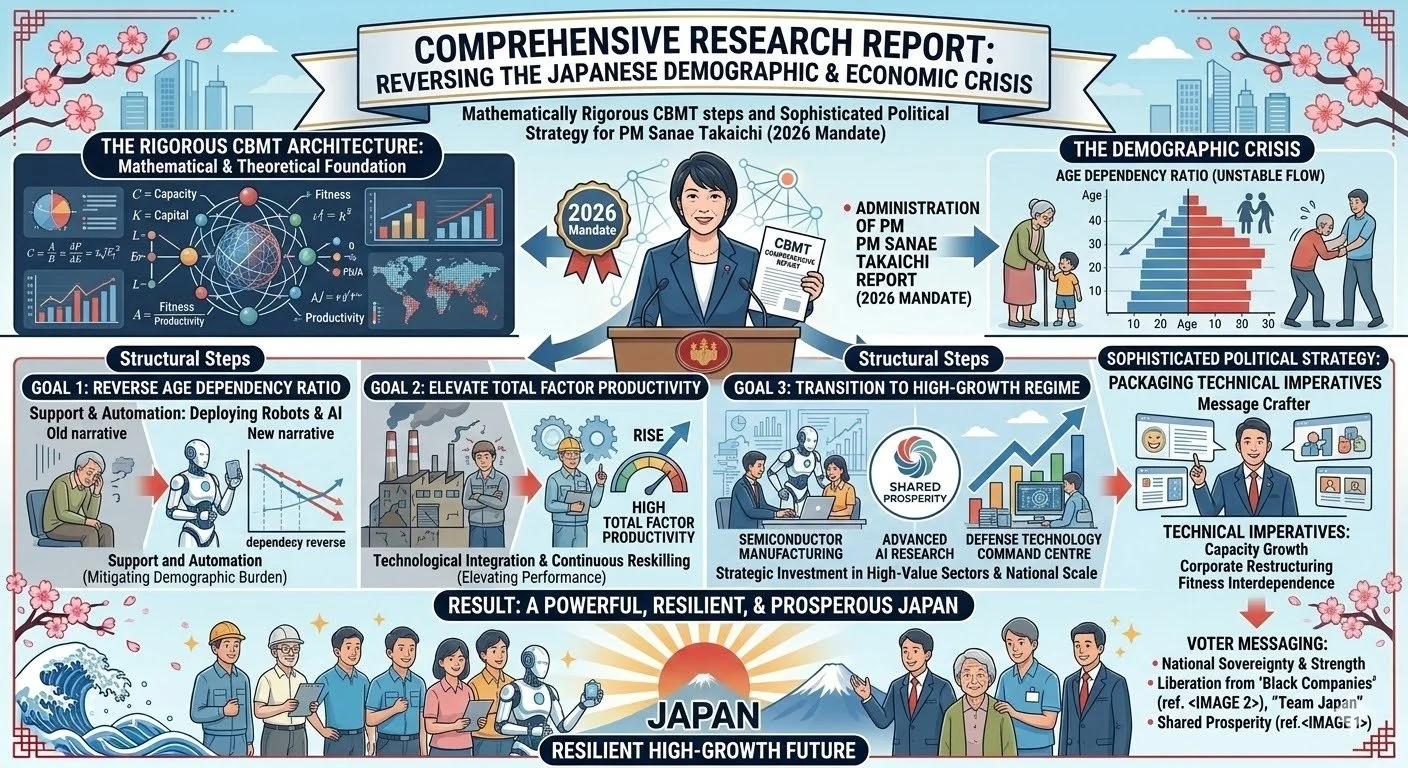
Japan occupies a unique position in the global macroeconomic landscape. For over three decades, the nation has served as the world’s primary laboratory for demographic contraction and economic stagnation. Since the collapse of the asset price bubble in the early 1990s, policymakers have relied heavily on orthodox and experimental macroeconomic interventions to stimulate aggregate demand. The most prominent of these efforts, the "Three Arrows" of Abenomics initiated in 2012, deployed aggressive monetary easing, flexible fiscal stimulus, and structural reforms to break the deflationary spiral. While these measures achieved temporary market stabilization and expanded the monetary base, they fundamentally failed to alter the long-term structural trajectory of the Japanese economy. The Bank of Japan’s ultra-accommodative policies, resulting in a public debt burden exceeding 240% of Gross Domestic Product, have yielded diminishing returns on real output and total factor productivity.
To accurately diagnose Japan's malaise and formulate a viable strategy for economic revival, it is necessary to transcend traditional neoclassical utility theories and adopt a fundamentally different ontological understanding of value. Capacity-Based Monetary Theory (CBMT) provides this rigorous theoretical framework. Conventional economics defines money functionally—as a medium of exchange, a unit of account, and a store of value. However, CBMT argues that these are merely symptoms of "moneyness" rather than descriptions of its underlying asset structure. In the double-entry bookkeeping of a sovereign state, money appears as a liability. A liability cannot exist in a vacuum; it must be balanced by a corresponding asset. CBMT posits that the asset backing the fiat liability of the Japanese yen is not gold, nor the mere authoritative decree of the state, but the Expected Future Impact of Japanese society.
Money, therefore, is a floating-price claim—a call option—on the future productive capacity of an economy. This capacity is a dynamic vector function of three primary variables: the aggregate labor of the population, the efficiency of that labor as amplified by technology and human capital, and the stability of the institutional social contract that allows this labor to project value into the future.
When evaluated through the lens of CBMT, Japan’s economic stagnation is not a failure of monetary supply, but a crisis of underlying collateral. As the nation’s population shrinks and its age dependency ratio accelerates, the absolute quantity of future labor available to redeem these monetary claims steadily degrades. If the money supply remains constant or expands while the capacity to produce impact degrades, the value of the claim structure inherently dilutes, manifesting as either explicit inflation or a prolonged stagnation in purchasing power.
This comprehensive research report applies the rigorous mathematical and theoretical architecture of CBMT to the Japanese demographic and economic crisis. It delineates the specific, structural steps required to reverse the economic consequences of the age dependency ratio, elevate total factor productivity, and transition the nation toward a high-growth regime. Furthermore, it provides a sophisticated political strategy, detailing how the highly technical imperatives of capacity growth, corporate restructuring, and fitness interdependence can be packaged and sold to an electorate that recently delivered a historic mandate to the administration of Prime Minister Sanae Takaichi in 2026.
The Mathematical Architecture of Capacity in a Shrinking Society
To operationalize CBMT for the Japanese economy, the abstract concept of societal impact must be mathematically defined. In economic terms, impact is synonymous with real output ($Y$)—the tangible goods, services, and innovations that a civilization produces. The fundamental premise of the theory is that the "price" of money serves as an index of the economy's production function. To accurately model this collateral, CBMT utilizes the Augmented Solow-Swan Framework, specifically the specification developed by Mankiw, Romer, and Weil (1992).
The rigorous production function for Expected Future Impact is defined as:
$$Y = K^\alpha H^\beta (A L)^{1-\alpha-\beta}$$
Where:
- $Y$ represents total production or "Impact" (the underlying collateral).
- $K$ is the stock of physical capital.
- $H$ is the stock of Human Capital (skills, education, health).
- $L$ is the aggregate labor force.
- $A$ is labor-augmenting technology, or "Efficiency Capacity."
- $\alpha$ and $\beta$ represent the elasticities of output with respect to physical and human capital, respectively.
The Demographic Drag and the Beckerian Revolution
In standard macroeconomic growth models, human capital is often treated merely as a qualitative multiplier embedded within the labor force. The critical intervention of the Mankiw-Romer-Weil specification is that it isolates Human Capital ($H$) as an independent factor of production with its own accumulation and depreciation dynamics. This is vital for Japan. The variable $L$ (aggregate labor) is undergoing a severe structural contraction. A shrinking population acts as a direct reduction in $L$, exerting profound downward pressure on the total output $Y$.
However, the mathematical separation of $H$ provides the precise blueprint for economic reversal. Drawing upon Gary Becker’s "Theory of the Allocation of Time," CBMT establishes that labor is not a fungible, static commodity, but a form of capital accumulated through deliberate investment. A currency backed by a population with exceptionally high levels of advanced education and operational agility represents a claim on a vastly larger pool of potential future impact. Therefore, "demographic dividends" are not purely about biological headcount. A shrinking population can mathematically sustain a strong currency and generate robust economic growth if the accumulation of Human Capital ($H$) and technological efficiency ($A$) significantly outpaces the numerical decline in $L$.
The Institutional Realization Rate ($\theta$) and the Hamilton Filter
Theoretical production capacity is economically meaningless if the societal software cannot secure and realize the fruits of that labor. Thomas Hobbes described the state of nature as a condition of infinite transaction costs. Money, as a claim on the future, cannot exist in a Hobbesian state because the discount rate is effectively infinite; no rational agent will exchange tangible goods today for a token promising goods tomorrow if expropriation is certain.
CBMT formalizes the role of the state and legal frameworks through the Institutional Realization Rate ($\theta$), a coefficient between 0 and 1.
The Realizable Impact is calculated as:
$$Y_{real} = \theta \cdot Y_{theoretical}$$
In Japan, the fundamental rule of law is robust, but the institutional realization rate has been historically suppressed by rigid corporate governance, regulatory bureaucracy, and a highly conservative approach to capital allocation.
Furthermore, traditional deterministic models fail to account for the stochastic risk of institutional degradation. CBMT employs the Hamilton Filter, a regime-switching model that recursively estimates the probability of an economy transitioning between hidden states (e.g., Stable vs. Collapse). In the Japanese context, the sudden spikes in food inflation and the historic depreciation of the yen witnessed prior to the 2026 elections can be interpreted through the Hamilton Filter as the market updating the probability of institutional paralysis. If the state fails to reform its rigid structures to support capacity growth, the discount rate spikes, and the value of the currency degrades. Reversing Japan's stagnation requires not just managing interest rates, but fundamentally optimizing $\theta$ through aggressive institutional modernization.
Deconstructing and Reversing the Age Dependency Ratio
The most profound vulnerability in Japan's capacity matrix is its demographic profile. The nation operates at the bleeding edge of global population aging. By 2024, Japan's old-age dependency ratio—the number of individuals aged 65 and older relative to the working-age population—reached an unprecedented 50.66%. When the youth demographic is included, the total age dependency ratio stood at a staggering 70.12%.
The demographic trajectory points toward a severe acceleration of this crisis. Japan's total population peaked at 128.5 million in 2010 and declined to 123.4 million by April 2025. Concurrently, the working-age population has been in constant retreat, plummeting 16% from a peak of 87.3 million in 1995 to 73.7 million in 2024. Demographic projections indicate that the working-age cohort will shrink by an additional 31% between 2023 and 2060. Depending on specific fertility assumptions, the National Institute of Population and Social Security Research estimates that the total age dependency ratio will climb to between 92.7 and 101.4 by 2060, creating an environment where every active worker must support at least one dependent.
Demographic Metric Historical Baseline (1995) Current State (2024/2025) Projected Outlook (2060) CBMT Capacity Implication Total Population 125.4 million 123.4 million ~90.0 million Gradual reduction in the total physical base of the societal asset. Working-Age (15-64) 87.3 million 73.7 million ~50.8 million Severe degradation of aggregate labor ($L$), diluting the fundamental value of monetary claims. Old-Age Dependency ~21.0% 50.66% ~74.0% Exponential increase in public expenditure, redirecting capital away from productive investment ($K$). Total Dependency ~43.0% 70.12% 92.7% - 101.4% Sovereign balance sheet stress; requires massive spike in efficiency ($A$) to avoid currency collapse.
Data synthesized from World Bank, OECD, and IPSS projections.
Reversing the Ratio Through Redefining Labor ($L$) Boundaries
Biological reversal of the dependency ratio through immediate increases in the fertility rate is a statistical impossibility in the near term; the demographic momentum is already locked in for the next two decades. However, the economic consequences of the ratio can be reversed by redefining the boundaries of what constitutes the aggregate labor force ($L$). The CBMT framework mandates that to preserve the currency's collateral, society must fluidly mobilize all untapped labor resources.
The traditional definition of the working-age population (15 to 64 years old) is obsolete. Japan has already achieved remarkable success in elevating the employment-to-population ratios among older demographics. By 2023, the employment rate for individuals aged 65 to 74 reached historic highs, and government surveys indicate that 10% of Japanese workers actively desire to remain in the workforce longer. Similarly, female labor force participation has grown to a record 55.1%.
To fundamentally alter the economic dependency ratio, the state must dismantle the institutional barriers that restrict this mobilization. This includes abolishing the "annual income barrier"—tax and social security thresholds that heavily penalize secondary earners, primarily women in non-regular employment, from increasing their working hours. Furthermore, the strategic integration of foreign labor is required. The foreign population in Japan increased by 10% year-on-year in December 2024, reaching nearly 3% of the total population. While mass, uncontrolled immigration presents significant risks to the social cohesion required for institutional stability ($\theta$), targeted expansions of the highly skilled professional visa system inject pre-accumulated Human Capital ($H$) directly into the Japanese production function without the generational lead time required for domestic education.
Engineering the Efficiency Variable ($A$): Traversing the Digital Cliff
A demographic contraction of Japan's magnitude can only be survived if the remaining workforce experiences an unprecedented explosion in productivity. Unfortunately, Japan's Total Factor Productivity (TFP) growth has stagnated for decades. Following the bubble collapse, Japan transitioned to a lower growth path characterized by a systemic failure in the creative-destruction process. By 2023, Japan ranked among the lowest in the G7 and OECD for labor productivity, generating output per hour worked that was roughly 60% of the U.S. level.
This stagnation is primarily anchored in the massive, highly fragmented service sector, which accounts for over 70% of Japan's GDP. Industries such as retail, logistics, and caregiving remain incredibly labor-intensive and culturally resistant to the automation that drove productivity gains in Western economies.
The 2025 Digital Cliff and Administrative Modernization
The most pressing bottleneck to efficiency ($A$) is what the Ministry of Economy, Trade and Industry (METI) identified as the "2025 Digital Cliff." This concept warned that the persistence of aging, fragmented legacy IT systems, combined with a severe shortage of digital talent, could inflict economic losses of up to 12 trillion yen annually from 2025 onward. Many Japanese administrative processes remain bound to analog formats, heavily reliant on physical hanko seals, fax machines, and in-person document submission.
To elevate $A$ across the macroeconomic landscape, the state must fundamentally redesign its societal infrastructure. The creation of the Digital Agency serves as the central control tower for this transformation, attempting to optimize the institutional realization rate ($\theta$) through aggressive digitalization. Key strategic interventions within the CBMT framework include:
- Federated Government Cloud and Data Free Flow with Trust (DFFT): The Digital Agency is mandating the migration of siloed ministerial systems into a unified Government Cloud, standardizing compliance and interoperability. This dramatically reduces the frictional transaction costs of governance. The "Digital Governance Implementation Plan" explicitly targets making all high-volume administrative procedures fully mobile-first by March 2027.
- The My Number Ecosystem: The expansion of the My Number card system (reaching over 100 million issued cards by mid-2025) allows for seamless authentication across public and private platforms, linking health insurance, public money receiving accounts, and electronic prescriptions. This infrastructure is vital for establishing the data architecture required to deploy advanced AI models across the economy.
Sectoral Bottleneck Current Macroeconomic Impact CBMT Efficiency Intervention ($A$) Legacy IT Architecture "2025 Digital Cliff" threatening 12T yen annual economic loss.
| Forced migration to Government Cloud; interoperability standardization.
| | Public Administration | 1,900 analog procedures; reliance on physical media and legacy storage.
| Mandated mobile-first public services by 2027; My Number card integration.
| | Service & Retail | Fragmented, heavily labor-intensive operations; high manual transaction costs.
| Widespread deployment of generative AI APIs; automated logistics subsidies.
| | Elderly Care | Projected shortage of 380,000 care workers by 2025; massive drain on $L$.
| Integration of humanoid robotics (AIREC) and therapeutic systems (Aibo).
|
Capital Deepening ($K$) as a Labor Substitute in Healthcare
Nowhere is the deficit of $L$ more acute than in the nursing and elderly care sector. The Ministry of Health anticipated a shortfall of approximately 380,000 care workers by 2025. The CBMT solution requires the aggressive substitution of physical capital ($K$) and technology ($A$) for absent human labor.
Japan is actively serving as a global test bed for this substitution through the government-backed "Moonshot Research and Development Program," which allocates $440 million USD toward societal challenges, heavily prioritizing robotics. The deployment of advanced humanoid robots, such as the AIREC prototype capable of complex physical tasks, and therapeutic robots like Sony’s Aibo, are designed to augment the capabilities of human caregivers. While currently in the prototype and early adoption phases, these technologies represent essential capital deepening. By subsidizing the integration of robotics into nursing homes, the state prevents a total collapse of the care infrastructure, ensuring that the broader workforce is not forced to exit the labor market to care for aging relatives.
Eradicating the Zombie Economy: Institutional Realization and Creative Destruction
Expanding theoretical capacity through technology is insufficient if resources remain trapped in unproductive silos. The Japanese economy has long suffered from a severe decline in allocative efficiency. During the prolonged era of zero-interest-rate policy (ZIRP), bank forbearance allowed insolvent, low-productivity firms to survive far beyond their natural market lifespan. These "zombie companies"—which cannot cover the interest on their debt with operational profits—numbered an estimated 228,000 in fiscal 2023.
Zombie firms act as a macroeconomic parasite. They absorb physical capital ($K$) and hoard human labor ($L$) that could otherwise be deployed to high-growth, innovative enterprises. Furthermore, their presence depresses pricing power across the economy and discourages the entry of dynamic startups, effectively paralyzing the process of creative destruction required for capacity expansion.
The Minimum Wage as a Weapon of Structural Reform
To drastically improve the Institutional Realization Rate ($\theta$), the state must force the reallocation of these trapped resources. Within the CBMT framework, this is achieved not merely through adjusting the cost of borrowing, but by weaponizing the cost of labor.
The administration has launched an aggressive campaign to raise the national average minimum wage to 1,500 yen within the 2020s, representing an ambitious annual increase of approximately 7%. While publicly framed as a mechanism to combat inflation and address the cost-of-living crisis, the macroeconomic objective is decidedly structural. A rapid, mandated increase in the wage floor is designed to push low-productivity firms that survive only through labor exploitation into insolvency.
By forcing zombie companies out of business, the government initiates a controlled demolition of the inefficient sectors. The labor and capital released from these bankruptcies flow into the broader market, where acute labor shortages in highly productive sectors will readily absorb them. This calculated strategy clears the arteries of the economy, ensuring that the remaining capital structure generates a substantially higher Total Factor Productivity.
Corporate Governance and the Tokyo Stock Exchange Mandates
The eradication of zombie companies at the bottom of the economy must be matched by structural reform at the top. For decades, Japanese corporate governance prioritized internal stability, lifetime employment, and intricate webs of cross-shareholdings (Keiretsu networks) over capital discipline and shareholder returns. This insular architecture severely depressed Return on Equity (ROE) and resulted in massive, unproductive cash hoarding that suppressed the velocity of capital.
To rectify this, the Tokyo Stock Exchange (TSE) launched a series of forceful interventions. In 2023, the TSE issued a mandate requiring listed companies to explicitly disclose action plans to implement management practices "Conscious of Cost of Capital and Stock Price". Companies trading with a price-to-book (P/B) ratio below 1.0—a cohort comprising nearly 40% of the top 2,000 Japanese equities—were targeted for intense scrutiny and potential delisting if they failed to improve capital efficiency.
This regulatory pressure has catalyzed a profound shift in the Institutional Realization Rate ($\theta$). Japanese corporations have initiated record levels of share buybacks, increased dividend payouts, and begun unwinding legacy cross-shareholdings. Furthermore, there has been a surge in mergers and acquisitions, driven largely by private equity firms facilitating the divestiture of non-core subsidiaries from bloated conglomerates. This corporate restructuring streamlines operations, ensuring that management is hyper-focused on maximizing the efficiency and output of their core competencies.
Fitness Interdependence and the Human Capital ($H$) Revolution
As the aggregate number of workers declines, the intrinsic value and output capability of each individual worker must exponentially increase. The traditional Japanese employment model, characterized by lifetime employment (shushin koyo) and seniority-based wages (nenko joretsu), was highly effective during periods of rapid population growth and industrial catch-up. It fostered intense company loyalty and the accumulation of firm-specific human capital. However, in an era defined by rapid digital transformation and artificial intelligence, this rigid system has become a profound liability.
The CBMT model highlights the necessity of continuous investment in the $H$ variable. To achieve this, Japan is undergoing a painful but essential transition toward job-based personnel management and continuous reskilling. The government has committed substantial subsidies—over 1 trillion yen over five years—to shift labor toward growth sectors through adult education and the acquisition of versatile, general human capital (such as advanced digital literacy, software engineering, and AI utilization).
Furthermore, the Financial Services Agency (FSA) has mandated that publicly traded companies comprehensively disclose their human capital strategies within their annual securities reports. Corporate boards are now legally required to quantify and report metrics on employee engagement, the gender pay gap, the ratio of women in managerial positions, and the explicit linkage between their human resource investments and overarching corporate strategy. This regulatory environment forces companies to treat human capital not as a depreciating operational expense, but as a vital asset class requiring rigorous management and continuous capital expenditure.
Replacing Kin Metaphors: ESOPs and Shared Fate
To truly maximize the efficiency of the workforce, the incentives of the employees ($H$), the management ($\theta$), and the capital providers ($K$) must be perfectly aligned. In earlier iterations of organizational theory, the intense loyalty of the Japanese corporate structure was often likened to biological kin selection. However, CBMT replaces misapplied biological metaphors with the robust framework of Fitness Interdependence, or "Shared Fate," pioneered by evolutionary anthropologists.
In modern cooperative structures, firms mimic the cooperative behaviors found in genetic kin groups by structurally linking the economic survival and prosperity of the employees directly to the equity and output of the firm. If the firm succeeds, the employees generate wealth; if the firm stagnates, the employees suffer proportional economic consequences.
This theoretical imperative is currently manifesting in Japan through the rapid expansion of Employee Stock Ownership Plans (ESOPs) and equity-based compensation. The introduction of the J-ESOP trust model, alongside the expanded utilization of Restricted Stock Units (RSUs) and Phantom Equity for startups, represents a fundamental shift away from rigid, pre-paid cash remuneration toward dynamic ownership.
By distributing the ownership of the means of production to the workforce, ESOPs radically reduce internal transaction costs, break down bureaucratic silos, and maximize the efficiency term ($A$) in the production function. Employees are no longer merely selling time; they are actively underwriting the Expected Future Impact of the enterprise, creating a powerful engine for productivity growth.
The Political Calculus: Packaging Capacity Growth for the 2026 Electorate
The macroeconomic principles dictated by Capacity-Based Monetary Theory—the eradication of zombie companies, the dismantling of lifetime employment, and the shift toward equity-linked performance—carry immense political peril. If poorly communicated, these policies can easily be perceived by the public as ruthless neoliberal austerity, corporate greed, or the abandonment of Japan's social contract.
To successfully implement these reforms, the government must expertly package the highly technical realities of CBMT into a narrative that resonates with the deep anxieties and aspirations of the Japanese electorate. The political landscape was radically reshaped by the snap election of February 2026, wherein Prime Minister Sanae Takaichi led the Liberal Democratic Party (LDP) to a historic, absolute supermajority, capturing 316 of the 465 seats in the lower house.
This victory provides the legislative mandate necessary to execute profound structural changes, but the underlying public sentiment is volatile. Opinion polling heading into 2026 revealed an electorate deeply pessimistic about the future, frustrated by soaring food inflation and a weak yen, and increasingly drawn to right-wing populist movements like the Sanseito party, which leveraged anti-immigration rhetoric and economic nationalism. Surprisingly, however, Takaichi's decisive, pragmatic realism captured the imagination of the youth vote, securing an astonishing 92.4% support among 18-to-29-year-olds who rejected the "lost generation" stereotype and turned out in record numbers.
To maintain this fragile coalition and execute the capacity-building agenda, the administration must deploy a strategic messaging framework that translates economic mathematics into patriotic imperative.
1. Framing Structural Reform as "National Economic Resilience"
The most dangerous phase of the CBMT reform process is the intentional destruction of zombie companies and the resulting localized unemployment. If framed as a "market efficiency drive," it will trigger fierce backlash from traditional conservatives and organized labor.
The Takaichi administration must strictly frame these aggressive restructuring measures through the lens of National Economic Resilience and Security. The messaging must clearly articulate that in an era of intense geopolitical fracture—characterized by Chinese economic coercion and vulnerable global supply chains—Japan cannot afford to waste its precious, dwindling human capital in stagnant, debt-ridden enterprises.
By raising minimum wages and forcing industrial consolidation, the government is not punishing the working class; it is "liberating" the Japanese workforce from exploitative "black companies" to deploy them into high-value, strategic sectors like semiconductor manufacturing, artificial intelligence, and defense technology. The pain of corporate restructuring is thus elevated from a consequence of raw capitalism to a necessary, patriotic reallocation of resources required to defend Japanese sovereignty and build "allied scale" within the Indo-Pacific.
2. Packaging Equity and Fitness Interdependence via the "Asset Income Doubling Plan"
Prime Minister Takaichi has engaged in populist rhetoric, actively criticizing corporations for exhibiting "too much focus on shareholders" at the expense of employee wages, and threatening to revise governance codes to mandate resource redistribution. While this rhetoric effectively channels public anger over the cost-of-living crisis, executing it through blunt regulatory force would alienate the foreign capital that has fueled the recent resurgence of the Japanese equity markets.
The strategic synthesis lies in aggressively utilizing the "Asset Income Doubling Plan" inherited from the Kishida era. The government must market the expansion of ESOPs, J-ESOPs, and broad-based profit-sharing not as complex financial engineering for executives, but as the democratization of capital. By actively converting the working class into the shareholder class, the administration effectively resolves the historical tension between capital and labor.
The messaging must communicate that introducing equity compensation is not an adoption of ruthless American corporate culture, but rather the modern, sophisticated evolution of traditional Japanese corporate harmony. It is a return to a true "Shared Fate" where the prosperity of the enterprise directly enriches the employee. Paired with the expansion of the tax-exempt NISA (Nippon Individual Savings Account) program—which aims to double NISA accounts to 34 million and unleash the 2,000 trillion yen in stagnant household financial assets—this policy allows everyday citizens to directly capture the wealth generated by the nation's capacity expansion.
3. "Team Japan" and the Rebranding of Automation
To overcome societal resistance to the integration of artificial intelligence and robotics, and to mitigate the anxiety surrounding the shift to job-based performance metrics, the administration must deploy inclusive, unifying messaging. The "Team Japan" concept, traditionally utilized in international diplomatic and sporting contexts, must be redirected inward to frame the modernization of the economy as a collective national endeavor.
Investment in Human Capital ($H$) and the demand for continuous reskilling must be presented not as an individualistic burden to survive a ruthless labor market, but as a civic contribution to the strengthening of the national fabric. Furthermore, AI and humanoid robotics must be explicitly positioned not as job replacements threatening human dignity, but as essential national assets—digital colleagues designed to shoulder the burden of dangerous or repetitive labor. The narrative must assure the public that automation serves to augment human potential, allowing Japanese citizens to dedicate their time to highly productive, creative, and empathetic endeavors, thereby preserving the fundamental quality of Japanese life in the face of demographic inevitability.
| CBMT Economic Imperative | Traditional Policy Framing (High Political Risk) | 2026 Strategic Messaging Framework (Low Political Risk) | Target Demographic Appeal |
|---|---|---|---|
| Eradicate Zombie Companies | Neoliberal Austerity; Free-Market Efficiency; Corporate Restructuring. | National Economic Resilience: Liberating human capital to build sovereign strength and secure supply chains. |
| Conservative Base; Nationalists; Geopolitical Realists. | | Implement ESOPs / Equity Comp | Executive Financial Engineering; Shareholder Primacy. | Asset Income Doubling & Shared Fate: Democratizing wealth; modernizing traditional corporate harmony and unity.
| Middle Class; Young Professionals seeking wealth accumulation. | | Automate Service & Care Sectors | Labor Substitution; AI Job Replacement; Cost-Cutting. | Team Japan & Digital Colleagues: Deploying technology to protect human dignity and preserve the Japanese standard of living.
| Elderly Voters; Healthcare Workers; Technologists. | | Dismantle Lifetime Employment | Labor Market Deregulation; Destruction of Job Security. | Eradicating Black Companies: Promoting work-life balance, individual agility, and the financial viability of family formation.
| Youth Voters; Working Women; Non-Regular Employees. |
Conclusion: The Path to a Capacity-Driven Future
The demographic reality of Japan's rapidly aging and shrinking population presents an insurmountable macroeconomic obstacle if viewed exclusively through the traditional lenses of aggregate demand and labor hour maximization. However, the rigorous application of Capacity-Based Monetary Theory (CBMT) illuminates a clear, mathematically sound trajectory for national revival. The fundamental value of the Japanese yen, and the overarching strength of the nation, are not strictly dependent on the sheer biological volume of its population. Rather, they are inextricably linked to the expected future impact that the society can efficiently produce.
To reverse the devastating economic consequences of its soaring age dependency ratio, Japan must ruthlessly and systematically optimize every variable within its production function. It must expand the functional boundaries of its aggregate labor pool ($L$) through the integration of older workers, the elevation of female labor force participation, and the strategic circulation of highly skilled global talent. It must forcefully elevate its technological efficiency ($A$) by traversing the 2025 digital cliff, modernizing its administrative architecture, and rapidly deploying artificial intelligence and robotics as direct labor substitutes in its bloated service sectors.
Furthermore, Japan must radically deepen its human capital ($H$) through relentless, lifelong reskilling, abandoning the rigid constraints of company-specific tenure in favor of agile, job-based expertise. Finally, it must perfect its Institutional Realization Rate ($\theta$) by systematically dismantling the zombie companies that choke allocative efficiency, enforcing rigorous corporate governance that demands capital discipline, and aligning the incentives of capital and labor through the widespread, aggressive adoption of Employee Stock Ownership Plans and fitness interdependence.
The historic 2026 supermajority has provided the political window required to execute these profound structural shifts. By strategically framing these vital economic reforms as matters of national resilience, shared fate, and the democratization of asset income, the leadership can secure the broad public consensus necessary to withstand the inevitable friction of transition. In doing so, Japan will not merely survive its demographic contraction; it will forge a new, highly efficient economic paradigm—a capacity-centric model of prosperity that will serve as the definitive blueprint for the entirety of the aging developed world.
-
Shrinkanomics: Policy Lessons from Japan on Aging – IMF F&D, accessed March 6, 2026, https://www.imf.org/en/publications/fandd/issues/2020/03/shrinkanomics-policy-lessons-from-japan-on-population-aging-schneider
The Abenomics Difference: Three Arrows of Roosevelt Resolve in Japan - Harvard DASH, accessed March 6, 2026, https://dash.harvard.edu/bitstreams/7312037d-d1a3-6bd4-e053-0100007fdf3b/download
Overcoming the Lost Decades? Abenomics after Three Years - Brookings Institution, accessed March 6, 2026, https://www.brookings.edu/wp-content/uploads/2015/09/HausmanTextFall15BPEA.pdf
Takaichi Wants to Make Japan Great Again. It Won't Be Easy. | TIME, accessed March 6, 2026, https://time.com/7378431/sanae-takaichi-japan-economy-military-china-trump/
Japan: OECD Economic Outlook, Volume 2025 Issue 2, accessed March 6, 2026, https://www.oecd.org/en/publications/2025/12/oecd-economic-outlook-volume-2025-issue-2_413f7d0a/full-report/japan_ea7efd0c.html
CBMT
Japan's Takaichi cements conservative agenda, accessed March 6, 2026, https://www.iiss.org/online-analysis/online-analysis/2026/02/japans-takaichi-cements-conservative-agenda/
Japan's Corporate Reform Wave: What It Means for Global Investors - Voyen Group, accessed March 6, 2026, https://voyen.com/journal/japans-corporate-reform-wave-what-it-means-for-global-investors/
Closing Japan's valuation gap by changing corporate traditions - McKinsey, accessed March 6, 2026, https://www.mckinsey.com/capabilities/strategy-and-corporate-finance/our-insights/closing-japans-valuation-gap-by-changing-corporate-traditions
How Japan's hard-right populists are profiting from anti-foreign sentiment and a cost of living crunch - The Guardian, accessed March 6, 2026, https://www.theguardian.com/world/2025/jul/19/japanese-first-sanseito-party-goes-into-election-leveraging-unease-about-foreigners
Age Dependency Ratio: Older Dependents to Working-Age Population for Japan (SPPOPDPNDOLJPN) | FRED | St. Louis Fed, accessed March 6, 2026, https://fred.stlouisfed.org/series/SPPOPDPNDOLJPN
Japan - Age Dependency Ratio, Old (% Of Working-age Population) - 2026 Data 2027 Forecast 1960-2024 Historical - Trading Economics, accessed March 6, 2026, https://tradingeconomics.com/japan/age-dependency-ratio-old-percent-of-working-age-population-wb-data.html
Japan - Age Dependency Ratio (% Of Working-age Population) - 2026 Data 2027 Forecast 1960-2024 Historical - Trading Economics, accessed March 6, 2026, https://tradingeconomics.com/japan/age-dependency-ratio-percent-of-working-age-population-wb-data.html
Demographics of Japan - Wikipedia, accessed March 6, 2026, https://en.wikipedia.org/wiki/Demographics_of_Japan
OECD Employment Outlook 2025: Japan, accessed March 6, 2026, https://www.oecd.org/en/publications/oecd-employment-outlook-2025-country-notes_f91531f7-en/japan_7672bd00-en.html
Population Projection for Japan, accessed March 6, 2026, https://www.ipss.go.jp/site-ad/index_english/esuikei/econ2.html
Japan's “Foreigner Policy” Skirts Key Issues: No Orderly Coexistence Without Plan for Immigration | Nippon.com, accessed March 6, 2026, https://www.nippon.com/en/in-depth/d01206/
Grand Design and Action Plan for a New Form of Capitalism 2024 Revised Version, accessed March 6, 2026, https://www.cas.go.jp/jp/seisaku/atarashii_sihonsyugi/pdf/ap2024en.pdf
Fourth Report of the Committee on New Direction of Economic and Industrial Policies, accessed March 6, 2026, https://www.meti.go.jp/english/policy/economy/industrial_council/pdf/250603008_01.pdf
Rapid Growth and Long Stagnation - Collège de France, accessed March 6, 2026, https://www.college-de-france.fr/fr/agenda/conferencier-invite/japanese-economy/rapid-growth-and-long-stagnation
Will China's economy follow the same path as Japan's? - Bruegel.org, accessed March 6, 2026, https://www.bruegel.org/policy-brief/will-chinas-economy-follow-same-path-japans
Why Japan's Economy Is Struggling in 2024–2025 – ERIC KIM, accessed March 6, 2026, https://erickimphotography.com/why-japans-economy-is-struggling-in-2024-2025/
Cross-country comparisons of labour productivity levels: OECD Compendium of Productivity Indicators 2025, accessed March 6, 2026, https://www.oecd.org/en/publications/oecd-compendium-of-productivity-indicators-2025_b024d9e1-en/full-report/cross-country-comparisons-of-labour-productivity-levels_b2fdb493.html
Japan's labor productivity falls to 28th among OECD countries - The Japan Times, accessed March 6, 2026, https://www.japantimes.co.jp/business/2025/12/23/japan-labor-productivity-oecd/
Challenges in Improving Productivity in the Service Industry - RIETI, accessed March 6, 2026, https://www.rieti.go.jp/en/papers/contribution/morikawa/29.html
Japan's digital transformation in crisis - CIO, accessed March 6, 2026, https://www.cio.com/article/4074930/japans-digital-transformation-in-crisis.html
Japan's Digital Cliff: The 2026 Reality And Breakthrough Solutions - DTS Software Vietnam, accessed March 6, 2026, https://dtsvn.com/en/japans-digital-cliff-the-2026-reality-and-breakthrough-solutions/
1 . The 20th World Digital Government Rankings 2025 Edition Released - Waseda University, accessed March 6, 2026, https://idg-waseda.jp/pdf/2025_Digital_Government_Ranking_Report.pdf
Activity Report and Future Plan of Digital Agency of Japan in 2025, accessed March 6, 2026, https://www.digital.go.jp/en/policies/report-2025
Activity Report and Future Plan of Digital Agency of Japan, accessed March 6, 2026, https://www.digital.go.jp/assets/contents/en/node/basic_page/field_ref_resources/e40758be-dd25-46e1-96e9-24cf5719a7a9/0168e4e2/20250905_en_activity_report.pdf
Japan's Agile AI Governance in Action: Fostering a Global Nexus Through Pluralistic Interoperability - CSIS, accessed March 6, 2026, https://www.csis.org/analysis/japans-agile-ai-governance-action-fostering-global-nexus-through-pluralistic
Robots in elderly care: Lessons from Japan's aging population - Sinolytics, accessed March 6, 2026, https://sinolytics.de/global-business-news/blog/geolytics/robots-elderly-care-lessons-from-japan/
Japan's Aging Society as a Technological Opportunity | Carnegie Endowment for International Peace, accessed March 6, 2026, https://carnegieendowment.org/research/2024/10/japans-aging-society-as-a-technological-opportunity
Confronting the zombies - OECD, accessed March 6, 2026, https://www.oecd.org/en/publications/confronting-the-zombies_f14fd801-en.html
'Zombie company' apocalypse might be the point of Japan's minimum wage push, accessed March 6, 2026, https://www.japantimes.co.jp/business/2025/06/03/economy/ishiba-minimum-wage-push/
Japan: Staff Concluding Statement of the 2025 Article IV Mission - IMF, accessed March 6, 2026, https://www.imf.org/en/news/articles/2025/02/07/mcs-020725-japan-staff-concluding-statement-of-the-2025-article-iv-mission
Ishiba's Economic Agenda: A Departure from Kishida's "Growth First" Approach?|Dai-Ichi Life Research Institute, accessed March 6, 2026, https://www.dlri.co.jp/file/english/202506TH.pdf
Japan's Corporate Reforms Create a Catalyst for Equity Returns | AB - AllianceBernstein, accessed March 6, 2026, https://www.alliancebernstein.com/us/en-us/defined-contribution/insights/investment-insights/japans-corporate-reforms-create-a-catalyst-for-equity-returns.html
Japan's Corporate Reforms Boost Shareholder Value in 2025 | J.P. Morgan Asset Management, accessed March 6, 2026, https://am.jpmorgan.com/es/en/asset-management/institutional/insights/portfolio-insights/etf-perspectives/japan-corporate-governance-shareholder-value/
Japan Corporate Reforms Lead to Corporate Dealmaking Growth - BofA Securities, accessed March 6, 2026, https://business.bofa.com/jp/en/japan-insights/corporate-reforms-drive-results.html
Value Vantage Point: As Japanese companies change, investment opportunities bloom, accessed March 6, 2026, https://www.franklintempleton.com/articles/2025/equity/as-japanese-companies-change-investment-opportunities-bloom
Japan A structural alpha opportunity - Eastspring Investments, accessed March 6, 2026, https://www.eastspring.com/hk/insights/deep-dives/japan-a-structural-alpha-opportunity
Japan's Private Equity Shake-up: Trends, Opportunities and Integration Challenges, accessed March 6, 2026, https://bccjapan.com/news/japans-private-equity-shake-trends-opportunities-and-integration-challenges
How people are navigating work transformation across Japan | World Economic Forum, accessed March 6, 2026, https://www.weforum.org/stories/2025/12/navigating-work-transformation-in-japan/
Rapid Growth and Long Stagnation - Collège de France, accessed March 6, 2026, https://www.college-de-france.fr/en/agenda/guest-lecturer/japanese-economy/rapid-growth-and-long-stagnation
Reskilling and Human Capital - RIETI, accessed March 6, 2026, https://www.rieti.go.jp/en/columns/a01_0743.html
Action Programme for Corporate Governance Reform 2025, accessed March 6, 2026, https://www.fsa.go.jp/en/refer/councils/follow-up/statements_8_overview.pdf
What is human capital management disclosure? We go over the 19 items across 7 areas requiring disclosure and why they are mandatory, and explain key points in performing disclosure | Insights | ABeam Consulting, accessed March 6, 2026, https://www.abeam.com/jp/en/insights/056/
Study on Global Investors' Focus Areas Regarding Human Capital Disclosure and Corporate Case Studies (English translated version, accessed March 6, 2026, https://www.fsa.go.jp/en/news/2025/20250411/01.pdf
Human Capital Reporting in Japan : Facilitating dialogue inside and outside the organization | Research Articles, accessed March 6, 2026, https://www.mri.co.jp/en/knowledge/article/202509_3.html
The Evolution of Reciprocal Altruism | The Quarterly Review of Biology: Vol 46, No 1, accessed March 6, 2026, https://www.journals.uchicago.edu/doi/10.1086/406755?mobileUi=0
Employee Stock Ownership Plan Market Report 2026 - The Business Research Company, accessed March 6, 2026, https://www.thebusinessresearchcompany.com/report/employee-stock-ownership-plan-global-market-report
The rise of equity-based executive compensation in Japan - Gideon Franklin, accessed March 6, 2026, https://www.gideonfranklin.com/the-rise-of-equity-based-executive-compensation-in-japan/
How the Japanese corporate compensation system made some sense | CEO Noriyuki's perspective | INVESTMENT IN JAPAN
Nxera Introduces Employee Stock Ownership Plan (J-ESOP) for Employees Residing in Japan - BioSpace, accessed March 6, 2026, https://www.biospace.com/press-releases/nxera-introduces-employee-stock-ownership-plan-j-esop-for-employees-residing-in-japan
Understanding Phantom Equity & Stock Plans for Startups - J.P. Morgan, accessed March 6, 2026, https://www.jpmorgan.com/insights/business-planning/understanding-phantom-equity-and-stock-plans-for-startups
KKR Partner: Now Is the Time for Japanese Employees to Receive Equity Compensation, Warning of U.S.-Style Inequality, accessed March 6, 2026, https://www.kkr.com/content/dam/kkr/invest/private-equity/ownership-works-japan-bloomberg-20251020.pdf
Cutting the Parent, Preserving the Subsidiary:Reverse Spin-Off Strategies in Corporate Downsizing | by Japan Business Insights, accessed March 6, 2026, https://japanbusinessinsights.medium.com/cutting-the-parent-preserving-the-subsidiary-reverse-spin-off-strategies-in-corporate-downsizing-436f4f97fc70
The Kishida Administration's Challenges after the Upper House Election: Fiscal and National Sustainability Restructuring - Japan Policy Forum, accessed March 6, 2026, https://www.japanpolicyforum.jp/politics/pt2022082908493412426.html
Top Risks 2026: Implications for Japan - Eurasia Group, accessed March 6, 2026, https://www.eurasiagroup.net/issues/Top-Risks-2026-Implications-for-Japan
Soaring food bills pose risk to Takaichi's election prospects - The Japan Times, accessed March 6, 2026, https://www.japantimes.co.jp/business/2026/02/06/economy/food-cost-rise-election/
Young Audiences Abandoning Traditional Media in the Age of Takaichi, accessed March 6, 2026, https://apjjf.org/2026/1/ikeda
Japan's youth are quietly securing their nation's future - The Japan Times, accessed March 6, 2026, https://www.japantimes.co.jp/commentary/2026/02/10/japan/japans-youth-secure-nations-future/
IDEAS, POWER AND EFFICIENCY: THE ... - DukeSpace, accessed March 6, 2026, https://dukespace.lib.duke.edu/bitstreams/397e2f7a-d0f0-423a-b46a-307f9f5717ed/download
Takaichi's Landslide: A Mandate for Strategic Realism and Allied Scale | Nippon.com, accessed March 6, 2026, https://www.nippon.com/en/in-depth/d01213/
Policy Speech by Prime Minister TAKAICHI Sanae to the 221st Session of the Diet, accessed March 6, 2026, https://japan.kantei.go.jp/105/statement/202602/20shiseihoshin.html
Takaichi Landslide Shows Limits of Chinese Economic Coercion - CSIS, accessed March 6, 2026, https://www.csis.org/analysis/takaichi-landslide-shows-limits-chinese-economic-coercion
Challenging Corporate Governance: Japanese PM Swipes at Companies' Shareholder Focus - Minerva-Manifest, accessed March 6, 2026, https://www.manifest.co.uk/challenging-corporate-governance-japanese-pm-swipes-at-companies-shareholder-focus/
Japan's Second Act: Shareholder Returns and Global Relevance - WisdomTree, accessed March 6, 2026, https://www.wisdomtree.com/investments/blog/2025/11/12/japans-second-act-shareholder-returns-and-global-relevance
Corporate Governance Reform in Japan - 金融庁, accessed March 6, 2026, https://www.fsa.go.jp/singi/japan_corporate_governance_forum/03.pdf
XNET Corporation (4762) Company Information Stock Information Earnings Trend, accessed March 6, 2026, https://www.xnet.co.jp/if/ir6files/20251224-1.pdf
Bridge Report:(4762)XNET Fiscal Year ended March 2025 - ブリッジサロン, accessed March 6, 2026, https://www.bridge-salon.jp/report_bridge/archives/eng/4762/20250718.html
2024 Investment Climate Statements: Japan - State Department Home, accessed March 6, 2026, https://2021-2025.state.gov/reports/2024-investment-climate-statements/japan/
Japan's Open Future: An Agenda for Global Citizenship 1843313111, 9781843313113 - DOKUMEN.PUB, accessed March 6, 2026, https://dokumen.pub/japans-open-future-an-agenda-for-global-citizenship-1843313111-9781843313113.html
Takaichi's choice: revolution, reform or regression - Stephen Nagy, accessed March 6, 2026, https://nagystephen.com/2025/10/23/takaichis-choice-revolution-reform-or-regression/