

Attorneys' Economic Impact and Ethical Reform
The legal profession occupies a profoundly paradoxical space within the architecture of modern economic theory. In one respect, legal practitioners are the indispensable custodians of the institutional frameworks that secure property rights, enforce contracts, and mitigate systemic uncertainties. These activities are universally recognized by institutional economists as absolute prerequisites for capital formation, technological innovation, and macroeconomic growth. Conversely, the profession is frequently scrutinized as an engine of rent-seeking behavior, characterized by exorbitant transaction costs, zero-sum litigation, and systemic deadweight losses that severely constrain aggregate economic output. The tension between these two realities has produced an economic environment where the foundational benefits of the rule of law are increasingly counterbalanced by the frictional costs of its execution. Furthermore, recent empirical data reveals a historic crisis of confidence, with public trust in the United States judicial system plummeting to a record low of 35 percent in 2024, representing a precipitous 24-point decline since 2020.[1] This decline in institutional trust is not merely a political phenomenon; it is a macroeconomic vulnerability.
To rigorously reconcile these opposing realities and chart a normative, economically viable path forward, this report applies the novel analytical framework of Capacity-Based Monetary Theory (CBMT). By redefining money as a priced claim on the future productive capacity of an economy, CBMT provides a precise mathematical and theoretical lens through which the macroeconomic impact of attorneys can be accurately quantified and evaluated. This analysis will meticulously evaluate the current economic footprint of the United States legal system, unpack the structural mechanisms by which legal friction and rent-seeking degrade national economic capacity, and propose a systemic pivot toward the doctrines of "Preventive" and "Proactive" lawyering. Finally, this report will outline exactly how these macroeconomic imperatives can be codified into a new operational standard within the American Bar Association (ABA) Model Rules of Professional Conduct, thereby permanently aligning the ethical obligations of attorneys with the economic preservation and expansion of society.
The Theoretical Framework: Capacity-Based Monetary Theory (CBMT)
To accurately assess the macroeconomic impact of the legal profession, one must first establish the fundamental ontology of value within a modern economy. Traditional monetary economics relies heavily on tripartite functional definitions of money, categorizing it merely as a medium of exchange, a unit of account, and a store of value. However, as advanced theoretical frameworks suggest, these functional definitions merely describe the operational symptoms of currency rather than articulating its underlying asset structure in an ontological sense.
Capacity-Based Monetary Theory (CBMT) resolves this ambiguity by positing that in the double-entry bookkeeping of a civilization, money manifests as a liability on the balance sheet of the sovereign state. Because a liability cannot exist in a vacuum without a corresponding asset, CBMT identifies the backing asset of fiat currency not as gold or mere state decree, but as the Expected Future Impact of the society that issues it. Consequently, money is conceptualized as a floating-price claim, effectively a call option, on the future productive capacity and aggregate labor of an economy. When an individual or entity accepts currency today, they are betting that the issuing society will possess the physical, intellectual, and institutional capacity to redeem that claim for tangible value at a later date.
The Augmented Solow-Swan Production Function and Human Capital
Under the CBMT framework, the productive capacity of an economy is not a static reserve of wealth but a highly dynamic vector function dependent on three primary variables: the aggregate labor of the population, the efficiency of that labor as amplified by technology and human capital, and the stability of the institutional social contract. To formalize this mathematically, CBMT utilizes the Augmented Solow-Swan framework, specifically the Mankiw-Romer-Weil specification, which crucially isolates Human Capital ($H$) as an independent and depreciable factor of production. The theoretical output, or "Impact" ($Y$), which serves as the collateral for the currency, is expressed as:
$$Y = K^\alpha H^\beta (A L)^{1-\alpha-\beta}$$
Where $Y$ represents total theoretical production, $K$ denotes the stock of physical capital, $H$ represents the stock of human capital (encompassing advanced skills, education, and professional expertise), $L$ is the aggregate labor force, and $A$ signifies labor-augmenting technology or "Efficiency Capacity". The variables $\alpha$ and $\beta$ represent the elasticities of output with respect to physical and human capital.
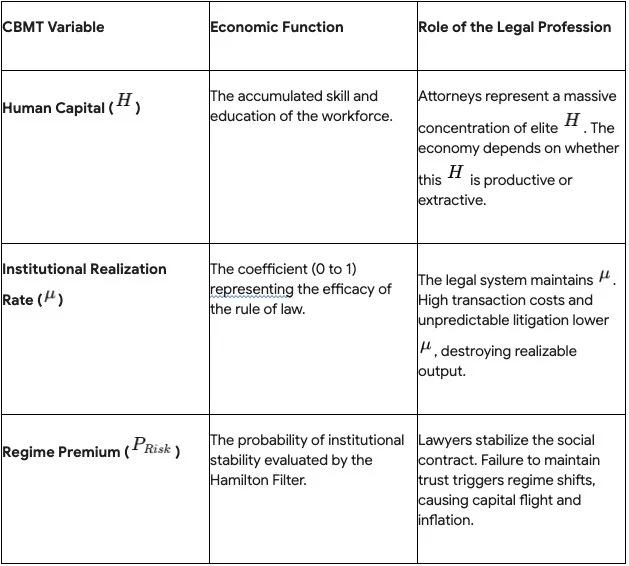
Within this precise macroeconomic equation, attorneys represent a highly concentrated, elite pool of Human Capital ($H$). Gary Becker’s micro-foundations of human capital assert that labor is not a fungible commodity but an asset accumulated through intense investment of time and resources. The American legal profession absorbs a massive share of the nation's top intellectual talent. The central macroeconomic question is whether this specific subset of $H$ is deployed to increase the overall efficiency and output of the economy ($A$ and $Y$), or whether the profession's operational model acts as a frictional force that diminishes output while extracting rents from other productive sectors.
The Institutional Realization Rate and the Hobbesian Trap
The theoretical capacity of an economy ($Y$) remains a purely mathematical abstraction if the fruits of labor cannot be legally secured. CBMT incorporates the institutional frameworks pioneered by Douglass North to account for the frictional costs of trust, order, and contract enforcement. In a theoretical Hobbesian "state of nature," characterized by systemic violence, expropriation, and an absence of property rights, the economy faces infinite transaction costs. In such a regime, money cannot exist because the discount rate applied to future impact is effectively infinite; rational agents will not trade present goods for future promises if the future guarantees expropriation.
To avert this Hobbesian trap, the state (the "Leviathan") imposes a legal order and a social contract, which is administered and maintained by the legal profession. CBMT formalizes this critical legal constraint through the Institutional Realization Rate ($\mu$), a coefficient ranging between 0 and 1 that quantifies the quality of a society's legal infrastructure, the predictability of contract enforcement, and the rule of law.
$$Y_{realizable} = \mu \times Y_{MRW}$$
In this formulation, $Y_{realizable}$ is the actual, tangible economic impact generated by the society, while $Y_{MRW}$ is the maximum theoretical output predicted by the Augmented Solow-Swan model. In a highly functional, high-trust society with an efficient legal system, $\mu$ approaches 1, meaning theoretical capacity is fully realized and the currency remains strong. Conversely, in a system paralyzed by systemic corruption, exorbitant litigation costs, or unpredictable judicial outcomes, $\mu$ degrades toward 0. Even a nation with vast physical resources ($K$) and labor ($L$) will suffer currency collapse and economic stagnation if its Institutional Realization Rate fails. Attorneys, acting as the primary architects and operators of the justice system, are the direct custodians of the $\mu$ variable. Their professional methodologies dictate whether $\mu$ operates near its optimum or serves as a severe discount on national productivity.
Signaling Theory and Regime-Switching Risk Models
CBMT further integrates Amotz Zahavi’s Handicap Principle and Michael Spence's signaling theory to explain how market participants identify and price high-capacity agents within complex systems. The massive expenditures associated with elite legal services often act as costly signals, proving surplus capacity and separating high-impact corporate actors from low-capacity ones. Furthermore, the pricing of money and the valuation of the economy are heavily dependent on regime-switching models, such as the Hamilton Filter, which constantly estimate the probability of institutional stability versus collapse. If the legal system becomes so inefficient that the Hamilton Filter detects a shift toward a regime of institutional failure, the discount rate spikes, investment capital flees, and the fundamental value of the economy degrades.
The Macroeconomic Baseline of the United States Legal System
The United States legal profession influences the broader economy through two divergent and conflicting channels. The first channel is the foundational enhancement of the Institutional Realization Rate ($\mu$) via the maintenance of the rule of law. The second channel is the degradation of economic capacity through widespread rent-seeking, massive deadweight losses, and the artificial inflation of transaction costs. To understand the profession's total macroeconomic footprint, both channels must be exhaustively analyzed using recent empirical data.
The Value of the Rule of Law and Direct GDP Contributions
The legal services sector is a colossal component of both global and domestic economic output. According to the 2024 Impact Report published by the International Bar Association (IBA), the legal profession directly contributes an astonishing \$1.6 trillion to the global economy annually.[4] This figure accounts for approximately 1.7 percent of the global Gross Domestic Product (GDP).[4] The global impact is driven by a workforce of more than 20 million lawyers, paralegals, and support staff, supported by an additional 14 million workers in the supplier ecosystem.[4] The \$1.6 trillion total is comprised of \$787 billion in direct legal service revenues, \$191 billion in tax contributions, and \$637 billion in ecosystem effects generated by supply-side services.[4] North America and Europe absolutely dominate this landscape, accounting for 80 percent of the global legal services market.[4]
Focusing specifically on the domestic front, data from the U.S. Bureau of Economic Analysis reveals that the legal services sector directly contributed \$387.7 billion to the United States GDP in 2024, reflecting a consistent upward trajectory from \$359 billion in 2023 and \$348 billion in 2022.[5] When the legal profession functions optimally, it unlocks immense, quantifiable socio-economic value that extends far beyond direct revenue generation. The IBA Impact Report utilizes big data analysis identifying over 24,000 potential correlations to demonstrate that countries firmly upholding the rule of law experience significantly greater socio-economic benefits than those that restrict legal rights.[4]
Specific macroeconomic benefits derived from a robust, independent legal system include:
- Governmental Accountability and Institutional Trust: Countries with the best access to justice experience 25 percent fewer cases of governmental overreach.[4] Strong independent legal professions hold governments to account, which stabilizes the Hamilton Filter regime probabilities and attracts foreign direct investment.[6, 4]
- Innovation and Capital Allocation: Innovation levels are demonstrably higher in countries ranking in the top quartile for the rule of law. The IBA estimates that this robust legal infrastructure could generate an additional \$83 billion in research and development investment globally by securing intellectual property and enforcing complex contractual joint ventures.[4]
- Socio-Economic Equality and Human Capital: Increasing legal aid to match the standards of the top quartile of countries could reduce global inequality by 5 percent.[4] Furthermore, a robust rule of law is associated with profound human capital ($H$) accumulation metrics, including 30 percent more girls completing secondary education, higher overall life expectancies, and 34 million fewer youths disengaged from education or employment.[4]
- Environmental and Labor Market Stability: Strong legal systems correlate with 53 percent less pollution and greater protection for minority communities.[4] Additionally, improving the effectiveness of civil justice systems could reduce informal, untaxed employment by \$34 million globally.[4]
By establishing a predictable environment where property rights are secure and contracts are impartially enforced, the legal profession allows market participants to confidently project value into the future. This predictability lowers the discount rate, drives the accumulation of physical capital ($K$), and fosters technological efficiency ($A$). As cross-national empirical studies consistently demonstrate, robust property rights protection and checks on government power are the most vital institutional prerequisites for long-run economic performance.[7, 8, 9]
The Frictional Drag: Rent-Seeking and the Misallocation of Talent
Despite the undeniable foundational benefits of the rule of law, the operational reality of the United States legal system introduces severe inefficiencies that act as a massive drag on economic capacity. The core theoretical explanation for this phenomenon lies in occupational choice and the economics of rent-seeking.
In a seminal 1991 paper published in the Quarterly Journal of Economics, economists Kevin Murphy, Andrei Shleifer, and Robert Vishny explored the macroeconomic implications of talent allocation.[10] The authors posited that individuals choose occupations that offer the highest returns on their abilities. When the most talented individuals in a society (the highest-tier $H$) direct their efforts toward entrepreneurship and technological innovation, they expand the production frontier, innovate, and foster aggregate economic growth.[10] However, when institutions allow for highly lucrative, zero-sum wealth redistribution, this same elite talent flows into rent-seeking professions—specifically, certain forms of law and speculative finance.[10]
Rent-seeking activities do not create new wealth; they merely redistribute existing wealth while consuming vast amounts of human and physical capital in the process.[10] Murphy, Shleifer, and Vishny's empirical cross-national evidence demonstrated a stark macroeconomic reality: countries with a higher proportion of college students majoring in engineering experience significantly faster economic growth, whereas countries with a higher proportion of students concentrating in law experience measurably slower growth.[10, 11]
This dynamic is further elucidated by Stephen Magee's theory of the "Invisible Foot," which argues that an overabundance of lawyers acts as a negative externality, imposing direct and indirect transaction costs, delays, and bottlenecks on property rights exchanges and economic undertakings.[12] While a certain baseline number of lawyers is essential to establish the rule of law, the relationship between lawyer density and economic welfare is subject to severe diminishing returns.[12] Beyond a specific equilibrium point, the legal profession transitions from an enabler of capacity to a bureaucratic tax on productive activities.[12, 13] In the context of CBMT, this rent-seeking behavior constitutes a systemic attack on the Institutional Realization Rate ($\mu$).
The Quantitative Burden of the United States Tort System
The theoretical critiques of legal rent-seeking are overwhelmingly substantiated by contemporary empirical data regarding the U.S. litigation landscape. The direct economic costs associated with the American tort system represent one of the most significant deadweight losses in the modern global economy.
According to a comprehensive 2024 empirical analysis produced by The Brattle Group and published by the U.S. Chamber of Commerce Institute for Legal Reform (ILR), the total costs and compensation paid into the U.S. tort system reached an unprecedented \$529 billion in 2022.[14, 15] This staggering figure equates to 2.1 percent of the entire national GDP. To contextualize this burden, the economic weight of the tort system amounts to a hidden "tort tax" of \$4,207 for every single American household.[14, 16] In the most severely impacted jurisdictions, often termed "Judicial Hellholes" due to unpredictable jackpot verdicts and the prevalence of junk science, the per-household cost is even higher, reaching \$5,429 in California and over \$8,000 in Delaware.[14, 17, 18]
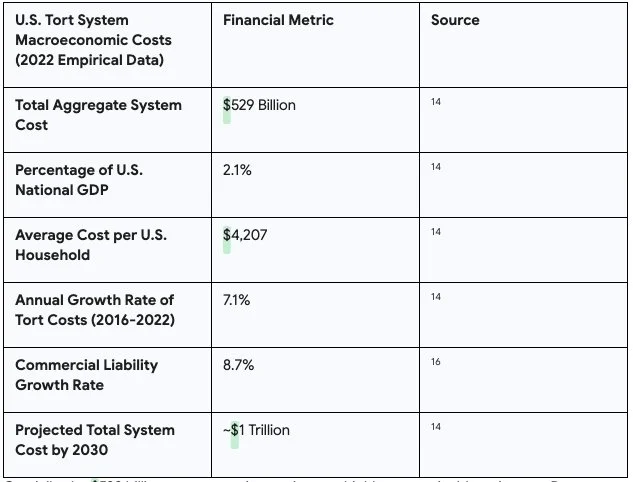
Crucially, the \$529 billion tort system is growing at a highly unsustainable trajectory. Between 2016 and 2022, national tort costs increased at an average annual rate of 7.1 percent, vastly outpacing both average annual economic inflation (3.4 percent) and average annual GDP growth (5.4 percent) over the same period.[15] Costs associated specifically with commercial liability are expanding even faster, at an alarming 8.7 percent annually.[16] If this trajectory remains unaltered, the direct costs of the U.S. lawsuit system will approach \$1 trillion by 2030.[14, 19]
The inefficiency of this system is profound. Research indicates that the tort system is highly ineffective at delivering actual relief to injured parties; traditionally, only 53 cents of every dollar paid into the tort system actually reaches the claimants, with the remaining 47 percent absorbed by the frictional costs of litigation, administrative overhead, and attorneys' fees.[20] The American Tort Reform Foundation estimates that this \$367.8 billion to \$529 billion annual lawsuit epidemic actively eliminates 4.8 million jobs across the U.S. economy by diverting capital away from productive expansion.[18]
Several specific procedural mechanisms severely exacerbate this macroeconomic drain:
- Substandard Patents and Patent Trolls: Non-practicing entities, commonly known as patent trolls, exploit the legal system to extract settlements from productive technology firms and startups.[21, 22] Economic research indicates that granting substandard patents imposes a deadweight loss of \$21 billion per year by deterring valid scientific research.[23] When combined with an additional \$4.5 billion in direct litigation and administrative costs, the total deadweight loss created by this specific sector of the patent system exceeds \$25.5 billion annually.[23]
- Class Action Distribution Inefficiencies: Between 2022 and 2024, class action settlements in the United States reached historic highs, totaling \$159.4 billion.[24] The top ten mega-settlements alone accounted for over 80 percent of this total value, representing an enormous wealth transfer.[24] However, the actual economic relief provided to the public is minimal; the median consumer recovery in these actions remains under $35 per person.[24] This highlights massive distribution inefficiencies and suggests a winner-take-all dynamic that primarily enriches the elite law firms possessing the capital to finance complex, multi-district litigation.[24]
- Social Inflation and Third-Party Litigation Funding: The proliferation of Third-Party Litigation Funding (TPLF)—where outside investors finance lawsuits in exchange for a percentage of the proceeds—has transformed litigation into a commoditized asset class.[16, 25] This financialization of justice, coupled with aggressive lawyer advertising, has driven a phenomenon known as "social inflation," where insured liability claims increase at a rate completely detached from underlying economic factors.[25] A recent report by the Swiss Re Institute revealed that social inflation increased liability claims in the U.S. by 57 percent over the past decade, reaching an annual growth peak of 7 percent in 2023.[25] This environment of heightened uncertainty reduces insurance capacity, raises premiums for consumers, and forces corporations into defensive postures that stifle capital investment.[25, 26]
In the strict terminology of Capacity-Based Monetary Theory, these massive frictional elements represent a catastrophic degradation of the Institutional Realization Rate ($\mu$). When an economy is burdened by a tort tax that consumes 2.1 percent of its GDP and grows exponentially faster than its baseline production function, the society is effectively incinerating its physical capital ($K$) and misallocating its most valuable human capital ($H$) to sustain a parasitic legal apparatus. This systemic friction directly diminishes the Expected Future Impact that underwrites the value of the U.S. dollar, driving structural economic inflation and compromising the long-term competitiveness of the nation's markets.
Law Firm Economics, Realization Rates, and the Billable Hour Trap
The macroeconomic inefficiencies of the legal system are deeply rooted in the microeconomic incentive structures of traditional law firms. Despite the broader economic uncertainty facing their corporate clients, elite law firms have experienced a period of unprecedented financial prosperity. The 2025 Report on the State of the US Legal Market, published jointly by the Thomson Reuters Institute and Georgetown Law, describes a "tectonic shift" in the industry.[27] Since 2019, profits per lawyer at Am Law 100 firms have increased by nearly 54 percent.[27]
This profitability is largely driven by aggressive, compounding increases in hourly billing rates. According to a Wells Fargo Legal Specialty Group survey, average standard billing rates grew by a staggering 9.6 percent in 2025, following a 9.1 percent increase in 2024.[28] Among the elite Am Law 50 firms, rate growth exceeded 10.4 percent in a single year.[28] Concurrently, law firms are heavily increasing their overhead spending on technology, business development, and generative artificial intelligence, treating these as strategic investments to capture larger market shares of counter-cyclical litigation demand.[29]
However, beneath this veneer of record-breaking profitability lies a fundamental structural flaw: the growing disconnect between the time billed by attorneys and the actual economic value perceived and paid for by the client. This disconnect is measured by the "realization rate"—the percentage of billed time that is successfully collected as actual cash revenue.[30] While billing rates have soared, realization rates have steadily declined. Industry data indicates that the average law firm now achieves an overall realization rate of merely 84 to 88 percent.[31, 32] In certain highly adversarial practice areas, such as complex litigation, realization rates routinely plummet to 82 percent or lower, meaning firms are effectively writing off nearly 20 percent of their labor as uncollectible friction.[31, 32]
This dynamic reveals the inherent macroeconomic fallacy of the traditional billable hour model. The billable hour financially rewards attorneys for the expenditure of time rather than the efficiency of the outcome.[33] It incentivizes prolonged discovery, procedural gamesmanship, and the generation of maximal complexity, directly conflicting with the client's desire for swift, predictable, and inexpensive resolution.[33, 34] As corporate clients become more sophisticated and heavily scrutinize invoices, they are actively pushing back against this model, leading to severe year-end collections disputes and the erosion of long-term attorney-client trust.[30, 35] The traditional law firm operational model has prioritized immediate revenue metrics over the sustainable preservation of the client's economic resources, further degrading the broader macroeconomic capacity of the nation.
Pivoting the Profession: From Reactive Friction to Proactive Value Creation
The empirical data paints an unequivocal picture: while the existence of a baseline legal system is necessary for market function, the current reactive execution of legal services in the United States acts as a severe macroeconomic constraint. To fundamentally alter the trajectory of the profession and generate a positive impact on the economy, attorneys must execute a systemic pivot away from the reactive model of post-hoc dispute resolution and embrace forward-looking paradigms of dispute prevention and structural value creation. This necessary transformation is deeply grounded in the established jurisprudential movements of Preventive Law and Proactive Law.
The Paradox of Reactive Legal Service
The traditional paradigm of the American legal profession is overwhelmingly reactive. Attorneys are typically engaged ex-post—summoned only after a contract has been breached, a regulatory violation has occurred, or a catastrophic injury has manifested. Operating from this adversarial posture, the primary objective is dispute resolution. However, as established by the principles of transaction cost economics, post-hoc litigation is inherently inefficient. It demands massive expenditures on retrospective discovery, navigating complex procedural hurdles, and engaging in zero-sum brinkmanship that frequently destroys the underlying commercial relationships.[34, 36]
Professor Richard Susskind famously identified this dynamic as the "paradox of reactive legal service".[37] The legal system waits for economic damage to occur before deploying its most sophisticated human capital ($H$) to mitigate the fallout. In a modern, complex, fast-paced economy, treating legal expertise solely as an emergency response mechanism is a profound misallocation of resources that virtually guarantees high deadweight losses and suboptimal macroeconomic outcomes.[36, 37]
Preventive Law: Securing the Institutional Realization Rate
The concept of Preventive Law was pioneered in the 1950s by Professor Louis M. Brown, who recognized that the traditional adversarial approach was fundamentally inadequate for optimizing client outcomes.[38, 39, 40] Brown posited a powerful medical analogy: just as preventive medicine utilizes vaccinations and routine checkups to avoid disease, Preventive Law utilizes strategic planning to "vaccinate" clients against the disease of legal disputes and costly litigation.[38, 41, 42]
Preventive Law defines that branch of legal practice concerned with minimizing the risk of legal trouble and maximizing legal rights at the precise moment when transactional facts are first being considered and established.[39] Brown advocated that lawyers should operate as strategic planners rather than mere combatants, conducting routine "legal checkups" to diagnose corporate vulnerabilities, ensure regulatory compliance, and implement protective procedures long before an acute crisis emerges.[39]
The core principles of Preventive Law revolve around risk anticipation and structural clarity. Attorneys employing this approach meticulously draft and negotiate contracts to eliminate ambiguities that frequently serve as the genesis of future disputes.[39] By addressing potential vulnerabilities early, standardizing critical contractual terms, and establishing shared understandings between parties, Preventive Law drastically reduces the probability of litigation.[37, 39]
From the perspective of Capacity-Based Monetary Theory, Preventive Law serves as the ultimate insurance mechanism for the Institutional Realization Rate ($\mu$). By resolving friction ex-ante, preventive lawyering ensures that the theoretical economic capacity of a firm ($Y_{MRW}$) is not subsequently cannibalized by the deadweight losses of the courtroom. It preserves the client's physical and financial capital ($K$), allowing those resources to be reinvested into productive operations rather than squandered on legal defense.
Proactive Law: Expanding the Macroeconomic Production Frontier
While Preventive Law focuses primarily on risk mitigation and dispute avoidance, the subsequent movement of Proactive Law, spearheaded in the late 1990s by Finnish scholar Helena Haapio, introduces a critical promotive dimension to the practice.[36, 38] Proactive Law expands the paradigm by perceiving the law not merely as a boundary of compliance or a shield against liability, but as an active, strategic instrument used to create value, strengthen collaborative relationships, and generate sustainable competitive advantage.[36, 38, 41]
Proactive Law requires a fundamental shift in the attorney's mindset, demanding that legal professionals step outside the isolated silos of black-letter doctrine and actively integrate their expertise with business strategy, project management, and human-centric design.[41, 43] Key components of the proactive approach include:
- The Creation of "Future Facts": Rather than litigating the immutable facts of past events, proactive lawyers use their legal knowledge to consciously design "future facts," structuring transactions, joint ventures, and organizational protocols that actively facilitate successful business performance.[41, 42]
- Relationship Preservation and Systems Intelligence: Proactive Law recognizes that aggressive, adversarial contracting often poisons the well of future cooperation. Proactive attorneys prioritize collaborative negotiations, treating contracts not as static weapons to be deployed in court, but as dynamic, living management tools that guide supply chain success and preserve vital commercial relationships.[42, 44, 45]
- Legal Design and Technological Integration: Recognizing that legal opacity creates systemic risk, proactive practitioners embrace legal design—utilizing visual elements, plain-language summaries, and clear architectures to ensure that non-lawyers fully understand their contractual obligations.[39] Furthermore, proactive law advocates for the implementation of "preventive legal technology," leveraging artificial intelligence to continuously audit contracts, flag compliance risks, and streamline operations, thereby making elite legal guidance highly accessible and frictionless.[39]
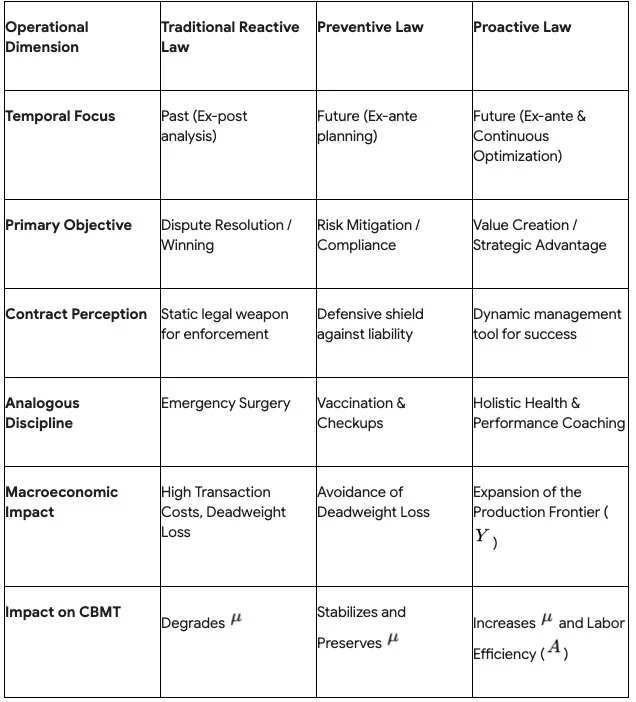
If the United States legal profession systematically pivots from the reactive paradigm to the preventive and proactive paradigms, the resulting macroeconomic dividend would be transformational. Eliminating even a fraction of the \$529 billion annual tort burden and redirecting the profession's elite human capital ($H$) toward value-generative corporate structuring would materially increase the Expected Future Impact of the national economy. This pivot would lower transaction costs, accelerate the velocity of commerce, and dramatically strengthen the underlying productive capacity that stabilizes the monetary system.
Codifying the Macroeconomic Mandate: Reforming the ABA Model Rules of Professional Conduct
To achieve a profession-wide pivot from reactive friction to proactive value creation, the theoretical concepts of Preventive and Proactive Law must be translated into enforceable, ethical mandates. The underlying incentive structures and professional obligations of American attorneys require a systemic overhaul. In the United States, the blueprint for legal ethics is the American Bar Association (ABA) Model Rules of Professional Conduct, which, when adopted by state supreme courts, serve as the binding regulatory framework for the profession.[46, 47]
Currently, the ABA Model Rules fail to address the macroeconomic impact of the legal profession. They are structurally focused on the micro-dynamics of the attorney-client relationship, the boundaries of zealous adversarial advocacy, and the mechanics of post-hoc dispute management.[47] They lack an explicit mandate requiring attorneys to prioritize economic efficiency or engage in proactive value creation.
The Limitations of the Current Regulatory Framework
An analysis of the existing Model Rules reveals a framework that permits, but does not ethically require, proactive and preventive lawyering:
- The Preamble: The current Preamble characterizes the lawyer as a "representative of clients, an officer of the legal system and a public citizen having special responsibility for the quality of justice".[48, 49] It notes that lawyers "play a vital role in the preservation of society".[48] However, this vital role is traditionally interpreted through the lens of civil rights, equal access to justice (as encouraged in Rule 6.1 regarding Pro Bono service [50]), and procedural fairness. It entirely ignores the lawyer's immense responsibility for the preservation of society's economic capacity.
- Rule 1.5 (Fees): This rule mandates that a lawyer shall not make an agreement for, charge, or collect an "unreasonable fee," listing several factors to determine reasonableness, such as the time and labor required and the novelty of the question.[51] Crucially, it does not explicitly penalize the intentional prolongation of disputes inherent in the billable hour model, nor does it mandate that fees must align with the actual economic value preserved or created for the client.[33]
- Rule 2.1 (Advisor): This rule explicitly permits a lawyer to exercise independent professional judgment and render candid advice. It states that a lawyer "may refer not only to law but to other considerations such as moral, economic, social and political factors, that may be relevant to the client's situation".[52, 53] While this permissive rule allows an attorney to act as a holistic counselor, it does not create an affirmative, disciplinary duty to proactively structure affairs to prevent foreseeable economic disputes.
- Rule 3.2 (Expediting Litigation): This rule states that a lawyer "shall make reasonable efforts to expedite litigation consistent with the interests of the client".[54] While aimed at reducing judicial delays, this rule is inherently reactive; it only applies after the catastrophic failure of litigation has already commenced. It does nothing to obligate the attorney to utilize legal design to prevent the litigation from occurring in the first place.
To fundamentally alter the economic output of the legal profession, the Model Rules must be modernized to incorporate the macroeconomic realities illuminated by Capacity-Based Monetary Theory. The ethical framework must explicitly recognize that unnecessary transaction costs, unchecked rent-seeking, and the deliberate escalation of adversarial friction constitute a severe breach of the lawyer's duty to the preservation of society.
Proposed Codification: Modifying the Preamble
The Preamble establishes the philosophical orientation and fundamental responsibilities of the profession. To integrate the macroeconomic mandate, the Preamble must be updated to reflect that economic efficiency is a core component of the "quality of justice." A proposed addition to Preamble Paragraph (or the creation of a new Paragraph ) should read:
Proposed Addition to the ABA Model Rules Preamble: "As public citizens and officers of the legal system, lawyers serve as the vital stewards of the institutional and contractual frameworks that enable economic stability, innovation, and societal prosperity. Lawyers must recognize that unnecessary legal friction, rent-seeking behaviors, and the deliberate escalation of adversarial disputes impose severe deadweight losses on the economy, thereby restricting the productive capacity of society as a whole. Therefore, in addition to their representational duties, lawyers possess a systemic, ethical responsibility to foster macroeconomic efficiency. This is achieved by prioritizing the prevention of disputes, utilizing clear and transparent legal design to ensure mutual understanding, and employing the law proactively to create sustainable value and reduce societal transaction costs."
Proposed Codification: A New Section—Rule 2.5 (Duty of Preventive and Proactive Counsel)
To successfully operationalize the doctrines of Preventive and Proactive Law, a new, mandatory rule must be introduced into the "Counselor" section of the Model Rules (falling sequentially after Rule 2.4, Lawyer Serving as Third-Party Neutral).[51] This new rule will transition the concepts of risk mitigation and value creation from best practices into enforceable standards of professional conduct.
Proposed Rule 2.5: Duty of Preventive and Proactive Counsel
(a) In representing a client in transactional, organizational, or advisory matters, a lawyer shall act competently and diligently to anticipate reasonably foreseeable legal and economic risks, and shall take proactive measures in the structuring of the client's affairs to prevent future disputes.
(b) A lawyer shall endeavor to draft legal instruments, agreements, and communications utilizing clear, unambiguous, and accessible language. The lawyer must take reasonable steps to ensure mutual comprehension among all executing parties to minimize the risk of subsequent litigation stemming from opacity or misunderstanding.
(c) When advising a client on a contemplated course of action or the initiation of adversarial proceedings, a lawyer shall explicitly consider the transaction costs, deadweight economic losses, and potential deterioration of commercial or personal relationships that may result from litigation. The lawyer shall affirmatively counsel the client regarding preventive alternatives, including collaborative structuring, alternative dispute resolution, and proactive risk avoidance mechanisms.
(d) A lawyer shall not deliberately exploit ambiguities, introduce unnecessary complexity, or engage in procedural gamesmanship during the formulation of legal agreements with the intent of generating future billable litigation or extracting economically inefficient rents.
Official Commentary on Proposed Rule 2.5
To guide disciplinary agencies and practitioners in the interpretation of this new mandate, the following official comments should be appended to Rule 2.5:
- ** The Promotive Dimension:** This Rule explicitly recognizes that the practice of law is not merely the reactive resolution of disputes, but the proactive structuring of relationships to create and preserve value. A lawyer serves the client and society best by acting as a strategic planner who immunizes the client against legal liabilities and friction before they materialize.
- ** Economic Efficiency and Transaction Costs:** Litigation and adversarial dispute resolution impose heavy, often unrecoverable transaction costs that deplete the economic resources of the client and the broader macroeconomic system. By prioritizing Preventive Law, lawyers fulfill their duty to preserve the economic capacity of society. Paragraph (c) requires the lawyer to communicate the true, holistic economic costs of adversarial postures, empowering the client to make rational, cost-effective decisions.
- ** Accessible Legal Design:** Paragraph (b) addresses a root cause of contractual failure: systemic opacity and unnecessary complexity. Lawyers should utilize modern legal design, standardized clauses, plain-language principles, and appropriate technological tools to ensure that legal documents are easily understood by the individuals and businesses governed by them. Obfuscation designed to secure a future adversarial advantage, or to ensure future reliance on legal counsel for basic interpretation, violates the spirit of this Rule.
- ** Relationship to Zealous Advocacy:** The duty to proactively prevent disputes does not conflict with a lawyer's duty of zealous advocacy under the adversary system. Rather, it acknowledges that the most effective and economically efficient advocacy routinely occurs ex-ante. Securing a client's interests through robust, unassailable, and transparent structuring renders subsequent, costly litigation entirely unnecessary.
Ancillary Reform: Realigning Rule 1.5 (Fees) to Support Proactive Value
Finally, to guarantee the success of the transition to Proactive Law, the fundamental economic incentives of the profession must be realigned. Rule 1.5, which governs fees, must be amended to explicitly encourage Alternative Fee Arrangements (AFAs) that reward value creation and efficiency rather than mere time expenditure.
When lawyers are compensated purely by the hour, the financial incentive structure rewards inefficiency. The system naturally maximizes the time spent on a matter, which inherently drives up transaction costs, lowers realization rates, and depresses the Institutional Realization Rate ($\mu$) of the broader economy.[32, 33] As the legal market rapidly integrates Generative AI, which can drastically reduce the time required to complete complex legal tasks, continuing to rely on an inputs-driven, time-based billing model is economically irrational.[33]
To rectify this, a specific comment should be added to Rule 1.5 officially endorsing value-based pricing:
"A fee structure that relies exclusively on the expenditure of time may fail to align the lawyer's financial incentives with the client's core objective of swift, efficient, and permanent resolution. Lawyers are strongly encouraged to utilize flat fees, phase-based billing, subscription models, and value-based pricing structures. These alternative arrangements appropriately reward the prompt prevention of disputes and the efficient, proactive structuring of legal affairs, particularly when the lawyer leverages technological advancements to eliminate transactional friction."
Conclusion
Viewed comprehensively through the rigorous macroeconomic lens of Capacity-Based Monetary Theory, the ultimate role of the United States legal profession is brought into sharp, empirical focus. Money is a derivative of future economic impact, and that future impact is entirely dependent upon the stability, efficiency, and clarity of the institutional frameworks that govern society. Attorneys are the primary architects and operators of this vital framework.
Currently, the United States economy suffers from an artificially suppressed Institutional Realization Rate ($\mu$). The expenditure of \$529 billion annually on an inefficient tort system, compounded by the prevalence of patent trolls, class action distribution failures, and rent-seeking behavior, diverts elite human capital away from technological innovation. This dynamic imposes a severe deadweight loss on national output, operating as a massive, hidden tax on American productivity.
However, the legal profession possesses the capacity to engineer its own reform. By systematically adopting the proven frameworks of Preventive and Proactive Law, attorneys can pivot from serving as agents of economic friction to acting as powerful engines of value creation. By anticipating risks, drafting highly accessible and transparent agreements, and prioritizing the preservation of long-term commercial relationships, the legal profession can drastically reduce transaction costs and expand the nation's production frontier. Codifying these proactive duties into the ABA Model Rules of Professional Conduct—specifically through the introduction of Rule 2.5, modifications to the Preamble, and the endorsement of value-based billing—will permanently align the ethical obligations of attorneys with the macroeconomic survival of the state. Ultimately, a legal profession strictly dedicated to the proactive prevention of disputes is the strongest possible underwriter of a nation's economic capacity.
-
US confidence in judicial system dropped to record low this year, data shows - The Guardian, accessed April 1, 2026, https://www.theguardian.com/us-news/2024/dec/17/judicial-system-courts-confidence-data
Americans' confidence in judicial system drops to record low | PBS News, accessed April 1, 2026, https://www.pbs.org/newshour/politics/americans-confidence-in-judicial-system-drops-to-record-low
Americans Pass Judgment on Their Courts - Gallup News, accessed April 1, 2026, https://news.gallup.com/poll/653897/americans-pass-judgment-courts.aspx
Capacity-Based Monetary Theory
Economic impact of the legal profession valued at $1.6tn states new IBA study, accessed April 1, 2026, https://www.ibanet.org/Economic-impact-of-the-legal-profession-valued-at-$1.6tn-states-new-IBA-study
Gross Domestic Product: Legal Services (5411) in the United States (USLEGALNGSP) | FRED | St. Louis Fed, accessed April 1, 2026, https://fred.stlouisfed.org/series/USLEGALNGSP
The Rule of Law and Economic Growth: Where Are We? By: Stephan Haggard Graduate School of International Relations and Pacifi, accessed April 1, 2026, https://law.utexas.edu/conferences/measuring/The%20Papers/ruleoflawconference.Haggard&Tiede.Rule%20of%20Law.March13.2010.pdf
Economic Consequences of Legal Framework | Statute Law Review - Oxford Academic, accessed April 1, 2026, https://academic.oup.com/slr/article/45/2/hmae024/7686329
Why the rule of law is the key to prosperity: Lessons from thirty years of data, accessed April 1, 2026, https://www.atlanticcouncil.org/in-depth-research-reports/issue-brief/why-the-rule-of-law-is-the-key-to-prosperity-lessons-from-thirty-years-of-data/
Working Paper No. 3530 - NBER, accessed April 1, 2026, https://www.nber.org/system/files/working_papers/w3530/w3530.pdf
Lawyers and Economic Growth - economics, psychology, policy, accessed April 1, 2026, https://economicspsychologypolicy.blogspot.com/2011/12/lawyers-and-economic-growth.html
Do Lawyers Inhibit Economic Growth? New Evidence from the 50 U.S. States, accessed April 1, 2026, https://digitalcommons.odu.edu/cgi/viewcontent.cgi?article=1071&context=economics_facpubs
Do Lawyers Impair Economic Growth? | Law & Social Inquiry | Cambridge Core, accessed April 1, 2026, https://www.cambridge.org/core/journals/law-and-social-inquiry/article/do-lawyers-impair-economic-growth/AED8D3146D2577613D8B1AEFB964DE72
Tort Costs in America: An Empirical Analysis of Costs and Compensation of the U.S. Tort System - Third Edition - ILR - U.S. Chamber Institute for Legal Reform, accessed April 1, 2026, https://instituteforlegalreform.com/research/tort-costs-in-america-an-empirical-analysis-of-costs-and-compensation-in-the-u-s-tort-system-third-edition/
Tort Costs in America - Institute for Legal Reform, accessed April 1, 2026, https://instituteforlegalreform.com/wp-content/uploads/2024/11/2024_ILR_USTorts-CostStudy-FINAL.pdf
U.S. Households Pay the Price of Rising Tort Lawsuit Costs | U.S. Chamber of Commerce, accessed April 1, 2026, https://www.uschamber.com/lawsuits/lawsuit-costs-are-escalating-and-u-s-households-are-paying-the-price
Study says West Virginia's tort costs are down thanks to legal reform, accessed April 1, 2026, https://wvchamber.com/study-says-west-virginias-tort-costs-are-down-thanks-to-legal-reform/
America's $367 Billion Lawsuit Epidemic - American Tort Reform Association, accessed April 1, 2026, https://atra.org/americas-367b-lawsuit-epidemic/
Hidden Costs of Lawsuits on U.S. Households Continue to Grow | U.S. Chamber of Commerce, accessed April 1, 2026, https://www.uschamber.com/lawsuits/hidden-costs-lawsuits-grow
Tort Costs in America: An Empirical Analysis of Costs and Compensation of the U.S. Tort System - ILR - Institute for Legal Reform, accessed April 1, 2026, https://instituteforlegalreform.com/research/tort-costs-in-america-an-empirical-analysis-of-costs-and-compensation-of-the-u-s-tort-system/
Committee on the Judiciary Subcommittee on Courts, Intellectual Property, and the Internet Hearing The Impact of Bad Patents on - Document Repository, accessed April 1, 2026, https://docs.house.gov/meetings/JU/JU03/20170713/106230/HHRG-115-JU03-Wstate-SamuelsJ-20170713.pdf
Patent Trolls: Evidence from Targeted Firms - NBER, accessed April 1, 2026, https://www.nber.org/papers/w20322
Quantifying the Cost of Substandard Patents: Some Preliminary Evidence, accessed April 1, 2026, https://yjolt.org/quantifying-cost-substandard-patents-some-preliminary-evidence
US Legal Settlement Campaigns – 35 Statistics Every Legal Professional Should Know in 2025 - Talli Insights, accessed April 1, 2026, https://blog.talli.ai/settlement-campaigns-statistics/
Litigation costs drive US liability claims by 57% over past decade, reveals Swiss Re Institute, accessed April 1, 2026, https://www.swissre.com/press-release/Litigation-costs-drive-US-liability-claims-by-57-over-past-decade-reveals-Swiss-Re-Institute/0b538159-9648-47da-a152-4550a7640d35
The Economic Effects of the Liability System - Hoover Institution, accessed April 1, 2026, https://www.hoover.org/research/economic-effects-liability-system
Law firms saw surge in demand and profits in 2025, new report says - ABA Journal, accessed April 1, 2026, https://www.abajournal.com/news/article/law-firms-saw-surge-in-demand-and-profits-in-2025-new-report-says
US firms see revenue grow in 2025 driven by rising billing rates and demand – study, accessed April 1, 2026, https://www.globallegalpost.com/news/us-firms-see-revenue-grow-in-2025-driven-by-rising-billing-rates-and-demand-study-1006740245
“2025 State of the US Legal Market” analysis: The cost of chasing opportunity, accessed April 1, 2026, https://www.thomsonreuters.com/en-us/posts/legal/legal-market-report-analysis-opportunity-cost/
Law Firms' Zeal for Realization Undermines Client Relationships - Bloomberg Law News, accessed April 1, 2026, https://news.bloomberglaw.com/legal-exchange-insights-and-commentary/law-firms-zeal-for-realization-undermines-client-relationships
Law Firm Realization Rate Analysis by Practice - LeanLaw - Legal Billing Made Easy, accessed April 1, 2026, https://www.leanlaw.co/blog/a-guide-to-analyzing-your-realization-rate-by-practice-area-to-identify-opportunities-for-improvement/
The Impact of Falling Law Firm Realization Rates - American Bar Association, accessed April 1, 2026, https://www.americanbar.org/groups/litigation/resources/litigation-news/2024/summer/impact-falling-law-firm-realization-rates/
2025 Report on the State of the US Legal Market | Thomson Reuters, accessed April 1, 2026, https://www.thomsonreuters.com/en-us/posts/wp-content/uploads/sites/20/2025/01/State-of-the-US-Legal-Market-Report-2025.pdf
Litigation Cost Survey of Major Companies - United States Courts, accessed April 1, 2026, https://www.uscourts.gov/sites/default/files/litigation_cost_survey_of_major_companies_0.pdf
Real Estate Law Billing Rates Guide 2025 - LeanLaw - Legal Billing Made Easy, accessed April 1, 2026, https://www.leanlaw.co/blog/real-estate-law-billing-rates-the-mid-sized-firms-guide-to-competitive-pricing-in-2025/
Proactive International Law, accessed April 1, 2026, https://repository.uclawsf.edu/cgi/viewcontent.cgi?article=4069&context=hastings_law_journal
From Risk Mitigation to Value Creation: Preventive and Proactive Law - Legal Creatives, accessed April 1, 2026, https://www.legalcreatives.com/blog/from-risk-mitigation-to-value-creation-preventive-law-and-proactive-law-differences-and-similarities
Building an Ethical Culture of Legal Knowledge (Chapter 10) - Legal ..., accessed April 1, 2026, https://www.cambridge.org/core/books/legal-knowledge-in-organizations/building-an-ethical-culture-of-legal-knowledge/E9E4144D9A89178EE7E0F06D58CA0E31
Full article: Preventive legal technology for micro-entities: improving access to justice in commercial contract analysis - Taylor & Francis, accessed April 1, 2026, https://www.tandfonline.com/doi/full/10.1080/13600869.2025.2602106
Working Paper - Semantic Scholar, accessed April 1, 2026, https://pdfs.semanticscholar.org/cdff/122db56fad9081dc9249d91b2882e003c272.pdf
Introduction to Proactive Law: A Business Lawyer's View, accessed April 1, 2026, https://scandinavianlaw.se/pdf/49-2.pdf
Resilience in Contract Law a Proactive/Preventive Law approach - Resilienz, accessed April 1, 2026, https://resilienz.hypotheses.org/287
Building Long-Term Strategic Value by Addressing Barriers to Future-Oriented Legal Thinking - DigitalCommons@Fairfield, accessed April 1, 2026, https://digitalcommons.fairfield.edu/cgi/viewcontent.cgi?article=1225&context=nealsb
Business Success and Problem Prevention through Proactive Contracting - Scandinavian Studies in Law, accessed April 1, 2026, https://scandinavianlaw.se/pdf/49-9.pdf
Introduction to Proactive Law: A Business Lawyer's View | Request PDF - ResearchGate, accessed April 1, 2026, https://www.researchgate.net/publication/284027387_Introduction_to_Proactive_Law_A_Business_Lawyer's_View
Model Rules of Professional Conduct - American Bar Association, accessed April 1, 2026, https://www.americanbar.org/groups/professional_responsibility/publications/model_rules_of_professional_conduct/
The Access and Justice Imperatives of the Rules of Professional Conduct - Georgetown Law, accessed April 1, 2026, https://www.law.georgetown.edu/legal-ethics-journal/wp-content/uploads/sites/24/2023/03/GT-GJLE220026.pdf
Model Rules of Professional Conduct: Preamble & Scope - American Bar Association, accessed April 1, 2026, https://www.americanbar.org/groups/professional_responsibility/publications/model_rules_of_professional_conduct/model_rules_of_professional_conduct_preamble_scope/
The Rules of Professional Conduct - PA Disciplinary Board, accessed April 1, 2026, https://www.padisciplinaryboard.org/for-attorneys/rules/rule/3/the-rules-of-professional-conduct
Rule 6.1: Voluntary Pro Bono Publico Service - American Bar Association, accessed April 1, 2026, https://www.americanbar.org/groups/professional_responsibility/publications/model_rules_of_professional_conduct/rule_6_1_voluntary_pro_bono_publico_service/
Model Rules of Professional Conduct - Table of Contents - American Bar Association, accessed April 1, 2026, https://www.americanbar.org/groups/professional_responsibility/publications/model_rules_of_professional_conduct/model_rules_of_professional_conduct_table_of_contents/
Rule 2.1: - American Bar Association, accessed April 1, 2026, https://www.americanbar.org/groups/professional_responsibility/policy/ethics_2000_commission/e2k_rule21/
Rule 2.1: Advisor - American Bar Association, accessed April 1, 2026, https://www.americanbar.org/groups/professional_responsibility/publications/model_rules_of_professional_conduct/rule_2_1_advisor/
Rule 3.2: Expediting Litigation - American Bar Association, accessed April 1, 2026, https://www.americanbar.org/groups/professional_responsibility/publications/model_rules_of_professional_conduct/rule_3_2_expediting_litigation/