

Japan's Economic Growth Strategy
Capacity-Based Monetary Theory and the Rebirth of the Japanese Economy: A Blueprint for Reversing Demographic Decline, Stimulating Growth, and Engineering Political Consensus
Introduction: The Macroeconomic Paradigm Shift and the Ontology of the Yen
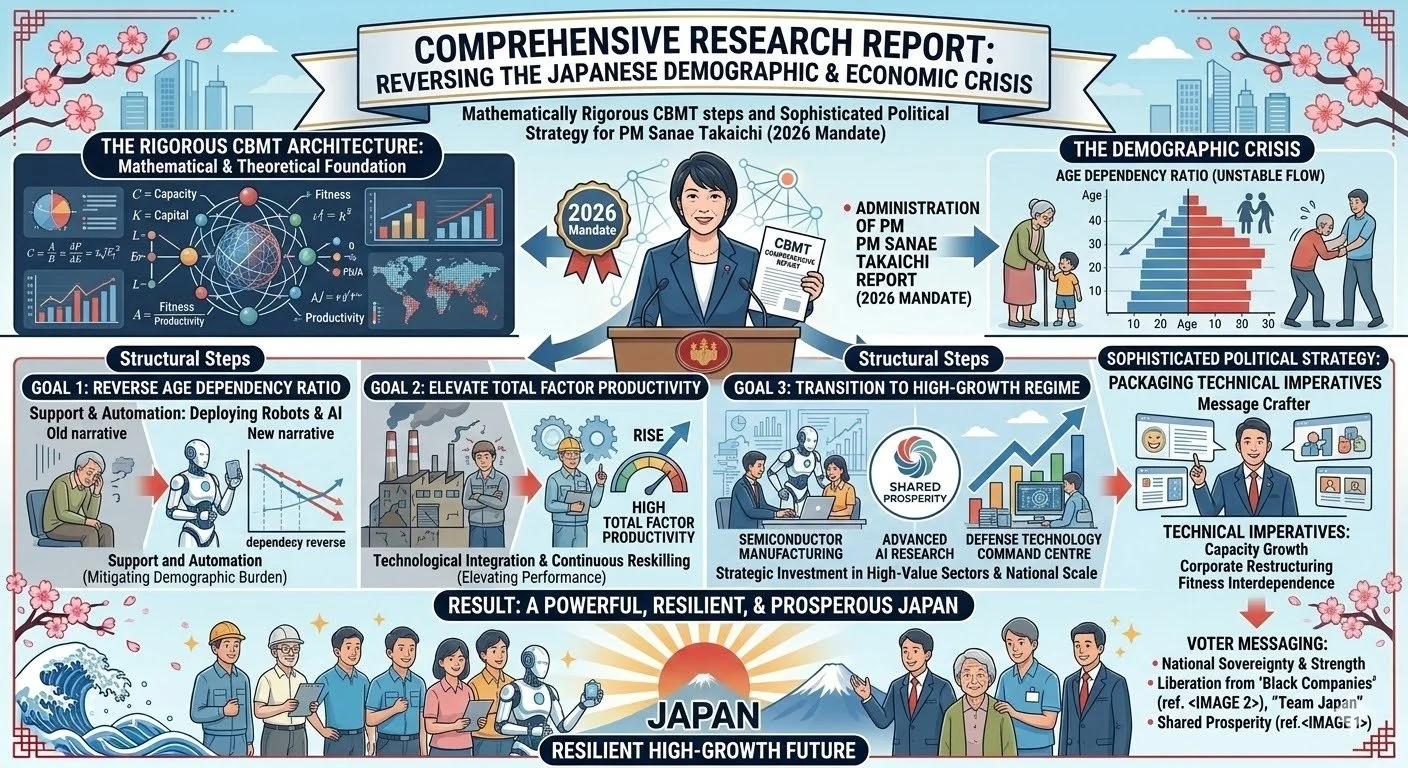
Japan occupies a unique position in the global macroeconomic landscape. For over three decades, the nation has served as the world’s primary laboratory for demographic contraction and economic stagnation. Since the collapse of the asset price bubble in the early 1990s, policymakers have relied heavily on orthodox and experimental macroeconomic interventions to stimulate aggregate demand. The most prominent of these efforts, the "Three Arrows" of Abenomics initiated in 2012, deployed aggressive monetary easing, flexible fiscal stimulus, and structural reforms to break the deflationary spiral. While these measures achieved temporary market stabilization and expanded the monetary base, they fundamentally failed to alter the long-term structural trajectory of the Japanese economy. The Bank of Japan’s ultra-accommodative policies, resulting in a public debt burden exceeding 240% of Gross Domestic Product, have yielded diminishing returns on real output and total factor productivity.
To accurately diagnose Japan's malaise and formulate a viable strategy for economic revival, it is necessary to transcend traditional neoclassical utility theories and adopt a fundamentally different ontological understanding of value. Capacity-Based Monetary Theory (CBMT) provides this rigorous theoretical framework. Conventional economics defines money functionally—as a medium of exchange, a unit of account, and a store of value. However, CBMT argues that these are merely symptoms of "moneyness" rather than descriptions of its underlying asset structure. In the double-entry bookkeeping of a sovereign state, money appears as a liability. A liability cannot exist in a vacuum; it must be balanced by a corresponding asset. CBMT posits that the asset backing the fiat liability of the Japanese yen is not gold, nor the mere authoritative decree of the state, but the Expected Future Impact of Japanese society.
Money, therefore, is a floating-price claim—a call option—on the future productive capacity of an economy. This capacity is a dynamic vector function of three primary variables: the aggregate labor of the population, the efficiency of that labor as amplified by technology and human capital, and the stability of the institutional social contract that allows this labor to project value into the future.
When evaluated through the lens of CBMT, Japan’s economic stagnation is not a failure of monetary supply, but a crisis of underlying collateral. As the nation’s population shrinks and its age dependency ratio accelerates, the absolute quantity of future labor available to redeem these monetary claims steadily degrades. If the money supply remains constant or expands while the capacity to produce impact degrades, the value of the claim structure inherently dilutes, manifesting as either explicit inflation or a prolonged stagnation in purchasing power.
This comprehensive research report applies the rigorous mathematical and theoretical architecture of CBMT to the Japanese demographic and economic crisis. It delineates the specific, structural steps required to reverse the economic consequences of the age dependency ratio, elevate total factor productivity, and transition the nation toward a high-growth regime. Furthermore, it provides a sophisticated political strategy, detailing how the highly technical imperatives of capacity growth, corporate restructuring, and fitness interdependence can be packaged and sold to an electorate that recently delivered a historic mandate to the administration of Prime Minister Sanae Takaichi in 2026.
The Mathematical Architecture of Capacity in a Shrinking Society
To operationalize CBMT for the Japanese economy, the abstract concept of societal impact must be mathematically defined. In economic terms, impact is synonymous with real output ($Y$)—the tangible goods, services, and innovations that a civilization produces. The fundamental premise of the theory is that the "price" of money serves as an index of the economy's production function. To accurately model this collateral, CBMT utilizes the Augmented Solow-Swan Framework, specifically the specification developed by Mankiw, Romer, and Weil (1992).
The rigorous production function for Expected Future Impact is defined as:
$$Y = K^\alpha H^\beta (A L)^{1-\alpha-\beta}$$
Where:
- $Y$ represents total production or "Impact" (the underlying collateral).
- $K$ is the stock of physical capital.
- $H$ is the stock of Human Capital (skills, education, health).
- $L$ is the aggregate labor force.
- $A$ is labor-augmenting technology, or "Efficiency Capacity."
- $\alpha$ and $\beta$ represent the elasticities of output with respect to physical and human capital, respectively.
The Demographic Drag and the Beckerian Revolution
In standard macroeconomic growth models, human capital is often treated merely as a qualitative multiplier embedded within the labor force. The critical intervention of the Mankiw-Romer-Weil specification is that it isolates Human Capital ($H$) as an independent factor of production with its own accumulation and depreciation dynamics. This is vital for Japan. The variable $L$ (aggregate labor) is undergoing a severe structural contraction. A shrinking population acts as a direct reduction in $L$, exerting profound downward pressure on the total output $Y$.
However, the mathematical separation of $H$ provides the precise blueprint for economic reversal. Drawing upon Gary Becker’s "Theory of the Allocation of Time," CBMT establishes that labor is not a fungible, static commodity, but a form of capital accumulated through deliberate investment. A currency backed by a population with exceptionally high levels of advanced education and operational agility represents a claim on a vastly larger pool of potential future impact. Therefore, "demographic dividends" are not purely about biological headcount. A shrinking population can mathematically sustain a strong currency and generate robust economic growth if the accumulation of Human Capital ($H$) and technological efficiency ($A$) significantly outpaces the numerical decline in $L$.
The Institutional Realization Rate ($\theta$) and the Hamilton Filter
Theoretical production capacity is economically meaningless if the societal software cannot secure and realize the fruits of that labor. Thomas Hobbes described the state of nature as a condition of infinite transaction costs. Money, as a claim on the future, cannot exist in a Hobbesian state because the discount rate is effectively infinite; no rational agent will exchange tangible goods today for a token promising goods tomorrow if expropriation is certain.
CBMT formalizes the role of the state and legal frameworks through the Institutional Realization Rate ($\theta$), a coefficient between 0 and 1.
The Realizable Impact is calculated as:
$$Y_{real} = \theta \cdot Y_{theoretical}$$
In Japan, the fundamental rule of law is robust, but the institutional realization rate has been historically suppressed by rigid corporate governance, regulatory bureaucracy, and a highly conservative approach to capital allocation.
Furthermore, traditional deterministic models fail to account for the stochastic risk of institutional degradation. CBMT employs the Hamilton Filter, a regime-switching model that recursively estimates the probability of an economy transitioning between hidden states (e.g., Stable vs. Collapse). In the Japanese context, the sudden spikes in food inflation and the historic depreciation of the yen witnessed prior to the 2026 elections can be interpreted through the Hamilton Filter as the market updating the probability of institutional paralysis. If the state fails to reform its rigid structures to support capacity growth, the discount rate spikes, and the value of the currency degrades. Reversing Japan's stagnation requires not just managing interest rates, but fundamentally optimizing $\theta$ through aggressive institutional modernization.
Deconstructing and Reversing the Age Dependency Ratio
The most profound vulnerability in Japan's capacity matrix is its demographic profile. The nation operates at the bleeding edge of global population aging. By 2024, Japan's old-age dependency ratio—the number of individuals aged 65 and older relative to the working-age population—reached an unprecedented 50.66%. When the youth demographic is included, the total age dependency ratio stood at a staggering 70.12%.
The demographic trajectory points toward a severe acceleration of this crisis. Japan's total population peaked at 128.5 million in 2010 and declined to 123.4 million by April 2025. Concurrently, the working-age population has been in constant retreat, plummeting 16% from a peak of 87.3 million in 1995 to 73.7 million in 2024. Demographic projections indicate that the working-age cohort will shrink by an additional 31% between 2023 and 2060. Depending on specific fertility assumptions, the National Institute of Population and Social Security Research estimates that the total age dependency ratio will climb to between 92.7 and 101.4 by 2060, creating an environment where every active worker must support at least one dependent.
Demographic Metric Historical Baseline (1995) Current State (2024/2025) Projected Outlook (2060) CBMT Capacity Implication Total Population 125.4 million 123.4 million ~90.0 million Gradual reduction in the total physical base of the societal asset. Working-Age (15-64) 87.3 million 73.7 million ~50.8 million Severe degradation of aggregate labor ($L$), diluting the fundamental value of monetary claims. Old-Age Dependency ~21.0% 50.66% ~74.0% Exponential increase in public expenditure, redirecting capital away from productive investment ($K$). Total Dependency ~43.0% 70.12% 92.7% - 101.4% Sovereign balance sheet stress; requires massive spike in efficiency ($A$) to avoid currency collapse.
Data synthesized from World Bank, OECD, and IPSS projections.
Reversing the Ratio Through Redefining Labor ($L$) Boundaries
Biological reversal of the dependency ratio through immediate increases in the fertility rate is a statistical impossibility in the near term; the demographic momentum is already locked in for the next two decades. However, the economic consequences of the ratio can be reversed by redefining the boundaries of what constitutes the aggregate labor force ($L$). The CBMT framework mandates that to preserve the currency's collateral, society must fluidly mobilize all untapped labor resources.
The traditional definition of the working-age population (15 to 64 years old) is obsolete. Japan has already achieved remarkable success in elevating the employment-to-population ratios among older demographics. By 2023, the employment rate for individuals aged 65 to 74 reached historic highs, and government surveys indicate that 10% of Japanese workers actively desire to remain in the workforce longer. Similarly, female labor force participation has grown to a record 55.1%.
To fundamentally alter the economic dependency ratio, the state must dismantle the institutional barriers that restrict this mobilization. This includes abolishing the "annual income barrier"—tax and social security thresholds that heavily penalize secondary earners, primarily women in non-regular employment, from increasing their working hours. Furthermore, the strategic integration of foreign labor is required. The foreign population in Japan increased by 10% year-on-year in December 2024, reaching nearly 3% of the total population. While mass, uncontrolled immigration presents significant risks to the social cohesion required for institutional stability ($\theta$), targeted expansions of the highly skilled professional visa system inject pre-accumulated Human Capital ($H$) directly into the Japanese production function without the generational lead time required for domestic education.
Engineering the Efficiency Variable ($A$): Traversing the Digital Cliff
A demographic contraction of Japan's magnitude can only be survived if the remaining workforce experiences an unprecedented explosion in productivity. Unfortunately, Japan's Total Factor Productivity (TFP) growth has stagnated for decades. Following the bubble collapse, Japan transitioned to a lower growth path characterized by a systemic failure in the creative-destruction process. By 2023, Japan ranked among the lowest in the G7 and OECD for labor productivity, generating output per hour worked that was roughly 60% of the U.S. level.
This stagnation is primarily anchored in the massive, highly fragmented service sector, which accounts for over 70% of Japan's GDP. Industries such as retail, logistics, and caregiving remain incredibly labor-intensive and culturally resistant to the automation that drove productivity gains in Western economies.
The 2025 Digital Cliff and Administrative Modernization
The most pressing bottleneck to efficiency ($A$) is what the Ministry of Economy, Trade and Industry (METI) identified as the "2025 Digital Cliff." This concept warned that the persistence of aging, fragmented legacy IT systems, combined with a severe shortage of digital talent, could inflict economic losses of up to 12 trillion yen annually from 2025 onward. Many Japanese administrative processes remain bound to analog formats, heavily reliant on physical hanko seals, fax machines, and in-person document submission.
To elevate $A$ across the macroeconomic landscape, the state must fundamentally redesign its societal infrastructure. The creation of the Digital Agency serves as the central control tower for this transformation, attempting to optimize the institutional realization rate ($\theta$) through aggressive digitalization. Key strategic interventions within the CBMT framework include:
- Federated Government Cloud and Data Free Flow with Trust (DFFT): The Digital Agency is mandating the migration of siloed ministerial systems into a unified Government Cloud, standardizing compliance and interoperability. This dramatically reduces the frictional transaction costs of governance. The "Digital Governance Implementation Plan" explicitly targets making all high-volume administrative procedures fully mobile-first by March 2027.
- The My Number Ecosystem: The expansion of the My Number card system (reaching over 100 million issued cards by mid-2025) allows for seamless authentication across public and private platforms, linking health insurance, public money receiving accounts, and electronic prescriptions. This infrastructure is vital for establishing the data architecture required to deploy advanced AI models across the economy.
Sectoral Bottleneck Current Macroeconomic Impact CBMT Efficiency Intervention ($A$) Legacy IT Architecture "2025 Digital Cliff" threatening 12T yen annual economic loss.
| Forced migration to Government Cloud; interoperability standardization.
| | Public Administration | 1,900 analog procedures; reliance on physical media and legacy storage.
| Mandated mobile-first public services by 2027; My Number card integration.
| | Service & Retail | Fragmented, heavily labor-intensive operations; high manual transaction costs.
| Widespread deployment of generative AI APIs; automated logistics subsidies.
| | Elderly Care | Projected shortage of 380,000 care workers by 2025; massive drain on $L$.
| Integration of humanoid robotics (AIREC) and therapeutic systems (Aibo).
|
Capital Deepening ($K$) as a Labor Substitute in Healthcare
Nowhere is the deficit of $L$ more acute than in the nursing and elderly care sector. The Ministry of Health anticipated a shortfall of approximately 380,000 care workers by 2025. The CBMT solution requires the aggressive substitution of physical capital ($K$) and technology ($A$) for absent human labor.
Japan is actively serving as a global test bed for this substitution through the government-backed "Moonshot Research and Development Program," which allocates $440 million USD toward societal challenges, heavily prioritizing robotics. The deployment of advanced humanoid robots, such as the AIREC prototype capable of complex physical tasks, and therapeutic robots like Sony’s Aibo, are designed to augment the capabilities of human caregivers. While currently in the prototype and early adoption phases, these technologies represent essential capital deepening. By subsidizing the integration of robotics into nursing homes, the state prevents a total collapse of the care infrastructure, ensuring that the broader workforce is not forced to exit the labor market to care for aging relatives.
Eradicating the Zombie Economy: Institutional Realization and Creative Destruction
Expanding theoretical capacity through technology is insufficient if resources remain trapped in unproductive silos. The Japanese economy has long suffered from a severe decline in allocative efficiency. During the prolonged era of zero-interest-rate policy (ZIRP), bank forbearance allowed insolvent, low-productivity firms to survive far beyond their natural market lifespan. These "zombie companies"—which cannot cover the interest on their debt with operational profits—numbered an estimated 228,000 in fiscal 2023.
Zombie firms act as a macroeconomic parasite. They absorb physical capital ($K$) and hoard human labor ($L$) that could otherwise be deployed to high-growth, innovative enterprises. Furthermore, their presence depresses pricing power across the economy and discourages the entry of dynamic startups, effectively paralyzing the process of creative destruction required for capacity expansion.
The Minimum Wage as a Weapon of Structural Reform
To drastically improve the Institutional Realization Rate ($\theta$), the state must force the reallocation of these trapped resources. Within the CBMT framework, this is achieved not merely through adjusting the cost of borrowing, but by weaponizing the cost of labor.
The administration has launched an aggressive campaign to raise the national average minimum wage to 1,500 yen within the 2020s, representing an ambitious annual increase of approximately 7%. While publicly framed as a mechanism to combat inflation and address the cost-of-living crisis, the macroeconomic objective is decidedly structural. A rapid, mandated increase in the wage floor is designed to push low-productivity firms that survive only through labor exploitation into insolvency.
By forcing zombie companies out of business, the government initiates a controlled demolition of the inefficient sectors. The labor and capital released from these bankruptcies flow into the broader market, where acute labor shortages in highly productive sectors will readily absorb them. This calculated strategy clears the arteries of the economy, ensuring that the remaining capital structure generates a substantially higher Total Factor Productivity.
Corporate Governance and the Tokyo Stock Exchange Mandates
The eradication of zombie companies at the bottom of the economy must be matched by structural reform at the top. For decades, Japanese corporate governance prioritized internal stability, lifetime employment, and intricate webs of cross-shareholdings (Keiretsu networks) over capital discipline and shareholder returns. This insular architecture severely depressed Return on Equity (ROE) and resulted in massive, unproductive cash hoarding that suppressed the velocity of capital.
To rectify this, the Tokyo Stock Exchange (TSE) launched a series of forceful interventions. In 2023, the TSE issued a mandate requiring listed companies to explicitly disclose action plans to implement management practices "Conscious of Cost of Capital and Stock Price". Companies trading with a price-to-book (P/B) ratio below 1.0—a cohort comprising nearly 40% of the top 2,000 Japanese equities—were targeted for intense scrutiny and potential delisting if they failed to improve capital efficiency.
This regulatory pressure has catalyzed a profound shift in the Institutional Realization Rate ($\theta$). Japanese corporations have initiated record levels of share buybacks, increased dividend payouts, and begun unwinding legacy cross-shareholdings. Furthermore, there has been a surge in mergers and acquisitions, driven largely by private equity firms facilitating the divestiture of non-core subsidiaries from bloated conglomerates. This corporate restructuring streamlines operations, ensuring that management is hyper-focused on maximizing the efficiency and output of their core competencies.
Fitness Interdependence and the Human Capital ($H$) Revolution
As the aggregate number of workers declines, the intrinsic value and output capability of each individual worker must exponentially increase. The traditional Japanese employment model, characterized by lifetime employment (shushin koyo) and seniority-based wages (nenko joretsu), was highly effective during periods of rapid population growth and industrial catch-up. It fostered intense company loyalty and the accumulation of firm-specific human capital. However, in an era defined by rapid digital transformation and artificial intelligence, this rigid system has become a profound liability.
The CBMT model highlights the necessity of continuous investment in the $H$ variable. To achieve this, Japan is undergoing a painful but essential transition toward job-based personnel management and continuous reskilling. The government has committed substantial subsidies—over 1 trillion yen over five years—to shift labor toward growth sectors through adult education and the acquisition of versatile, general human capital (such as advanced digital literacy, software engineering, and AI utilization).
Furthermore, the Financial Services Agency (FSA) has mandated that publicly traded companies comprehensively disclose their human capital strategies within their annual securities reports. Corporate boards are now legally required to quantify and report metrics on employee engagement, the gender pay gap, the ratio of women in managerial positions, and the explicit linkage between their human resource investments and overarching corporate strategy. This regulatory environment forces companies to treat human capital not as a depreciating operational expense, but as a vital asset class requiring rigorous management and continuous capital expenditure.
Replacing Kin Metaphors: ESOPs and Shared Fate
To truly maximize the efficiency of the workforce, the incentives of the employees ($H$), the management ($\theta$), and the capital providers ($K$) must be perfectly aligned. In earlier iterations of organizational theory, the intense loyalty of the Japanese corporate structure was often likened to biological kin selection. However, CBMT replaces misapplied biological metaphors with the robust framework of Fitness Interdependence, or "Shared Fate," pioneered by evolutionary anthropologists.
In modern cooperative structures, firms mimic the cooperative behaviors found in genetic kin groups by structurally linking the economic survival and prosperity of the employees directly to the equity and output of the firm. If the firm succeeds, the employees generate wealth; if the firm stagnates, the employees suffer proportional economic consequences.
This theoretical imperative is currently manifesting in Japan through the rapid expansion of Employee Stock Ownership Plans (ESOPs) and equity-based compensation. The introduction of the J-ESOP trust model, alongside the expanded utilization of Restricted Stock Units (RSUs) and Phantom Equity for startups, represents a fundamental shift away from rigid, pre-paid cash remuneration toward dynamic ownership.
By distributing the ownership of the means of production to the workforce, ESOPs radically reduce internal transaction costs, break down bureaucratic silos, and maximize the efficiency term ($A$) in the production function. Employees are no longer merely selling time; they are actively underwriting the Expected Future Impact of the enterprise, creating a powerful engine for productivity growth.
The Political Calculus: Packaging Capacity Growth for the 2026 Electorate
The macroeconomic principles dictated by Capacity-Based Monetary Theory—the eradication of zombie companies, the dismantling of lifetime employment, and the shift toward equity-linked performance—carry immense political peril. If poorly communicated, these policies can easily be perceived by the public as ruthless neoliberal austerity, corporate greed, or the abandonment of Japan's social contract.
To successfully implement these reforms, the government must expertly package the highly technical realities of CBMT into a narrative that resonates with the deep anxieties and aspirations of the Japanese electorate. The political landscape was radically reshaped by the snap election of February 2026, wherein Prime Minister Sanae Takaichi led the Liberal Democratic Party (LDP) to a historic, absolute supermajority, capturing 316 of the 465 seats in the lower house.
This victory provides the legislative mandate necessary to execute profound structural changes, but the underlying public sentiment is volatile. Opinion polling heading into 2026 revealed an electorate deeply pessimistic about the future, frustrated by soaring food inflation and a weak yen, and increasingly drawn to right-wing populist movements like the Sanseito party, which leveraged anti-immigration rhetoric and economic nationalism. Surprisingly, however, Takaichi's decisive, pragmatic realism captured the imagination of the youth vote, securing an astonishing 92.4% support among 18-to-29-year-olds who rejected the "lost generation" stereotype and turned out in record numbers.
To maintain this fragile coalition and execute the capacity-building agenda, the administration must deploy a strategic messaging framework that translates economic mathematics into patriotic imperative.
1. Framing Structural Reform as "National Economic Resilience"
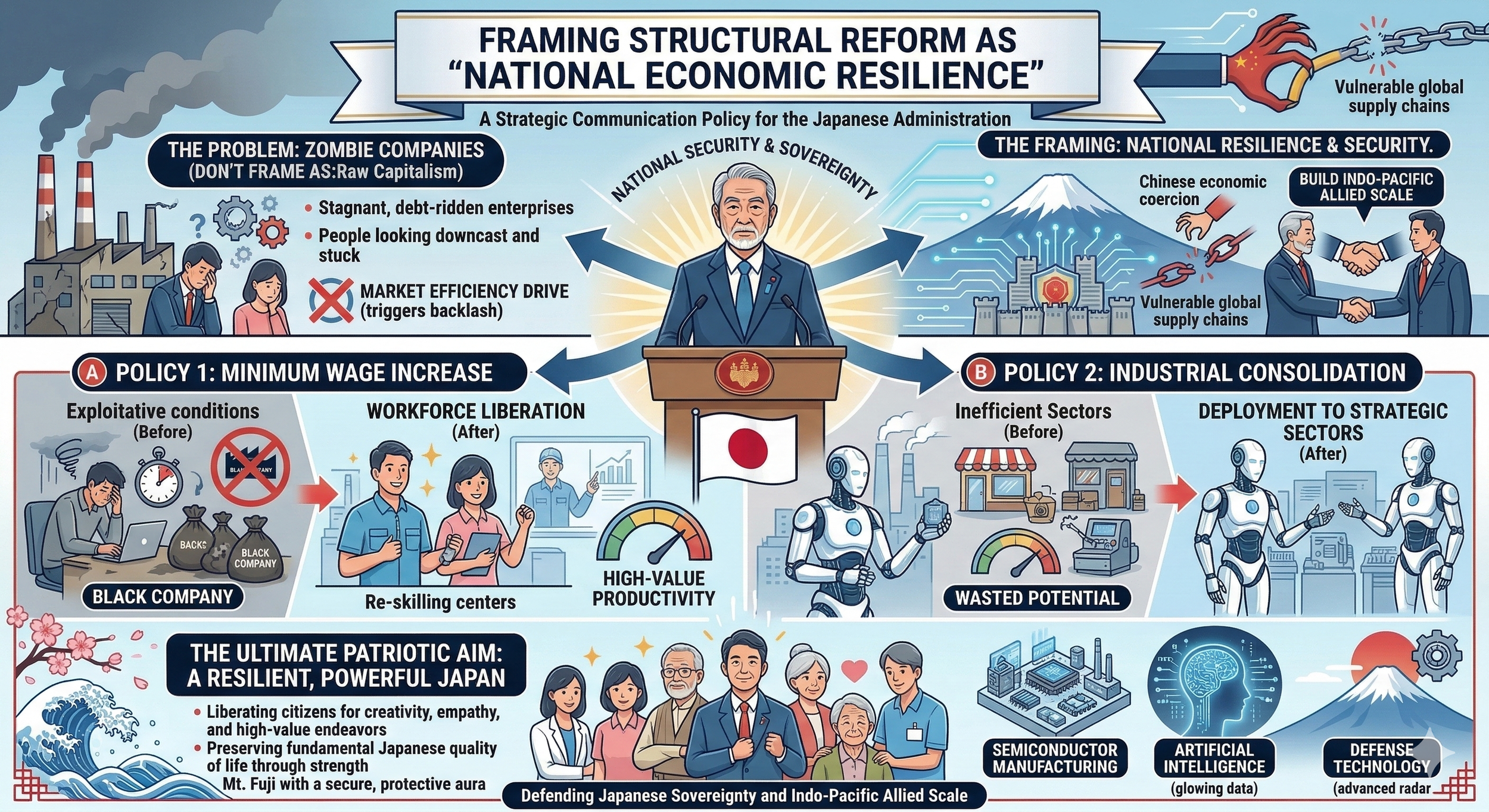
The most dangerous phase of the CBMT reform process is the intentional destruction of zombie companies and the resulting localized unemployment. If framed as a "market efficiency drive," it will trigger fierce backlash from traditional conservatives and organized labor.
The Takaichi administration must strictly frame these aggressive restructuring measures through the lens of National Economic Resilience and Security. The messaging must clearly articulate that in an era of intense geopolitical fracture—characterized by Chinese economic coercion and vulnerable global supply chains—Japan cannot afford to waste its precious, dwindling human capital in stagnant, debt-ridden enterprises.
By raising minimum wages and forcing industrial consolidation, the government is not punishing the working class; it is "liberating" the Japanese workforce from exploitative "black companies" to deploy them into high-value, strategic sectors like semiconductor manufacturing, artificial intelligence, and defense technology. The pain of corporate restructuring is thus elevated from a consequence of raw capitalism to a necessary, patriotic reallocation of resources required to defend Japanese sovereignty and build "allied scale" within the Indo-Pacific.
2. Packaging Equity and Fitness Interdependence via the "Asset Income Doubling Plan"
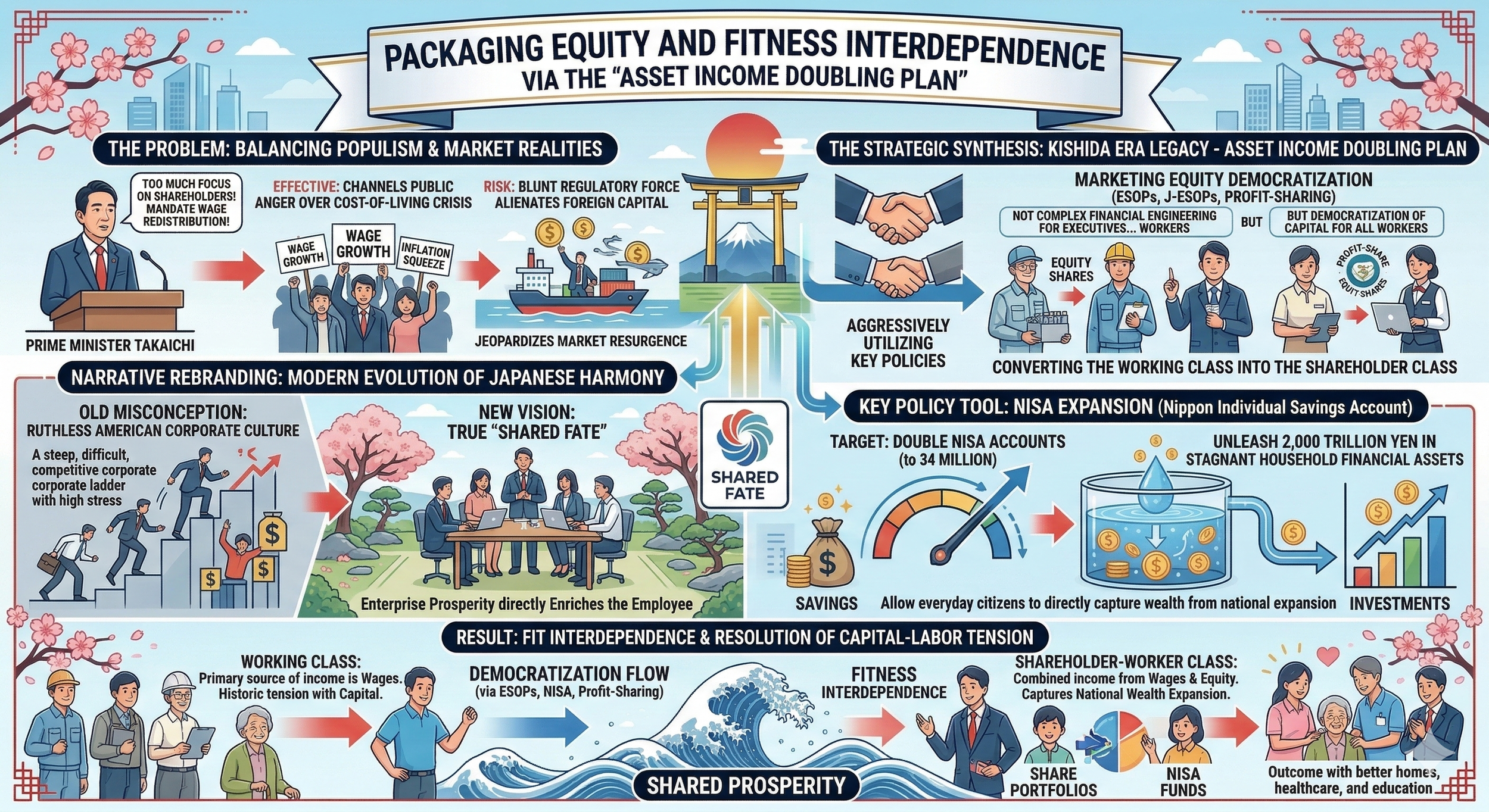
Prime Minister Takaichi has engaged in populist rhetoric, actively criticizing corporations for exhibiting "too much focus on shareholders" at the expense of employee wages, and threatening to revise governance codes to mandate resource redistribution. While this rhetoric effectively channels public anger over the cost-of-living crisis, executing it through blunt regulatory force would alienate the foreign capital that has fueled the recent resurgence of the Japanese equity markets.
The strategic synthesis lies in aggressively utilizing the "Asset Income Doubling Plan" inherited from the Kishida era. The government must market the expansion of ESOPs, J-ESOPs, and broad-based profit-sharing not as complex financial engineering for executives, but as the democratization of capital. By actively converting the working class into the shareholder class, the administration effectively resolves the historical tension between capital and labor.
The messaging must communicate that introducing equity compensation is not an adoption of ruthless American corporate culture, but rather the modern, sophisticated evolution of traditional Japanese corporate harmony. It is a return to a true "Shared Fate" where the prosperity of the enterprise directly enriches the employee. Paired with the expansion of the tax-exempt NISA (Nippon Individual Savings Account) program—which aims to double NISA accounts to 34 million and unleash the 2,000 trillion yen in stagnant household financial assets—this policy allows everyday citizens to directly capture the wealth generated by the nation's capacity expansion.
3. "Team Japan" and the Rebranding of Automation
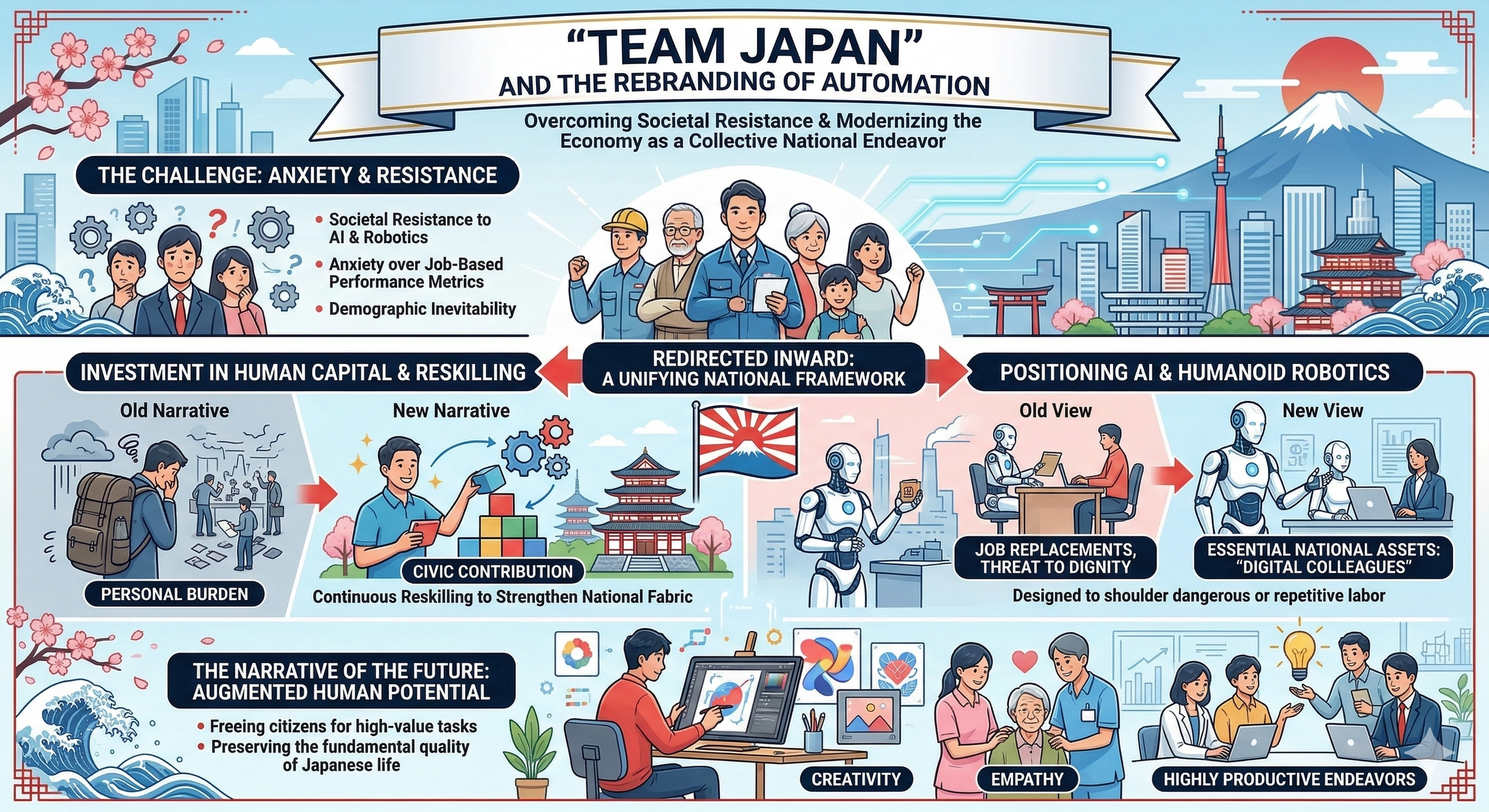
To overcome societal resistance to the integration of artificial intelligence and robotics, and to mitigate the anxiety surrounding the shift to job-based performance metrics, the administration must deploy inclusive, unifying messaging. The "Team Japan" concept, traditionally utilized in international diplomatic and sporting contexts, must be redirected inward to frame the modernization of the economy as a collective national endeavor.
Investment in Human Capital ($H$) and the demand for continuous reskilling must be presented not as an individualistic burden to survive a ruthless labor market, but as a civic contribution to the strengthening of the national fabric. Furthermore, AI and humanoid robotics must be explicitly positioned not as job replacements threatening human dignity, but as essential national assets—digital colleagues designed to shoulder the burden of dangerous or repetitive labor. The narrative must assure the public that automation serves to augment human potential, allowing Japanese citizens to dedicate their time to highly productive, creative, and empathetic endeavors, thereby preserving the fundamental quality of Japanese life in the face of demographic inevitability.
| CBMT Economic Imperative | Traditional Policy Framing (High Political Risk) | 2026 Strategic Messaging Framework (Low Political Risk) | Target Demographic Appeal |
|---|---|---|---|
| Eradicate Zombie Companies | Neoliberal Austerity; Free-Market Efficiency; Corporate Restructuring. | National Economic Resilience: Liberating human capital to build sovereign strength and secure supply chains. |
| Conservative Base; Nationalists; Geopolitical Realists. | | Implement ESOPs / Equity Comp | Executive Financial Engineering; Shareholder Primacy. | Asset Income Doubling & Shared Fate: Democratizing wealth; modernizing traditional corporate harmony and unity.
| Middle Class; Young Professionals seeking wealth accumulation. | | Automate Service & Care Sectors | Labor Substitution; AI Job Replacement; Cost-Cutting. | Team Japan & Digital Colleagues: Deploying technology to protect human dignity and preserve the Japanese standard of living.
| Elderly Voters; Healthcare Workers; Technologists. | | Dismantle Lifetime Employment | Labor Market Deregulation; Destruction of Job Security. | Eradicating Black Companies: Promoting work-life balance, individual agility, and the financial viability of family formation.
| Youth Voters; Working Women; Non-Regular Employees. |
Conclusion: The Path to a Capacity-Driven Future
The demographic reality of Japan's rapidly aging and shrinking population presents an insurmountable macroeconomic obstacle if viewed exclusively through the traditional lenses of aggregate demand and labor hour maximization. However, the rigorous application of Capacity-Based Monetary Theory (CBMT) illuminates a clear, mathematically sound trajectory for national revival. The fundamental value of the Japanese yen, and the overarching strength of the nation, are not strictly dependent on the sheer biological volume of its population. Rather, they are inextricably linked to the expected future impact that the society can efficiently produce.
To reverse the devastating economic consequences of its soaring age dependency ratio, Japan must ruthlessly and systematically optimize every variable within its production function. It must expand the functional boundaries of its aggregate labor pool ($L$) through the integration of older workers, the elevation of female labor force participation, and the strategic circulation of highly skilled global talent. It must forcefully elevate its technological efficiency ($A$) by traversing the 2025 digital cliff, modernizing its administrative architecture, and rapidly deploying artificial intelligence and robotics as direct labor substitutes in its bloated service sectors.
Furthermore, Japan must radically deepen its human capital ($H$) through relentless, lifelong reskilling, abandoning the rigid constraints of company-specific tenure in favor of agile, job-based expertise. Finally, it must perfect its Institutional Realization Rate ($\theta$) by systematically dismantling the zombie companies that choke allocative efficiency, enforcing rigorous corporate governance that demands capital discipline, and aligning the incentives of capital and labor through the widespread, aggressive adoption of Employee Stock Ownership Plans and fitness interdependence.
The historic 2026 supermajority has provided the political window required to execute these profound structural shifts. By strategically framing these vital economic reforms as matters of national resilience, shared fate, and the democratization of asset income, the leadership can secure the broad public consensus necessary to withstand the inevitable friction of transition. In doing so, Japan will not merely survive its demographic contraction; it will forge a new, highly efficient economic paradigm—a capacity-centric model of prosperity that will serve as the definitive blueprint for the entirety of the aging developed world.
-
Shrinkanomics: Policy Lessons from Japan on Aging – IMF F&D, accessed March 6, 2026, https://www.imf.org/en/publications/fandd/issues/2020/03/shrinkanomics-policy-lessons-from-japan-on-population-aging-schneider
The Abenomics Difference: Three Arrows of Roosevelt Resolve in Japan - Harvard DASH, accessed March 6, 2026, https://dash.harvard.edu/bitstreams/7312037d-d1a3-6bd4-e053-0100007fdf3b/download
Overcoming the Lost Decades? Abenomics after Three Years - Brookings Institution, accessed March 6, 2026, https://www.brookings.edu/wp-content/uploads/2015/09/HausmanTextFall15BPEA.pdf
Takaichi Wants to Make Japan Great Again. It Won't Be Easy. | TIME, accessed March 6, 2026, https://time.com/7378431/sanae-takaichi-japan-economy-military-china-trump/
Japan: OECD Economic Outlook, Volume 2025 Issue 2, accessed March 6, 2026, https://www.oecd.org/en/publications/2025/12/oecd-economic-outlook-volume-2025-issue-2_413f7d0a/full-report/japan_ea7efd0c.html
CBMT
Japan's Takaichi cements conservative agenda, accessed March 6, 2026, https://www.iiss.org/online-analysis/online-analysis/2026/02/japans-takaichi-cements-conservative-agenda/
Japan's Corporate Reform Wave: What It Means for Global Investors - Voyen Group, accessed March 6, 2026, https://voyen.com/journal/japans-corporate-reform-wave-what-it-means-for-global-investors/
Closing Japan's valuation gap by changing corporate traditions - McKinsey, accessed March 6, 2026, https://www.mckinsey.com/capabilities/strategy-and-corporate-finance/our-insights/closing-japans-valuation-gap-by-changing-corporate-traditions
How Japan's hard-right populists are profiting from anti-foreign sentiment and a cost of living crunch - The Guardian, accessed March 6, 2026, https://www.theguardian.com/world/2025/jul/19/japanese-first-sanseito-party-goes-into-election-leveraging-unease-about-foreigners
Age Dependency Ratio: Older Dependents to Working-Age Population for Japan (SPPOPDPNDOLJPN) | FRED | St. Louis Fed, accessed March 6, 2026, https://fred.stlouisfed.org/series/SPPOPDPNDOLJPN
Japan - Age Dependency Ratio, Old (% Of Working-age Population) - 2026 Data 2027 Forecast 1960-2024 Historical - Trading Economics, accessed March 6, 2026, https://tradingeconomics.com/japan/age-dependency-ratio-old-percent-of-working-age-population-wb-data.html
Japan - Age Dependency Ratio (% Of Working-age Population) - 2026 Data 2027 Forecast 1960-2024 Historical - Trading Economics, accessed March 6, 2026, https://tradingeconomics.com/japan/age-dependency-ratio-percent-of-working-age-population-wb-data.html
Demographics of Japan - Wikipedia, accessed March 6, 2026, https://en.wikipedia.org/wiki/Demographics_of_Japan
OECD Employment Outlook 2025: Japan, accessed March 6, 2026, https://www.oecd.org/en/publications/oecd-employment-outlook-2025-country-notes_f91531f7-en/japan_7672bd00-en.html
Population Projection for Japan, accessed March 6, 2026, https://www.ipss.go.jp/site-ad/index_english/esuikei/econ2.html
Japan's “Foreigner Policy” Skirts Key Issues: No Orderly Coexistence Without Plan for Immigration | Nippon.com, accessed March 6, 2026, https://www.nippon.com/en/in-depth/d01206/
Grand Design and Action Plan for a New Form of Capitalism 2024 Revised Version, accessed March 6, 2026, https://www.cas.go.jp/jp/seisaku/atarashii_sihonsyugi/pdf/ap2024en.pdf
Fourth Report of the Committee on New Direction of Economic and Industrial Policies, accessed March 6, 2026, https://www.meti.go.jp/english/policy/economy/industrial_council/pdf/250603008_01.pdf
Rapid Growth and Long Stagnation - Collège de France, accessed March 6, 2026, https://www.college-de-france.fr/fr/agenda/conferencier-invite/japanese-economy/rapid-growth-and-long-stagnation
Will China's economy follow the same path as Japan's? - Bruegel.org, accessed March 6, 2026, https://www.bruegel.org/policy-brief/will-chinas-economy-follow-same-path-japans
Why Japan's Economy Is Struggling in 2024–2025 – ERIC KIM, accessed March 6, 2026, https://erickimphotography.com/why-japans-economy-is-struggling-in-2024-2025/
Cross-country comparisons of labour productivity levels: OECD Compendium of Productivity Indicators 2025, accessed March 6, 2026, https://www.oecd.org/en/publications/oecd-compendium-of-productivity-indicators-2025_b024d9e1-en/full-report/cross-country-comparisons-of-labour-productivity-levels_b2fdb493.html
Japan's labor productivity falls to 28th among OECD countries - The Japan Times, accessed March 6, 2026, https://www.japantimes.co.jp/business/2025/12/23/japan-labor-productivity-oecd/
Challenges in Improving Productivity in the Service Industry - RIETI, accessed March 6, 2026, https://www.rieti.go.jp/en/papers/contribution/morikawa/29.html
Japan's digital transformation in crisis - CIO, accessed March 6, 2026, https://www.cio.com/article/4074930/japans-digital-transformation-in-crisis.html
Japan's Digital Cliff: The 2026 Reality And Breakthrough Solutions - DTS Software Vietnam, accessed March 6, 2026, https://dtsvn.com/en/japans-digital-cliff-the-2026-reality-and-breakthrough-solutions/
1 . The 20th World Digital Government Rankings 2025 Edition Released - Waseda University, accessed March 6, 2026, https://idg-waseda.jp/pdf/2025_Digital_Government_Ranking_Report.pdf
Activity Report and Future Plan of Digital Agency of Japan in 2025, accessed March 6, 2026, https://www.digital.go.jp/en/policies/report-2025
Activity Report and Future Plan of Digital Agency of Japan, accessed March 6, 2026, https://www.digital.go.jp/assets/contents/en/node/basic_page/field_ref_resources/e40758be-dd25-46e1-96e9-24cf5719a7a9/0168e4e2/20250905_en_activity_report.pdf
Japan's Agile AI Governance in Action: Fostering a Global Nexus Through Pluralistic Interoperability - CSIS, accessed March 6, 2026, https://www.csis.org/analysis/japans-agile-ai-governance-action-fostering-global-nexus-through-pluralistic
Robots in elderly care: Lessons from Japan's aging population - Sinolytics, accessed March 6, 2026, https://sinolytics.de/global-business-news/blog/geolytics/robots-elderly-care-lessons-from-japan/
Japan's Aging Society as a Technological Opportunity | Carnegie Endowment for International Peace, accessed March 6, 2026, https://carnegieendowment.org/research/2024/10/japans-aging-society-as-a-technological-opportunity
Confronting the zombies - OECD, accessed March 6, 2026, https://www.oecd.org/en/publications/confronting-the-zombies_f14fd801-en.html
'Zombie company' apocalypse might be the point of Japan's minimum wage push, accessed March 6, 2026, https://www.japantimes.co.jp/business/2025/06/03/economy/ishiba-minimum-wage-push/
Japan: Staff Concluding Statement of the 2025 Article IV Mission - IMF, accessed March 6, 2026, https://www.imf.org/en/news/articles/2025/02/07/mcs-020725-japan-staff-concluding-statement-of-the-2025-article-iv-mission
Ishiba's Economic Agenda: A Departure from Kishida's "Growth First" Approach?|Dai-Ichi Life Research Institute, accessed March 6, 2026, https://www.dlri.co.jp/file/english/202506TH.pdf
Japan's Corporate Reforms Create a Catalyst for Equity Returns | AB - AllianceBernstein, accessed March 6, 2026, https://www.alliancebernstein.com/us/en-us/defined-contribution/insights/investment-insights/japans-corporate-reforms-create-a-catalyst-for-equity-returns.html
Japan's Corporate Reforms Boost Shareholder Value in 2025 | J.P. Morgan Asset Management, accessed March 6, 2026, https://am.jpmorgan.com/es/en/asset-management/institutional/insights/portfolio-insights/etf-perspectives/japan-corporate-governance-shareholder-value/
Japan Corporate Reforms Lead to Corporate Dealmaking Growth - BofA Securities, accessed March 6, 2026, https://business.bofa.com/jp/en/japan-insights/corporate-reforms-drive-results.html
Value Vantage Point: As Japanese companies change, investment opportunities bloom, accessed March 6, 2026, https://www.franklintempleton.com/articles/2025/equity/as-japanese-companies-change-investment-opportunities-bloom
Japan A structural alpha opportunity - Eastspring Investments, accessed March 6, 2026, https://www.eastspring.com/hk/insights/deep-dives/japan-a-structural-alpha-opportunity
Japan's Private Equity Shake-up: Trends, Opportunities and Integration Challenges, accessed March 6, 2026, https://bccjapan.com/news/japans-private-equity-shake-trends-opportunities-and-integration-challenges
How people are navigating work transformation across Japan | World Economic Forum, accessed March 6, 2026, https://www.weforum.org/stories/2025/12/navigating-work-transformation-in-japan/
Rapid Growth and Long Stagnation - Collège de France, accessed March 6, 2026, https://www.college-de-france.fr/en/agenda/guest-lecturer/japanese-economy/rapid-growth-and-long-stagnation
Reskilling and Human Capital - RIETI, accessed March 6, 2026, https://www.rieti.go.jp/en/columns/a01_0743.html
Action Programme for Corporate Governance Reform 2025, accessed March 6, 2026, https://www.fsa.go.jp/en/refer/councils/follow-up/statements_8_overview.pdf
What is human capital management disclosure? We go over the 19 items across 7 areas requiring disclosure and why they are mandatory, and explain key points in performing disclosure | Insights | ABeam Consulting, accessed March 6, 2026, https://www.abeam.com/jp/en/insights/056/
Study on Global Investors' Focus Areas Regarding Human Capital Disclosure and Corporate Case Studies (English translated version, accessed March 6, 2026, https://www.fsa.go.jp/en/news/2025/20250411/01.pdf
Human Capital Reporting in Japan : Facilitating dialogue inside and outside the organization | Research Articles, accessed March 6, 2026, https://www.mri.co.jp/en/knowledge/article/202509_3.html
The Evolution of Reciprocal Altruism | The Quarterly Review of Biology: Vol 46, No 1, accessed March 6, 2026, https://www.journals.uchicago.edu/doi/10.1086/406755?mobileUi=0
Employee Stock Ownership Plan Market Report 2026 - The Business Research Company, accessed March 6, 2026, https://www.thebusinessresearchcompany.com/report/employee-stock-ownership-plan-global-market-report
The rise of equity-based executive compensation in Japan - Gideon Franklin, accessed March 6, 2026, https://www.gideonfranklin.com/the-rise-of-equity-based-executive-compensation-in-japan/
How the Japanese corporate compensation system made some sense | CEO Noriyuki's perspective | INVESTMENT IN JAPAN
Nxera Introduces Employee Stock Ownership Plan (J-ESOP) for Employees Residing in Japan - BioSpace, accessed March 6, 2026, https://www.biospace.com/press-releases/nxera-introduces-employee-stock-ownership-plan-j-esop-for-employees-residing-in-japan
Understanding Phantom Equity & Stock Plans for Startups - J.P. Morgan, accessed March 6, 2026, https://www.jpmorgan.com/insights/business-planning/understanding-phantom-equity-and-stock-plans-for-startups
KKR Partner: Now Is the Time for Japanese Employees to Receive Equity Compensation, Warning of U.S.-Style Inequality, accessed March 6, 2026, https://www.kkr.com/content/dam/kkr/invest/private-equity/ownership-works-japan-bloomberg-20251020.pdf
Cutting the Parent, Preserving the Subsidiary:Reverse Spin-Off Strategies in Corporate Downsizing | by Japan Business Insights, accessed March 6, 2026, https://japanbusinessinsights.medium.com/cutting-the-parent-preserving-the-subsidiary-reverse-spin-off-strategies-in-corporate-downsizing-436f4f97fc70
The Kishida Administration's Challenges after the Upper House Election: Fiscal and National Sustainability Restructuring - Japan Policy Forum, accessed March 6, 2026, https://www.japanpolicyforum.jp/politics/pt2022082908493412426.html
Top Risks 2026: Implications for Japan - Eurasia Group, accessed March 6, 2026, https://www.eurasiagroup.net/issues/Top-Risks-2026-Implications-for-Japan
Soaring food bills pose risk to Takaichi's election prospects - The Japan Times, accessed March 6, 2026, https://www.japantimes.co.jp/business/2026/02/06/economy/food-cost-rise-election/
Young Audiences Abandoning Traditional Media in the Age of Takaichi, accessed March 6, 2026, https://apjjf.org/2026/1/ikeda
Japan's youth are quietly securing their nation's future - The Japan Times, accessed March 6, 2026, https://www.japantimes.co.jp/commentary/2026/02/10/japan/japans-youth-secure-nations-future/
IDEAS, POWER AND EFFICIENCY: THE ... - DukeSpace, accessed March 6, 2026, https://dukespace.lib.duke.edu/bitstreams/397e2f7a-d0f0-423a-b46a-307f9f5717ed/download
Takaichi's Landslide: A Mandate for Strategic Realism and Allied Scale | Nippon.com, accessed March 6, 2026, https://www.nippon.com/en/in-depth/d01213/
Policy Speech by Prime Minister TAKAICHI Sanae to the 221st Session of the Diet, accessed March 6, 2026, https://japan.kantei.go.jp/105/statement/202602/20shiseihoshin.html
Takaichi Landslide Shows Limits of Chinese Economic Coercion - CSIS, accessed March 6, 2026, https://www.csis.org/analysis/takaichi-landslide-shows-limits-chinese-economic-coercion
Challenging Corporate Governance: Japanese PM Swipes at Companies' Shareholder Focus - Minerva-Manifest, accessed March 6, 2026, https://www.manifest.co.uk/challenging-corporate-governance-japanese-pm-swipes-at-companies-shareholder-focus/
Japan's Second Act: Shareholder Returns and Global Relevance - WisdomTree, accessed March 6, 2026, https://www.wisdomtree.com/investments/blog/2025/11/12/japans-second-act-shareholder-returns-and-global-relevance
Corporate Governance Reform in Japan - 金融庁, accessed March 6, 2026, https://www.fsa.go.jp/singi/japan_corporate_governance_forum/03.pdf
XNET Corporation (4762) Company Information Stock Information Earnings Trend, accessed March 6, 2026, https://www.xnet.co.jp/if/ir6files/20251224-1.pdf
Bridge Report:(4762)XNET Fiscal Year ended March 2025 - ブリッジサロン, accessed March 6, 2026, https://www.bridge-salon.jp/report_bridge/archives/eng/4762/20250718.html
2024 Investment Climate Statements: Japan - State Department Home, accessed March 6, 2026, https://2021-2025.state.gov/reports/2024-investment-climate-statements/japan/
Japan's Open Future: An Agenda for Global Citizenship 1843313111, 9781843313113 - DOKUMEN.PUB, accessed March 6, 2026, https://dokumen.pub/japans-open-future-an-agenda-for-global-citizenship-1843313111-9781843313113.html
Takaichi's choice: revolution, reform or regression - Stephen Nagy, accessed March 6, 2026, https://nagystephen.com/2025/10/23/takaichis-choice-revolution-reform-or-regression/