

Capacity-Based Analysis of the San Francisco Bay Area Legal and Institutional Environment
Introduction to the Crisis of Municipal Capacity
The San Francisco Bay Area represents one of the most concentrated agglomerations of human capital, technological efficiency, and aggregate wealth in modern economic history. Historically, the region has functioned as the preeminent engine of global innovation, commanding massive agglomeration premiums and driving extraordinary economic output. However, beneath the surface of this economic powerhouse lies a profound and accelerating structural degradation of its legal, political, and institutional environment. To rigorously understand the root causes, mechanical failures, and staggering economic costs of this degradation, it is necessary to move beyond the boundaries of standard neoclassical economic analysis and employ Capacity-Based Monetary Theory (CBMT).
Under the CBMT framework, money and municipal value are not static stores of wealth, nor are they mere fiat illusions. Rather, they are floating-price claims on the future productive capacity of an economy. This productive capacity is determined by a dynamic vector function of aggregate labor, the efficiency of that labor as amplified by technology and human capital, and, crucially, the stability of the institutional social contract that allows this labor to project value into the future. When an individual, corporation, or investor accepts the currency or buys into the real estate of a municipality, they are essentially acquiring a call option on the future labor and institutional stability of that society.
When the institutional frameworks of a municipality begin to fray—due to political capture, excessive bureaucratic friction, ideological rigidity, or the breakdown of fundamental public safety—the frictional costs of trust and order skyrocket. In the Bay Area, and San Francisco in particular, the local government has increasingly failed to maintain the institutional "Leviathan" required to suppress transaction costs and enforce the social contract. Consequently, the city is experiencing a localized reversion toward a Hobbesian state, characterized by unpredictable regulatory enforcement, unchecked property crime, and entrenched political machines that extract massive deadweight losses from the productive economy.
This comprehensive research report provides an exhaustive, data-driven analysis of the weaknesses embedded within the current legal and political environment of the Bay Area. Utilizing insights from prominent technology leaders and political organizers such as Garry Tan, alongside municipal budget data, economic cost modeling, and institutional jurisprudence, this analysis diagnoses the specific structural failures of the region. Furthermore, this report models the multi-billion-dollar costs these issues impose on the Bay Area and outlines actionable, voter-friendly methods for addressing them through charter reform, regulatory streamlining, and pragmatic political realignment.
Actionable, Voter-Friendly Remediation Strategies
To reverse the degradation of the Institutional Realization Rate ($I$) and restore the Bay Area's expected future impact, a comprehensive, structural overhaul of the legal and political environment is required. Marginal policy tweaks are insufficient; the solutions must bypass the entrenched political machine by appealing directly to the voters through direct democracy and systemic reform.
Civic organizations like GrowSF, TogetherSF, and Garry Tan's network have pioneered the concept of building "parallel machines" to educate, organize, and mobilize the electorate toward pragmatic, centrist reforms. The following are actionable, voter-friendly methods to address the identified weaknesses, categorized by their institutional target.
1. Building the Parallel Civic Machine
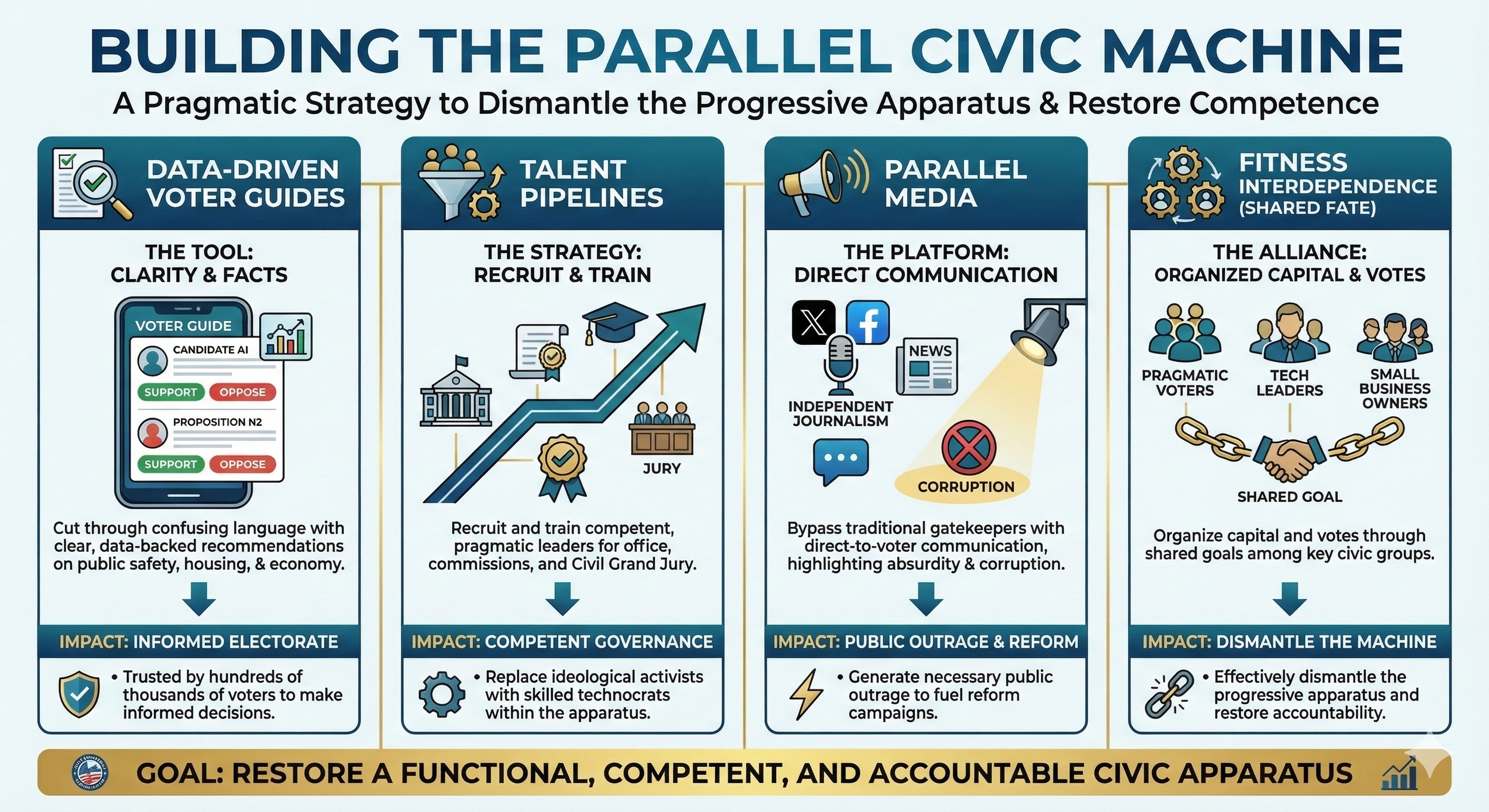
As Garry Tan has articulated, the traditional unelected political machine relies on a monopoly of information, institutional inertia, and the funding of parallel progressive nonprofits. To defeat it, pragmatic centrists must build and fund their own infrastructure.
Data-Driven Voter Guides: Organizations like GrowSF distribute highly effective, data-backed voter guides that cut through deliberately confusing ballot language. These guides clearly outline which candidates and propositions support public safety, housing growth, and economic pragmatism, and are trusted by hundreds of thousands of voters.
Talent Pipelines: To permanently alter the bureaucracy, groups are recruiting and training a new generation of pragmatic leaders to run for office, serve on city commissions, or join the Civil Grand Jury. This ensures that competent technocrats replace ideological activists within the apparatus.
Parallel Media: Utilizing platforms like X (formerly Twitter) and funding independent local journalism to bypass the traditional political communications apparatus. This direct-to-voter communication highlights the absurdities, grifts, and corruption of the incumbent machine, generating the public outrage necessary to fuel reform campaigns.
By establishing "Fitness Interdependence" (Shared Fate) among pragmatic voters, tech leaders, and small business owners, this parallel machine can organize capital and votes effectively enough to dismantle the progressive apparatus.
2. Comprehensive Charter Reform and Executive Restoration
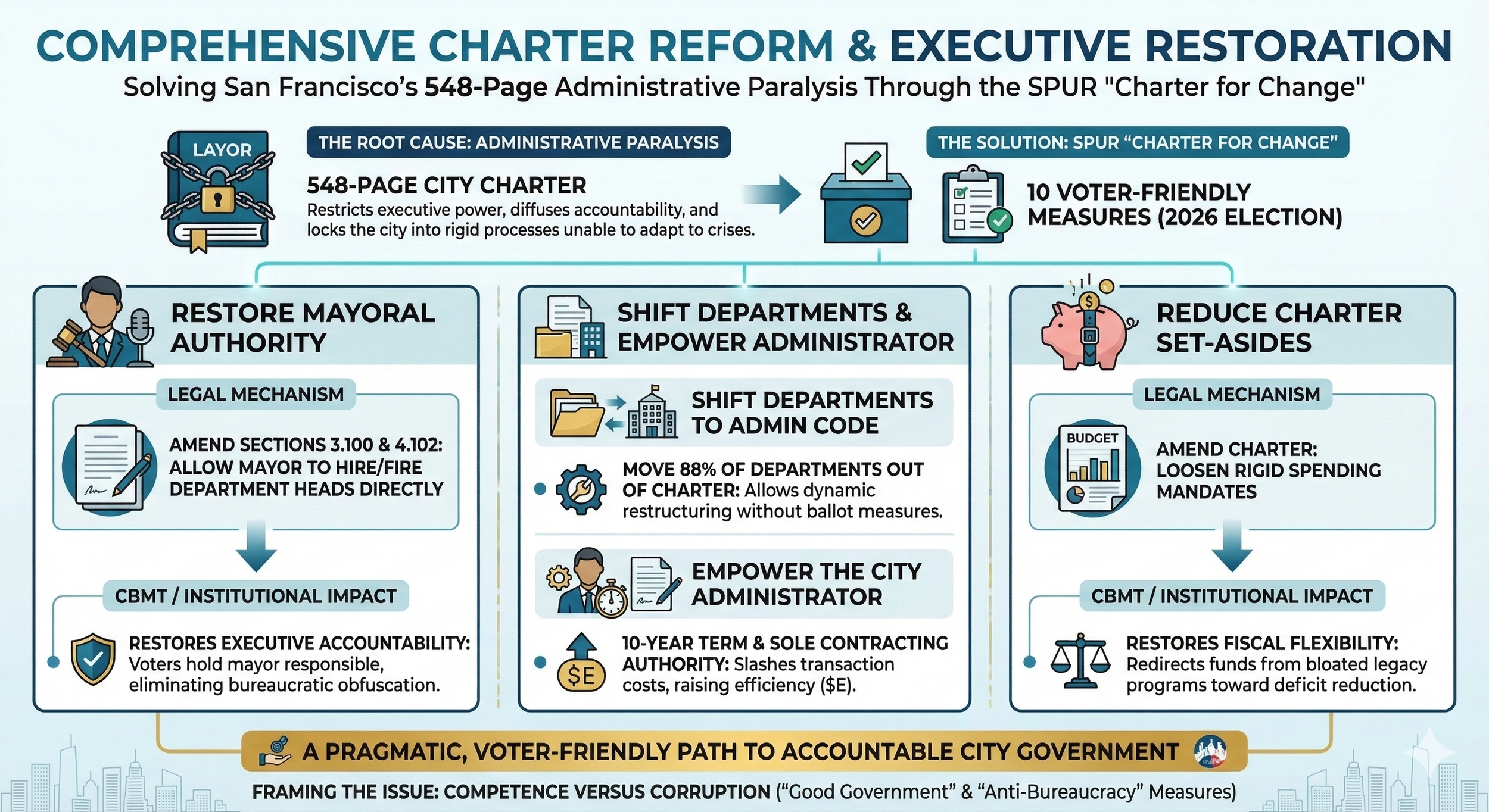
San Francisco's 548-page city charter is the root cause of its administrative paralysis. It restricts executive power, diffuses accountability, and locks the city into administrative processes that cannot adapt to crises. SPUR (San Francisco Bay Area Planning and Urban Research Association) has outlined a comprehensive "Charter for Change" featuring 10 specific, voter-friendly ballot measures intended for the 2026 election.
The most critical charter reforms required to restore institutional efficiency include:
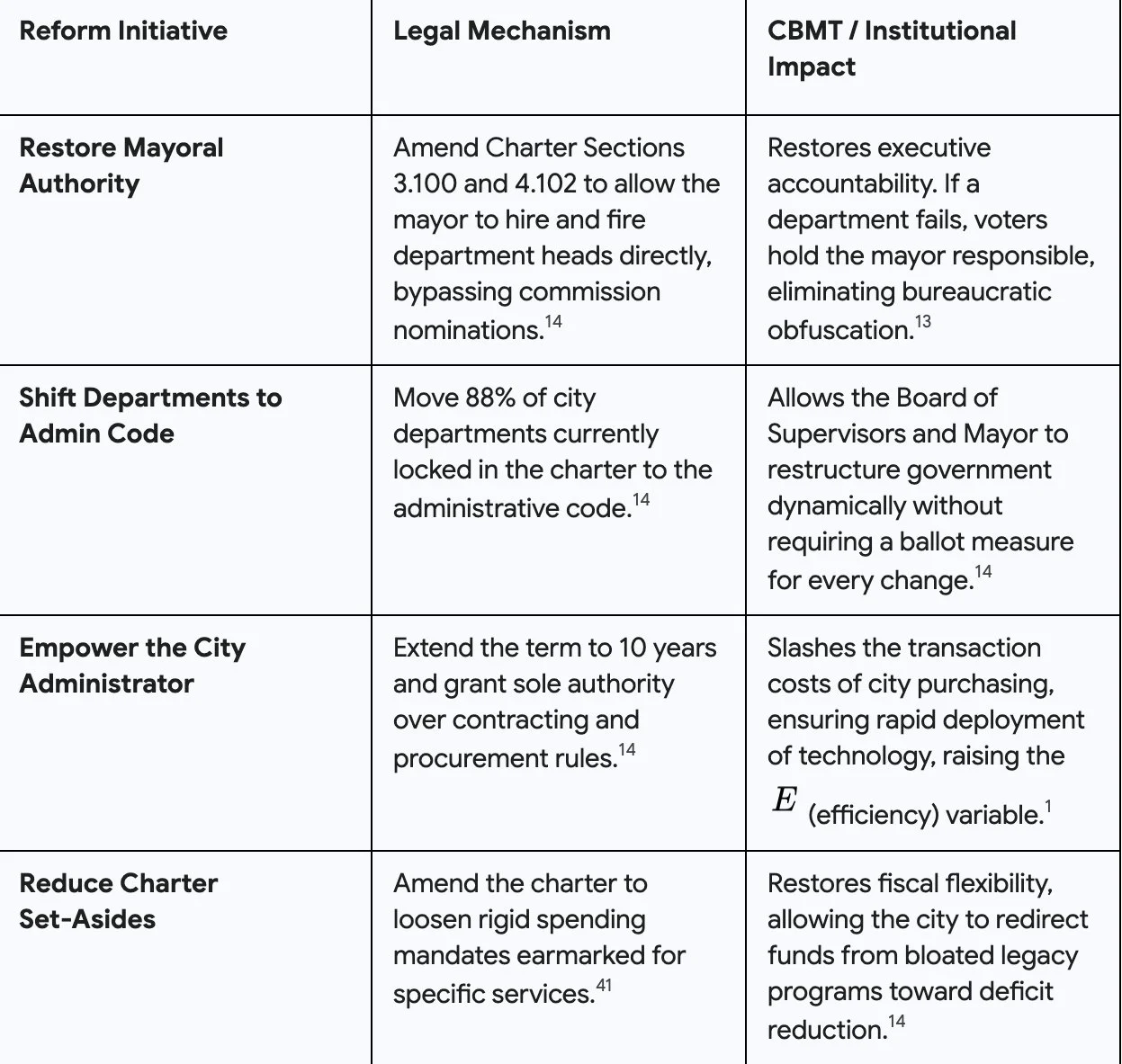
By presenting these reforms to the electorate as "Good Government" and "Anti-Bureaucracy" measures, they possess strong voter appeal across ideological lines, framing the issue as competence versus corruption.
3. Commission Streamlining and Bureaucratic Reduction
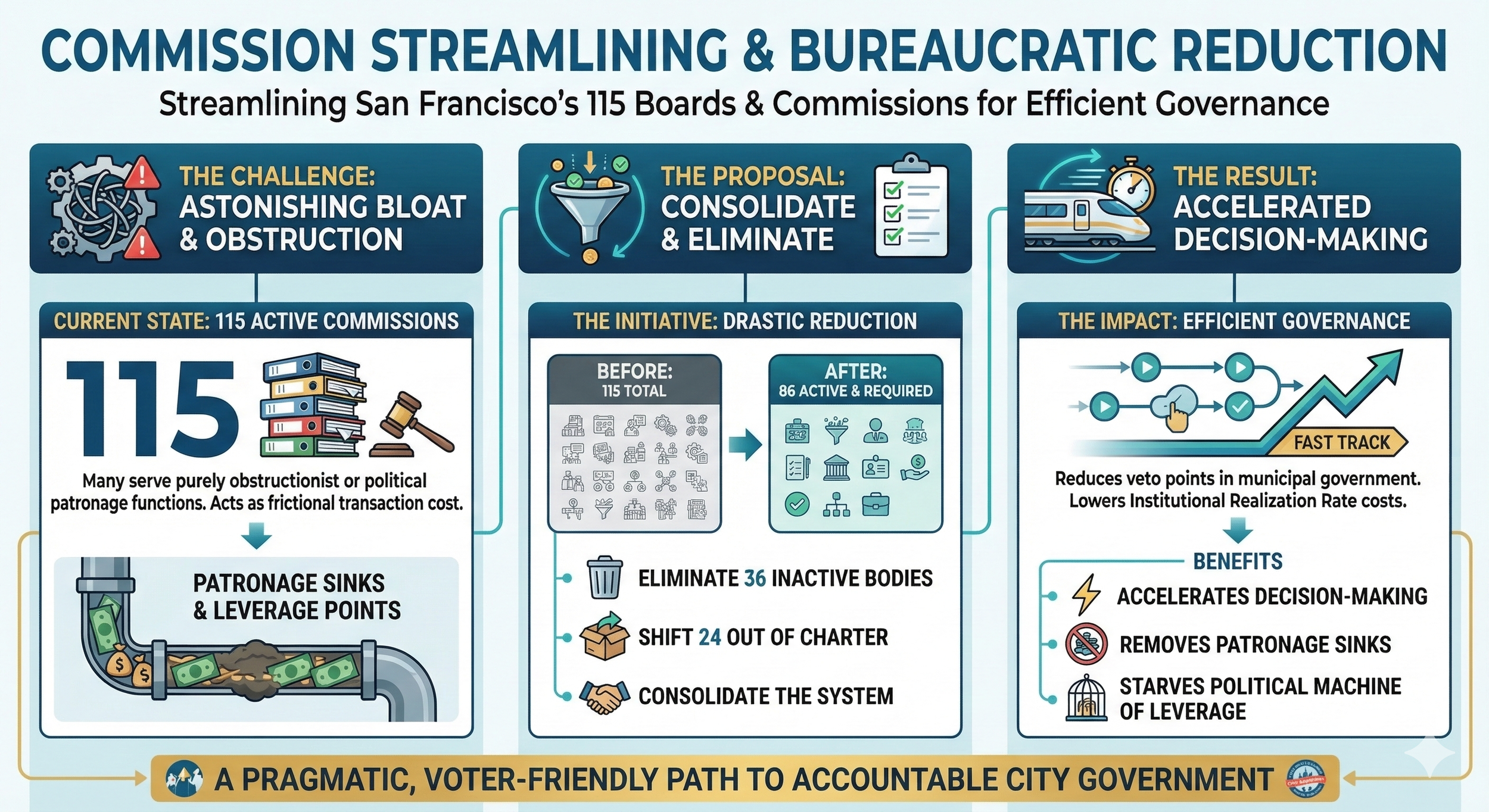
San Francisco currently maintains an astonishing 115 active boards and commissions, many of which serve purely obstructionist or political patronage functions. A highly actionable, voter-friendly initiative currently underway via a working group aims to drastically reduce this number to streamline governance.
The proposal consolidates the system down to 86 active and legally required bodies, explicitly eliminating 36 inactive bodies, and shifting 24 out of the charter entirely. Streamlining these commissions reduces the number of veto points in the municipal government. In CBMT terms, every unnecessary commission acts as a frictional transaction cost that lowers the Institutional Realization Rate. By dismantling the bloated commission structure, the city accelerates decision-making, removes patronage sinks, and starves the unelected political machine of its leverage points.
4. Housing Entitlement By-Right and the End of Discretionary Review
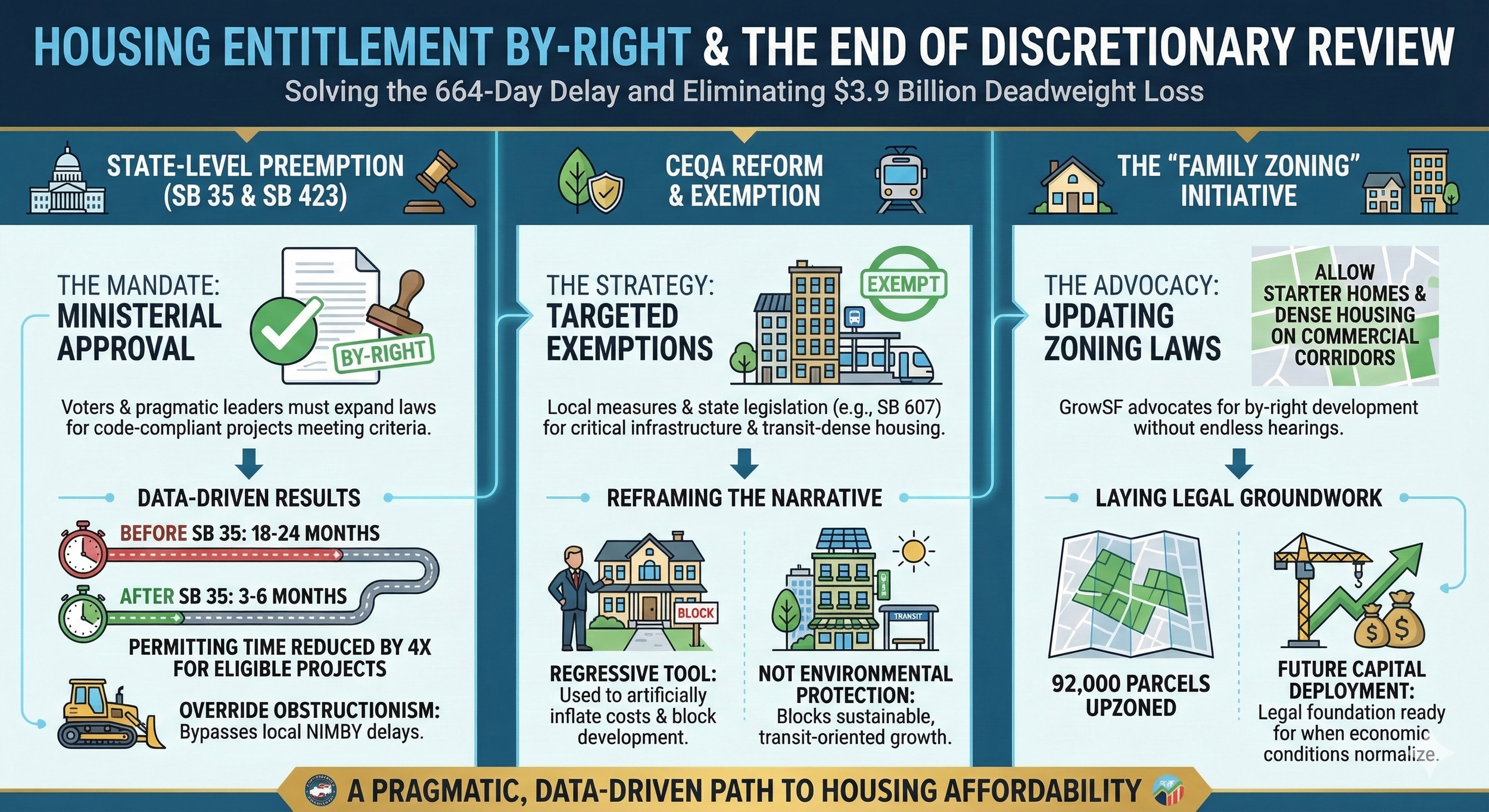
To solve the 664-day permitting delay and eliminate the $3.9 billion deadweight loss in housing construction, the legal environment must be fundamentally altered to eliminate discretionary review for code-compliant projects.
State-Level Preemption (SB 35 and SB 423): Voters and pragmatic leaders must continue to lean on, fund advocacy for, and expand state laws like SB 35 and SB 423, which mandate ministerial (by-right) approval for housing projects that meet certain affordability and labor criteria. Data conclusively shows that SB 35 has already reduced housing permitting times in San Francisco by four times (from 18-24 months down to 3-6 months) for eligible projects. Expanding these state-level preemptions overrides local NIMBY obstructionism.
CEQA Reform and Exemption: While full repeal of the California Environmental Quality Act is politically difficult at the state level, local ballot measures and targeted state legislation (like SB 607) can exempt critical infrastructure and dense housing near transit from environmental review. The political narrative must frame CEQA not as an environmental protection law, but as a regressive tool used by wealthy homeowners to artificially inflate housing costs and block sustainable, transit-oriented development.
The "Family Zoning" Initiative: Local groups like GrowSF advocate heavily for "Family Zoning," which updates zoning laws to allow families to build starter homes or dense housing on commercial corridors without facing endless hearings. While the current implementation of this upzoning plan faces macroeconomic headwinds due to high construction costs and market weakness , legally enshrining the upzoning of 92,000 parcels lays the necessary legal groundwork for massive capital deployment when interest rates and material costs normalize.
5. Restoring the Leviathan: Public Safety and Technological Leverage
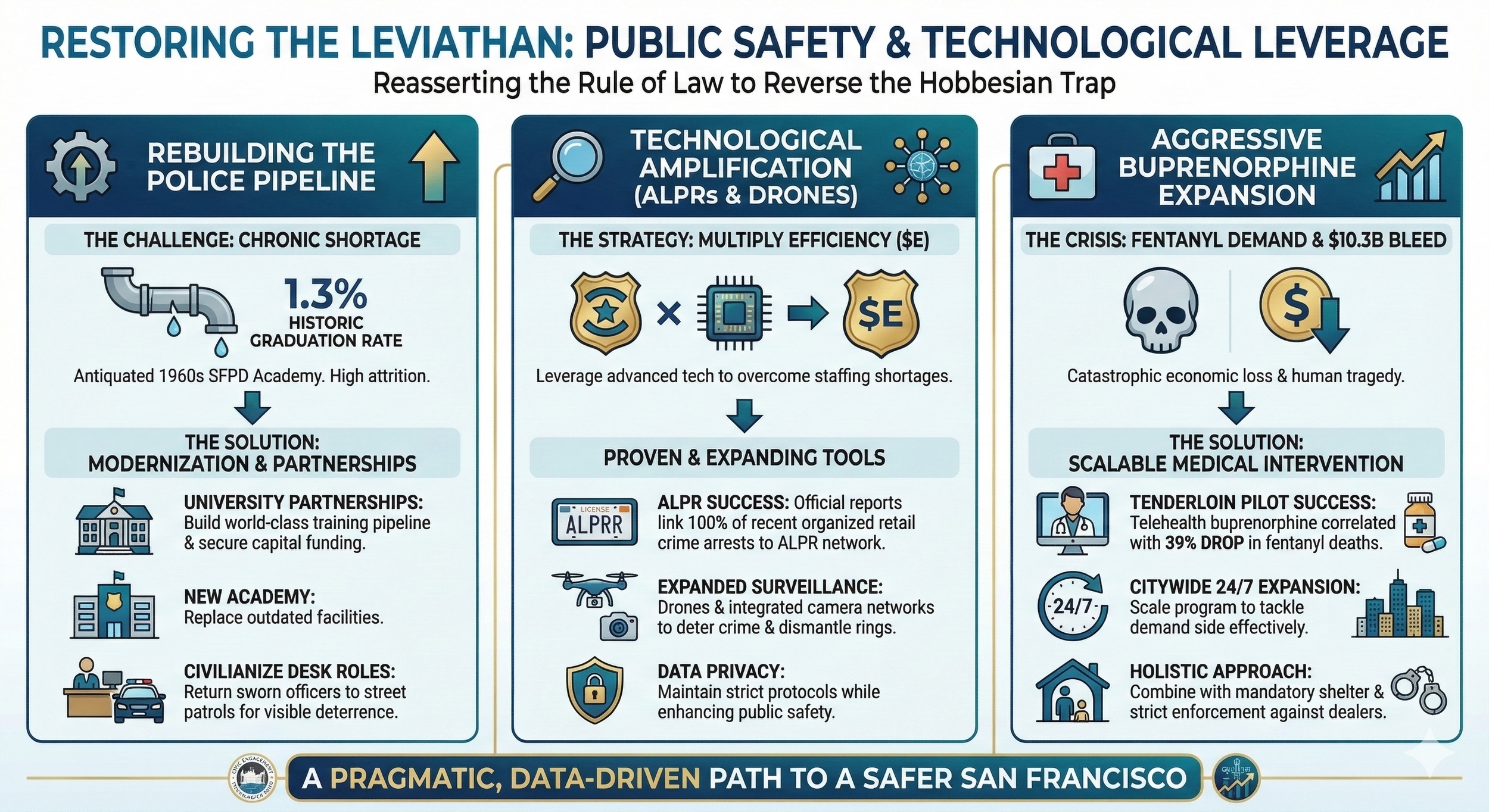
To reverse the Hobbesian Trap of organized retail theft and open-air drug markets, the city must aggressively reassert its monopoly on force and the rule of law.
Rebuilding the Police Pipeline: San Francisco suffers from a chronic, severe police shortage, with graduation rates for applicants historically hovering at a dismal 1.3%. Voter-friendly initiatives must bypass the political machine by partnering directly with local universities to build a world-class training pipeline and secure capital funding to replace the antiquated 1960s SFPD Academy. Furthermore, aggressively civilianizing desk roles will immediately return sworn officers to street patrols, increasing visible deterrence.
Technological Amplification (ALPRs and Drones): Given the severe staffing shortages, the city must multiply the efficiency ($E$) of its existing police force using advanced technology. The recent deployment of Automated License Plate Readers (ALPRs) has already proven highly effective; official reports indicate that all organized retail crime arrests in San Francisco in recent quarters were directly attributed to the ALPR network. Expanding algorithmic policing, drone surveillance, and integrated camera networks—while maintaining strict data privacy protocols—is a highly cost-effective, voter-friendly method of deterring crime and dismantling theft rings.
Aggressive Buprenorphine Expansion: To tackle the demand side of the fentanyl crisis and reduce the catastrophic $10.3 billion economic bleed, the city must expand medical interventions that work. The recent nighttime pilot program that connects people in the Tenderloin with a doctor via telehealth to prescribe buprenorphine (a medication for opioid use disorder) on the spot has shown massive success, correlating with a 39% drop in fentanyl deaths since its launch. Scaling this program citywide, 24/7, combined with mandatory shelter and strict enforcement against dealers, is a highly pragmatic, data-driven solution to restore human capital.
Theoretical Framework: Capacity-Based Monetary Theory Applied to San Francisco
To accurately price the cost of the Bay Area's institutional failures and design effective remediation strategies, one must first establish a rigorous theoretical foundation. Capacity-Based Monetary Theory provides the exact diagnostic tools required to dissect the San Francisco crisis, integrating the augmented growth models of Mankiw, Romer, and Weil with the institutional frameworks of Douglass North and the allocation theories of Gary Becker.
The Production Function of Municipal Impact
In an economic sense, municipal impact is synonymous with real output ($Y$)—representing the tangible goods, services, and innovations that a city produces. The capacity to produce this impact relies on the Augmented Solow-Swan model (the Mankiw-Romer-Weil specification), which treats human capital ($H$) as an independent, accumulating factor of production alongside physical capital. The rigorous production function for impact is defined mathematically as:
$$Y = K^\alpha (E \cdot H \cdot L)^{1-\alpha}$$
Where $K$ represents the stock of physical capital (housing, infrastructure, commercial real estate), $E$ is efficiency capacity (technology and institutional structure), $H$ is human capital (skills, education, health of the workforce), and $L$ is the aggregate labor force. The Bay Area possesses globally unmatched levels of $H$, driven by a highly educated tech workforce, and $E$, driven by venture capital and technological innovation. Historically, this allowed the region to generate immense expected future impact, driving up property values, wages, and the region's overall economic premium. A strong municipal economy is essentially a bet on the society’s ability to maintain high levels of investment in both human capital and physical infrastructure.
The Institutional Realization Rate ($I$) and the Hobbesian Trap
However, theoretical capacity is meaningless if the fruits of labor cannot be secured due to a breakdown in the legal and institutional frameworks. Production capacity is purely theoretical if the local government cannot guarantee the passage of time required to redeem claims on value. To account for this, CBMT introduces the Institutional Realization Rate ($I$), a coefficient between 0 and 1, which represents the effectiveness of the rule of law, contract enforcement, and public safety.
The actual realized value of the municipal economy is therefore modeled as:
$$Realizable Impact = Y \times I$$
In a high-trust, well-governed society (such as Switzerland), the $I$ coefficient approaches 1, meaning the theoretical capacity of the population is fully realizable. In a failing institutional environment, $I$ drops significantly. When the local government fails to enforce basic laws—such as prosecuting retail theft, clearing open-air drug markets, or providing predictable timelines for building permits—it precipitates what CBMT refers to as a "Hobbesian Trap".
Thomas Hobbes described the state of nature as a condition of war where life is solitary, poor, nasty, brutish, and short. In economic terms, a Hobbesian state is a regime of infinite transaction costs. Money and long-term investment cannot exist in a Hobbesian state because they are inherently claims on the future; if the future is characterized by violence, expropriation, or infinite bureaucratic delay, the discount rate effectively becomes infinite. No rational economic agent will exchange capital today for a token promising a return tomorrow if "tomorrow" brings arbitrary confiscation or chaotic street conditions.
In the Bay Area, the decline of the Institutional Realization Rate is the primary driver of the current economic crisis. The $I$ coefficient is being artificially suppressed by an entrenched political machine that prioritizes ideological rigidity, bureaucratic veto points, and the extraction of rents via nonprofit networks over the fundamental maintenance of civic order.
O-Ring Filtering and the Hamilton Regime Shift
The specific dynamics of San Francisco's decline can be further explained by Michael Kremer’s O-Ring Theory of Economic Development, integrated into the CBMT framework. Kremer demonstrated that in complex production processes, high-skill workers cluster together because a single mistake by a low-skill component destroys the value of the entire chain. San Francisco historically functioned as the ultimate O-Ring filter. Its high cost of living acted as a screening mechanism, setting a cost of entry that guaranteed immense talent density and maximized the probability of serendipitous, high-value synergy.
However, this filter only functions if the high costs guarantee a high-efficiency network. When the physical environment becomes unsafe, unsanitary, or overly hostile to business, the agglomeration premium collapses. Elite workers and corporations, who are highly mobile, simply leave. To price this risk, CBMT employs the Hamilton Filter, a stochastic regime-switching model used to estimate discrete shifts in time series data. When the Hamilton Filter detects a shift in the transition matrix suggesting that the local "Leviathan" is losing control of its streets and institutions, the market updates the probability of a "Collapse Regime". The subsequent spike in the discount rate manifests as crashing commercial real estate values and capital flight.
The Degradation of the Legal and Political Environment
The degradation of the Bay Area's Institutional Realization Rate is not an accident of nature, macroeconomic headwinds, or localized bad luck. It is the direct result of specific, identifiable political and legal structures that have systematically captured the municipal apparatus. An exhaustive analysis of the local political environment reveals a system that has been subsumed by a coalition of public-sector unions, highly funded but unaccountable nonprofits, and ideologically driven progressive supervisors.
The Unelected Political Machine and Institutional Capture
Technology leaders and civic organizers, most notably Y Combinator CEO Garry Tan, have extensively documented the mechanics of this political machine. According to this critique, the traditional San Francisco political apparatus operates as an unelected shadow government, insulated from the voters it purportedly serves. This machine utilizes a vast network of city-funded nonprofits to administer core social services, particularly in the realms of homelessness, supportive housing, and drug rehabilitation.
Because these nonprofits are largely shielded from democratic accountability and rigorous, data-driven performance auditing, they create a perverse incentive structure. Solving the crises they are funded to address would effectively result in the loss of their lucrative city contracts. This dynamic is a textbook example of institutional capture, where the agents tasked with delivering a public service capture the regulatory and funding apparatus to ensure the continuous flow of capital without the obligation of delivering the desired outcome.
Tan, who has spent nearly half a million dollars of his own capital organizing centrist political action since 2015, has articulated that replacing this machine requires building a "parallel" civic infrastructure. He has frequently drawn the ire of the progressive establishment, famously quoting Tupac Shakur lyrics in a late-night social media post directed at progressive supervisors, which he later apologized for, stating it was intended as a political joke but was received as a threat. Despite the controversy, his underlying critique remains a cornerstone of the modern centrist movement in San Francisco: the city’s legal and political environment has been hijacked by idealists who refuse to acknowledge the nuts-and-bolts realities of civic governance.
Corruption, Patronage, and the "Chinatown Grift"
This institutional opacity frequently crosses the line from mere inefficiency into outright patronage and corruption. A specific manifestation of this institutional decay is the phenomenon colloquially referred to by reformers as the "Chinatown Grift," which involves networks of localized political fiefdoms, opaque property holdings, and the funneling of public funds.
Within San Francisco, organizations such as the Rose Pak Democratic Club and the Chinatown Community Development Center (CCDC) wield immense political influence over zoning approvals, real estate development, and the disbursement of city grants. The utilization of numerous opaque Limited Liability Companies (LLCs) to hold real estate, manage city grants, and obscure ownership creates a labyrinthine financial structure that shields operations from public and journalistic scrutiny. This allows connected insiders to extract rents from the city budget while blocking competitive development that might challenge their hegemony.
The systemic nature of this patronage was recently highlighted by the Collective Impact scandal. An investigation revealed that a city official directed public funds to projects and nonprofits with deep personal ties, most notably to Collective Impact, whose executive director was living with the official. The city attorney and the San Francisco district attorney were forced to launch separate investigations into the alleged fraud and misuse of funds, ultimately seeking to ban the nonprofit from receiving city grants for five years. When public funds are siphoned into patronage networks rather than being invested in human capital ($H$) or physical infrastructure ($K$), the efficiency capacity ($E$) of the municipality degrades, lowering the overall output of the city.
Charter Complexity as Legal Friction
The legal environment exacerbates this capture through structural complexity. The San Francisco City Charter, which serves as the local constitution, is an astonishingly bloated document spanning 548 pages. Over the past 30 years, it has been expanded by over 100 voter-approved amendments, transforming it from a foundational legal framework into a massive procedural manual that dictates minutiae and restricts executive agility.
This charter fragments executive power across 115 different boards and commissions. This extreme fragmentation diffuses accountability, making it nearly impossible for voters to identify who is actually responsible for systemic failures. For example, the mayor currently lacks the unilateral authority to hire or fire many department heads without the approval of these commissions. Consequently, the executive branch is rendered impotent, unable to enact rapid operational changes during crises, while the unelected political machine assumes de facto control through its influence over the commission appointees. In the context of CBMT, this charter complexity represents a massive frictional transaction cost that degrades the Institutional Realization Rate.
Ideological Rigidity and the Rejection of the Solow Residual
The political machine's legal environment is characterized by a fundamental, ideological rejection of economic growth. Through heavily restrictive zoning, the weaponization of environmental laws, and mandatory discretionary review processes, the city legally penalizes the creation of new physical capital ($K$).
Furthermore, the ideological commitment to policies that refuse to penalize property crime or open-air drug use directly attacks the region's human capital ($H$) and talent density. Elite labor relies on the aforementioned O-Ring dynamics; if the physical environment becomes unsafe or unsanitary, the cluster breaks down. Garry Tan and civic groups like GrowSF and TogetherSF have pointed out that policies prioritizing "harm reduction" to the absolute exclusion of law enforcement have functionally surrendered the city's public spaces to drug cartels and organized retail theft rings. This is not an accident, but a feature of an ideological framework that views enforcement as inherently oppressive, thereby willingly sacrificing the Hobbesian baseline of public safety.
Economic Cost Modeling of Institutional Failures
To fully grasp the severity of the Bay Area's legal and political weaknesses, we must translate these qualitative institutional failures into explicit, quantitative economic costs. By utilizing the CBMT framework, we can model how the degradation of the Institutional Realization Rate manifests in four primary domains: the housing permitting crisis, the retail theft epidemic, the fentanyl overdose crisis, and the resulting fiscal deficit.
1. The Housing Permitting Crisis: The Cost of Infinite Delay
San Francisco's housing entitlement process is widely considered the most complex, expensive, and unpredictable in the United States, representing a catastrophic failure to accumulate physical capital ($K$). The legal environment mandates that even fully code-compliant projects are subject to discretionary review, allowing single individuals or neighborhood groups to halt development indefinitely.
The primary weapon used in this obstruction is the California Environmental Quality Act (CEQA). Originally intended to protect natural habitats, CEQA has been entirely weaponized by neighborhood preservationists (NIMBYs), rival developers, and labor unions to extort concessions or block housing entirely. Because almost anyone can file a CEQA lawsuit anonymously and with minimal upfront cost, it introduces stochastic, unquantifiable risk into every real estate development pro forma. As noted by legal experts, a new building could conform to every San Francisco housing rule and receive City Hall approval, but still face years of delays from CEQA appeals.
The economic cost of this legal environment is staggering. According to recent data, the average time to get a housing permit approved in San Francisco is 664 days—nearly two years merely to secure the paperwork to begin construction. Furthermore, a comprehensive study by RAND indicates that multifamily housing in California costs more than twice as much per square foot to construct as it does in states like Texas or Colorado, largely due to these extended timelines, exorbitant impact fees, and strict design and labor requirements.
To quantify the explicit monetary cost of this regulatory burden, we look to adjacent markets. A rigorous economic study analyzing the premium paid for "ready-to-issue" (RTI) pre-approved permits in Los Angeles found that developers pay a 50% premium—equating to $48 per square foot—just to avoid the permitting process. This indicates that the legal friction itself constitutes exactly one-third of the gap between home prices and raw construction costs.
In San Francisco, the state housing mandate requires the city to permit and build 82,000 new homes by 2031. However, in 2024, the city built only 1,735 new homes, the lowest figure in a dozen years.
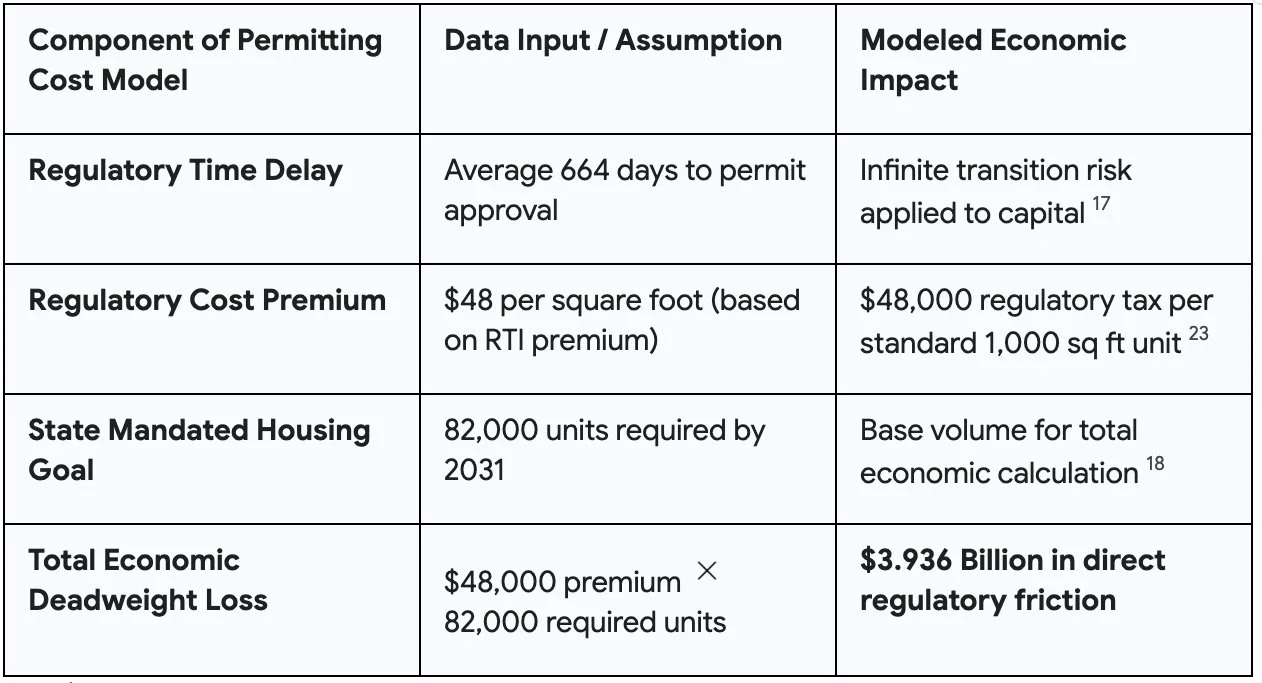
This \$3.9 billion figure represents only the direct, upfront deadweight loss imposed by the permitting system. It does not account for the secondary, macroeconomic effects of labor misallocation, where exorbitant housing costs prevent highly productive workers from moving to the region, thereby stifling the aggregate output ($Y$) of the entire Bay Area economy.
2. The Collapse of the Hobbesian Contract: Organized Retail Crime
The second major weakness in the legal environment is the failure of the municipal Leviathan to maintain a monopoly on force and protect private property, directly violating the Hobbesian mandate. Progressive criminal justice reforms (such as Proposition 47, which reclassified many nonviolent thefts as misdemeanors), combined with understaffed police departments and restrictive pursuit policies, have created a high-reward, low-risk environment for organized retail crime (ORC).
While some national data suggests overall violent crime is decreasing, California has experienced a unique and persistent surge in specific property crimes. Shoplifting in California increased by 13.8% in 2024 and is now 48% higher than pre-pandemic levels in 2019. The situation deteriorated to the point where the California Highway Patrol's (CHP) Organized Retail Crime Task Force was forced to step in where municipal authorities had failed. Between October 2023 and June 2025, state-funded local law enforcement operations resulted in a staggering 25,675 arrests and the recovery of \$190 million in stolen property across the state. In 2025 alone, the task force recovered \$8.6 million in stolen goods.
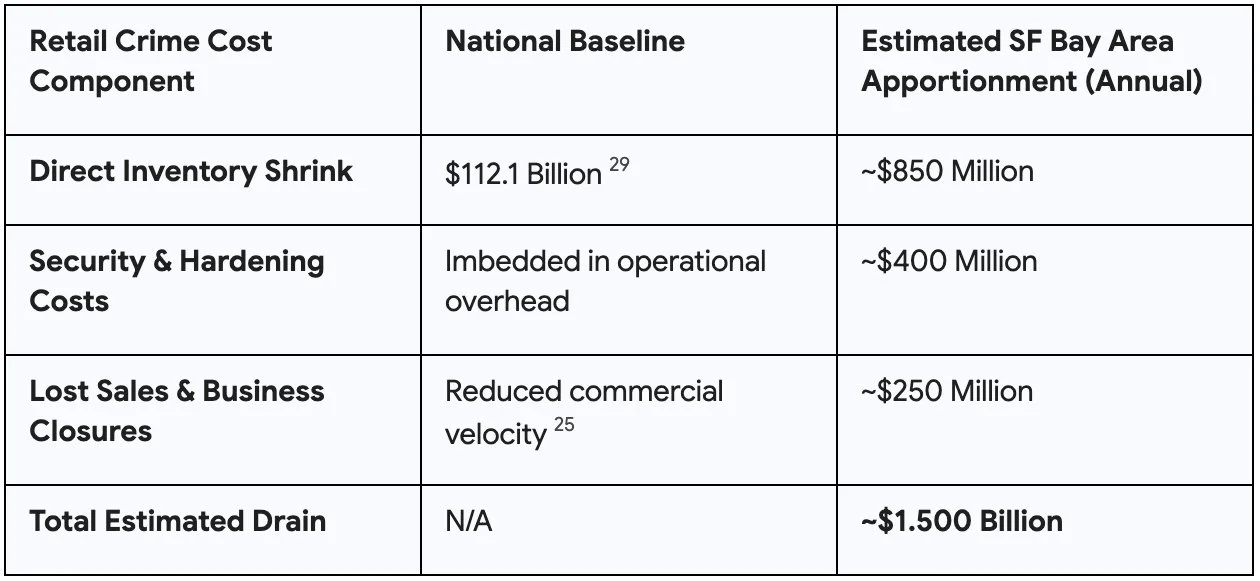
However, the value of recovered goods represents only a minuscule fraction of the total economic damage. The true cost of retail theft extends far beyond the direct inventory loss (shrink). It includes:
- Security Expenditures: The necessity of hiring private armed guards, installing reinforced glass, and locking everyday merchandise behind plexiglass degrades the consumer experience and dramatically reduces sales velocity.
- Business Closures: Major corporate retailers and vulnerable small businesses alike are forced to abandon high-theft corridors, leading to boarded-up storefronts, loss of neighborhood amenities, and spreading blight.
- Loss of Municipal Tax Revenue: When businesses close or relocate, the municipality permanently loses sales tax, payroll tax, and commercial property tax revenue, accelerating the city's fiscal death spiral.
Nationally, retail shrink accounted for an estimated \$112.1 billion in losses. If we allocate a proportional burden to the San Francisco metropolitan area based on GDP contribution and heightened crime indices, the localized economic drain easily exceeds \$1.5 billion annually in direct inventory loss, security hardening costs, and lost commercial velocity.
3. The Destruction of Human Capital ($H$): The Fentanyl Crisis
The most severe degradation of the institutional social contract is the opioid and fentanyl crisis, heavily concentrated in specific San Francisco neighborhoods like the Tenderloin and South of Market (SOMA). The legal and political environment in San Francisco has historically prioritized ideological "harm reduction"—focusing on the distribution of drug paraphernalia and the prevention of immediate fatal overdose—while explicitly de-prioritizing law enforcement against open-air drug markets and cartel distribution networks.
The human toll has been catastrophic, representing a massive destruction of the city's human capital ($H$) and labor force ($L$). In 2023, San Francisco recorded a record 810 accidental drug overdose deaths, the vast majority involving synthetic fentanyl. While preliminary figures show a decline to approximately 635 deaths in 2024 and an estimated 624 deaths in 2025 (largely due to increased law enforcement crackdowns and the expansion of buprenorphine access via a nighttime pilot program), the death toll remains historically anomalous. Toxicological reports confirm the continued presence of highly lethal adulterants like fluoro fentanyl, xylazine (tranq), and bromazolam, complicating treatment and driving mortality.
To model the economic cost of this crisis with academic rigor, we apply the methodology utilized by the White House Council of Economic Advisers (CEA). The CEA models the Value of a Statistical Life (VSL) in the United States at \$13.0 million (adjusted to 2025 dollars). Beyond the direct loss of life, the model accounts for the loss of labor force productivity, staggering healthcare system burdens, and associated crime-related expenses, which add significant proportional costs. Nationally, the CEA estimates the total cost of the opioid epidemic at an unfathomable \$1.11 trillion.
Applying this rigorous economic valuation to San Francisco specifically yields the following localized cost model:
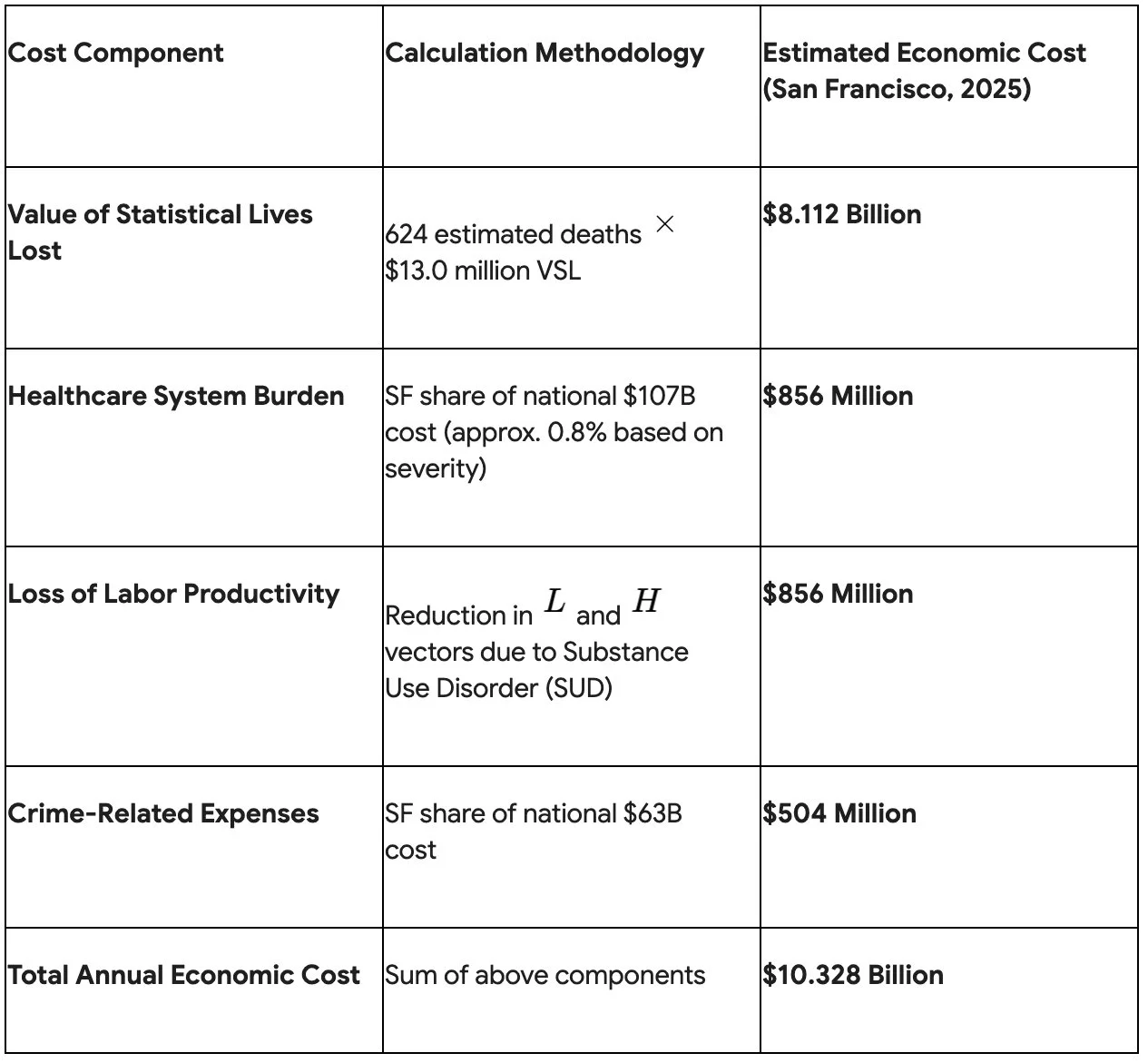
Sources: Office of the Chief Medical Examiner ; White House CEA Opioid Report.
The fentanyl crisis is not merely a public health tragedy; under the Capacity-Based Monetary Theory framework, it is the systemic, ongoing destruction of the aggregate labor pool and human capital. An annual economic bleed of over $10.3 billion critically impairs the city's capacity to generate future impact, representing the ultimate failure of the institutional realization rate.
4. Fiscal Collapse and the Evaporation of the Solow Residual
The cumulative effect of a broken housing market, rampant retail theft, and the public health catastrophe is a mass exodus of the tax base. The agglomeration premium of San Francisco—the willingness of elite corporations and individuals to pay exorbitant costs to access the dense talent network—has collapsed. The Hamilton Filter has detected the regime shift, and capital has fled.
This is most evident in the commercial real estate sector. The city has experienced a net negative absorption of 7.5 million square feet of office space, and the overall vacancy rate sits at a staggering 31.6%. This commercial hollowing out has profound, immediate fiscal implications. As office buildings are reassessed at vastly lower values, property tax revenues plummet. Furthermore, the departure of over 31,000 tech jobs from the city proper has severely reduced payroll and gross receipts business tax revenues.
As a direct consequence, the San Francisco City Controller projected a massive budget deficit of \$817.5 million for the fiscal years 2025–2026 and 2026–2027, growing to nearly $1 billion by 2027-2028—the largest expected deficit in the city's history. To close this gap, Mayor Daniel Lurie's recently proposed \$15.9 billion budget required the elimination of over 1,400 city positions (mostly vacant) and the rolling back of \$100 million in community grants to pre-COVID levels, while setting aside \$400 million in reserves to protect against federal volatility.
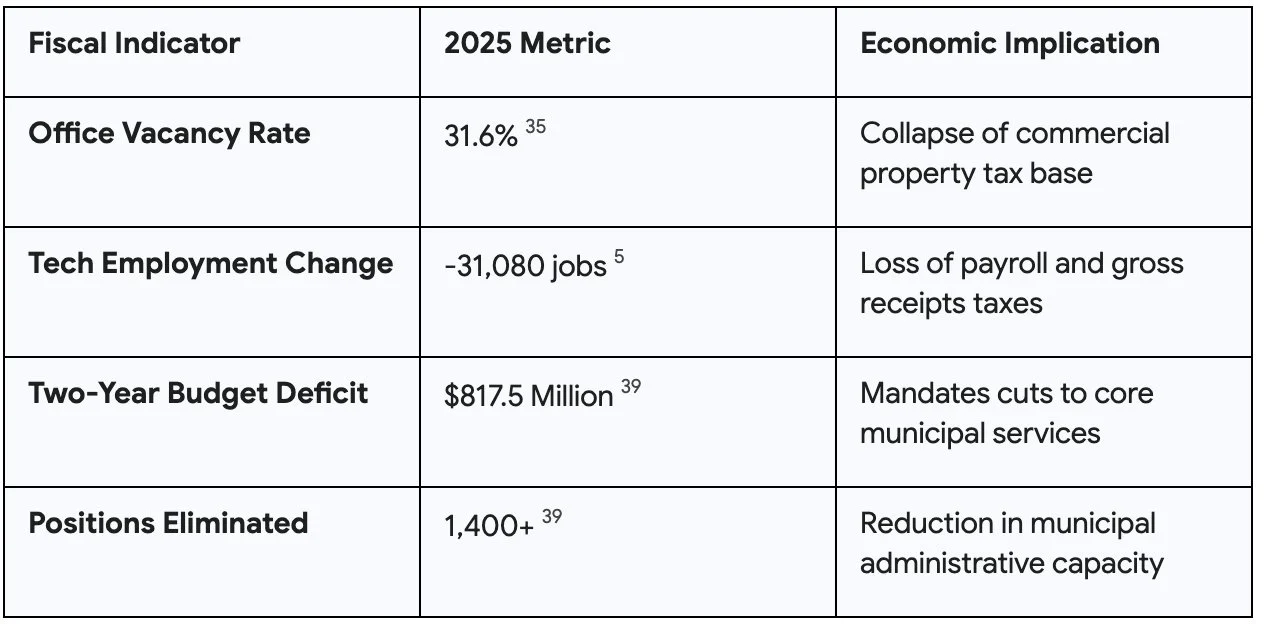
This fiscal crisis creates a classic urban doom loop: falling revenues mandate cuts to basic city services (such as street cleaning, transit, and public safety), which further degrades the physical environment, prompting more businesses and taxpayers to leave, thereby causing revenues to fall even further. The legal environment's inability to adapt to this reality—due to charter-mandated spending minimums and entrenched labor contracts—prevents the agility required to survive the downturn.
Conclusion
The San Francisco Bay Area is currently suffering from a severe, structural depression of its Institutional Realization Rate. According to Capacity-Based Monetary Theory, the region possesses unparalleled theoretical economic capacity—driven by an elite labor force, massive venture capital accumulation, and world-class technological efficiency. However, this capacity is being systematically diluted and destroyed by a broken legal and political environment characterized by an antiquated, 548-page city charter, a labyrinthine permitting process, and an unaccountable political machine that extracts rents through nonprofit corruption while surrendering public spaces to the Hobbesian forces of crime and synthetic opioid addiction.
The explicit economic costs of this institutional decay are existential. The housing permitting bureaucracy extracts nearly $4 billion in deadweight loss from the economy by infinitely delaying the accumulation of physical capital. The organized retail theft epidemic drains over \$1.5 billion annually in shrink, security hardening, and lost tax revenue. Most devastatingly, the fentanyl crisis destroys over \$10.3 billion annually in human capital, labor productivity, and statistical life value. Cumulatively, these cascading failures have collapsed the region's agglomeration premium, resulting in a 31.6% commercial office vacancy rate, the loss of over 31,000 tech jobs, and a nearly \$1 billion structural municipal budget deficit.
However, the trajectory of decline is reversible. By understanding municipal value as a priced claim on expected future impact, policymakers, tech leaders, and civic organizers have a clear, overriding mandate: they must ruthlessly eliminate the frictional costs of trust and order. This requires enacting the SPUR "Charter for Change" to centralize executive accountability , heavily streamlining the 115 bloated city commissions , bypassing CEQA through aggressive state-level by-right housing laws , and fully funding technological force-multipliers like ALPR networks for law enforcement.
Through the rigorous mobilization of a parallel civic infrastructure—funded by pragmatic leaders like Garry Tan and executed through data-driven voter education by groups like GrowSF—the Bay Area electorate can dismantle the entrenched political machine. By restoring the rule of law, streamlining the bureaucracy, and allowing the free, unhindered accumulation of physical and human capital, the region can reestablish its institutional social contract, reverse the Hamiltonian collapse regime, and secure its position as the premier engine of economic impact in the 21st century.
-
CBMT
Y Combinator CEO Garry Tan launches dark-money group to influence California politics, accessed March 4, 2026, https://missionlocal.org/2026/02/sf-garry-tan-california-politics-garrys-list/
The Tech Plutocrats Dreaming of a Right-Wing San Francisco | The New Republic, accessed March 4, 2026, https://newrepublic.com/article/178675/garry-tan-tech-san-francisco
Y Combinator CEO Garry Tan's War on San Francisco Politics Has Only Just Begun - Reddit, accessed March 4, 2026, https://www.reddit.com/r/bayarea/comments/16tobva/y_combinator_ceo_garry_tans_war_on_san_francisco/
Budget Briefing December 2025 Update - San Francisco - SFMTA, accessed March 4, 2026, https://www.sfmta.com/media/44482/download?inline
Corruption in the United States - Wikipedia, accessed March 4, 2026, https://en.wikipedia.org/wiki/Corruption_in_the_United_States
The New York Times lauds Garry Tan—and it's really pathetic - 48 Hills, accessed March 4, 2026, https://48hills.org/2024/04/the-new-york-times-lauds-garry-tan-and-its-really-pathetic/
accessed December 31, 1969, https://garryslist.org/posts/the-sf-chinatown-grift-explained
accessed December 31, 1969, https://garry.substack.com/p/the-sf-chinatown-grift-explained
BOARD OF SUPERVISORS CITY AND COUNTY OF SAN, accessed March 4, 2026, https://sfbos.org/sites/default/files/bag090418_agenda.pdf
March 5, 2024 - SF.gov, accessed March 4, 2026, https://www.sf.gov/sites/default/files/2024-01/M24_EN_VIP_web.pdf
Chinatown, San Francisco - Wikipedia, accessed March 4, 2026, https://en.wikipedia.org/wiki/Chinatown,_San_Francisco
Charter for Change | SPUR, accessed March 4, 2026, https://www.spur.org/publications/policy-brief/2025-11-10/charter-change
Empowering San Francisco's government through charter reform - SPUR, accessed March 4, 2026, https://www.spur.org/sites/default/files/2025-11/SPUR_Charter_for_Change.pdf
Charter Reform - SF.gov, accessed March 4, 2026, https://media.api.sf.gov/documents/Charter_Reform_Update_for_LBEAC_02.05.pdf
Charter Reform Working Group - SF.gov, accessed March 4, 2026, https://media.api.sf.gov/documents/Charter_Reform_Working_Group_-_Feb_5_Meeting_Slides_7KhsTap.pdf
San Francisco's permitting backlog just hit 664 days. : r/BayAreaRealEstate - Reddit, accessed March 4, 2026, https://www.reddit.com/r/BayAreaRealEstate/comments/1qje91p/san_franciscos_permitting_backlog_just_hit_664/
SF Is Building Few New Homes Despite Looser Rules. Will One More Change Start the Flow? - The Frisc, accessed March 4, 2026, https://thefrisc.com/sf-is-building-few-new-homes-despite-looser-rules-will-one-more-change-start-the-flow/
State Releases Accountability Report on San Francisco's Housing Policies and Practices, accessed March 4, 2026, https://www.hcd.ca.gov/about-hcd/newsroom/state-releases-accountability-report-on-san-franciscos-housing-policies-and-practices
city and county of san francisco board of supervisors - budget and legislative analyst, accessed March 4, 2026, https://sfbos.org/sites/default/files/BLA.Zurich_4_Pillars.111924.a.pdf
GrowSF: The #1 voter guide in San Francisco, trusted by hundreds of thousands of San Franciscans | GrowSF.org, accessed March 4, 2026, https://growsf.org/
California Planning and Development Report: CP&DR News Briefs November 4, 2025: San Francisco "Family Zoning;" Housing Costs; Los Angeles Co. Depopulation; and More | USC Lusk, accessed March 4, 2026, https://lusk.usc.edu/news/california-planning-and-development-report-cpdr-news-briefs-november-4-2025-san-francisco
How Costly Is Permitting in Housing Development? - Evan Soltas, accessed March 4, 2026, https://evansoltas.com/papers/Permitting_SoltasGruber2026.pdf
SF must create 82,000 new homes in 8 years. The city is already behind, accessed March 4, 2026, https://www.sfchronicle.com/projects/2023/san-francisco-housing/
Retail Crime, Cargo Theft Impact Businesses, Consumers Across the Country, accessed March 4, 2026, https://www.uschamber.com/economy/retail-crime-cargo-theft-impacts-businesses-and-consumers-across-the-country
With new laws and 800 new arrests, CHP keeps taking down organized retail theft operations statewide | Governor of California, accessed March 4, 2026, https://www.gov.ca.gov/2025/11/04/with-new-laws-and-800-new-arrests-chp-keeps-taking-down-organized-retail-theft-operations-statewide/
Overall Crime in California Fell Last Year, but Shoplifting Continued to Rise, accessed March 4, 2026, https://www.ppic.org/blog/overall-crime-in-california-fell-last-year-but-shoplifting-continued-to-rise/
Retail theft crackdown keeps delivering results: 25,675 arrests and $190 million in recovered stolen goods | Governor of California, accessed March 4, 2026, https://www.gov.ca.gov/2025/11/06/retail-theft-crackdown-keeps-delivering-results-25675-arrests-and-190-million-in-recovered-stolen-goods/
25 Shocking Retail Theft Statistics: In-Depth Review (2025) - Safe and Sound Security, accessed March 4, 2026, https://getsafeandsound.com/blog/retail-theft-statistics/
Tracking San Francisco's drug overdose epidemic, accessed March 4, 2026, https://www.sfchronicle.com/projects/san-francisco-drug-overdose-deaths/
San Francisco overdose deaths plummet, accessed March 4, 2026, https://www.sfcommunityhealth.org/newsroom/san-francisco-overdose-deaths-plummet
Jan24-Jan25 XLS Report.xlsx - SF.gov, accessed March 4, 2026, https://media.api.sf.gov/documents/2025_02_OCME_Overdose_Report.pdf
Jan24-Dec24 XLS Report.xlsx - SF.gov, accessed March 4, 2026, https://www.sf.gov/sites/default/files/2025-01/2025%2001_OCME%20Overdose%20Report.pdf
The Staggering Cost of the Illicit Opioid Epidemic in the United States - The White House, accessed March 4, 2026, https://www.whitehouse.gov/articles/2025/03/the-staggering-cost-of-the-illicit-opioid-epidemic-in-the-united-states/
SAN FRANCISCO OFFICE - Kidder Mathews, accessed March 4, 2026, https://kidder.com/wp-content/uploads/market_report/office-market-research-san-francisco-2025-2q.pdf
Balancing San Francisco's Budget, Part 1: The Budget Process | SPUR, accessed March 4, 2026, https://www.spur.org/news/2025-05-02/balancing-san-franciscos-budget-part-1-budget-process
CITY AND COUNTY OF SAN FRANCISCO - SF.gov, accessed March 4, 2026, https://media.api.sf.gov/documents/March_Update_FY_25-26_through_FY_29-30_03.31.25_FINAL.pdf
Mayor Lurie Signs Balanced, Responsible Budget Driving San Francisco's Recovery | SF.gov, accessed March 4, 2026, https://www.sf.gov/news-mayor-lurie-signs-balanced-responsible-budget-driving-san-franciscos-recovery
New Budget Preserves Services, Cuts 1400 Positions, Closes $817.5M Deficit | GrowSF.org, accessed March 4, 2026, https://growsf.org/news/2025-05-30-budget/
Status of the San Francisco Economy: November 2025 | SF.gov, accessed March 4, 2026, https://media.api.sf.gov/documents/Status_of_the_San_Francisco_Economy_November_2025.pdf
Urbanist think tank SPUR unveils plans to revamp S.F. charter - Mission Local, accessed March 4, 2026, https://missionlocal.org/2025/11/spur-sf-charter-reform/
About GrowSF, accessed March 4, 2026, https://growsf.org/about/
Charter Reform Working Group | SF.gov, accessed March 4, 2026, https://www.sf.gov/charter-reform-working-group
RECENT LEGISLATIVE ACTIONS TO INCREASE HOUSING PRODUCTION IN CALIFORNIA1, accessed March 4, 2026, https://shou.senate.ca.gov/system/files/2025-02/recent-leg-actions-factsheet-updated-feb-2025_0.pdf
California continues to have the highest cost of living — due to our severe housing shortage. Let's change that. : r/sanfrancisco - Reddit, accessed March 4, 2026, https://www.reddit.com/r/sanfrancisco/comments/1j3l5o1/california_continues_to_have_the_highest_cost_of/
Family Zoning Plan: Economic Impact Report - SF.gov, accessed March 4, 2026, https://media.api.sf.gov/documents/250700_economic_impact_final.pdf
Organized Retail Theft Grant Programs - Annual Summary Report for Quarters 1 through 5 October 2023 to December 2024 - California Board of State and Community Corrections - CA.gov, accessed March 4, 2026, https://www.bscc.ca.gov/wp-content/uploads/2025/04/ORT-Annual-Report-April-2025_FINAL.pdf